
Reviewed · how we check firm rules
Evaluation service · reviewed November 2026
We pass your Tradeify challenge for a flat $220
We pass Tradeify evaluations for a flat $220, at any account size, and hand the funded account back to you. Tradeify sells two evaluation families with opposite risk shapes — one has a daily loss limit that only pauses the account, the other has no daily limit but a consistency rate that decides the payout — so the first decision is not the size but which of the two you buy. This page works through that choice, the end-of-day trailing drawdown, the soft daily breach, the 4:45 PM flatten, the terms check that happens before payment, and what the funded stage actually asks of you.
Key takeaways
- Tradeify's drawdown trails the highest end-of-day balance but is enforced in real time against net liquidation, so an open position can breach the floor before the close.
- On the Growth family the daily loss limit is a soft breach: trading pauses until the next session and the account survives. On Select there is no daily limit at all, and a 40% consistency rate applies during the evaluation instead.
- Every trade has to be flat by 4:45 PM ET. There is no overnight, weekend or swing holding on any account, including funded ones.
- News trading is permitted without restriction, which removes a constraint most firms impose and makes the session easier to plan.
- Hedging and correlated positions are prohibited across accounts, not just within one.
- Flat $220 whatever the account size, retries inside the engagement at no extra fee, no cut of profits, and the firm’s clause on third-party trading put in writing first.
Contents
- Growth or Select: the choice that decides the attempt
- Tiers, targets and what each number buys
- The end-of-day trailing drawdown, enforced all day
- The daily loss limit is a soft breach
- The 4:45 PM flatten, and the session you actually get
- The plan a Tradeify pass runs on
- The terms check, before anything is bought
- How long a Tradeify pass takes
- What the flat fee covers
- A worked Tradeify pass, week by week
- What a failed attempt costs
- The funded stage: Flex or Daily
- Frequently asked questions
Growth or Select: the choice that decides the attempt
Tradeify's two evaluation families are not tiers of the same product. They are different answers to the same question — how should an evaluation punish a bad day — and the answer changes how an attempt is traded from the first session.
Growth carries a daily loss limit. Reaching it stops trading for the day, and the account survives to the next session because the breach is soft. The trade-off is that the daily limit sits well inside the trailing drawdown on the smaller tiers, so a single bad session ends the day rather than the evaluation. Growth is the cheaper family and the one that can, in principle, be finished in a single strong day.
Select removes the daily loss limit entirely. Nothing stops trading inside a session, and the only hard floor is the trailing drawdown. In exchange it applies a 40% consistency rate during the evaluation — no single day may be more than 40% of total profit — and on passing you choose a funded path, Select Flex or Select Daily, which you keep permanently.
| Question | Growth | Select |
|---|---|---|
| Daily loss limit | Yes — soft breach, pauses the day | None |
| Consistency during evaluation | None | 40% (50% add-on available) |
| Hard floor | Trailing drawdown only | Trailing drawdown only |
| Fastest plausible pass | One strong session | A paced series of days |
| Best fit | Traders whose edge is concentrated in a few sessions | Traders who trade every day and dislike being stopped out |
For a service pass the choice usually comes down to which failure mode is easier to control. On Growth the daily limit caps the damage per session, which makes a bad week survivable but a single oversized position fatal to the day. On Select the trailing drawdown is the only wall, so the sizing discipline has to do all the work, and the consistency rate means the profit pattern matters as much as the total.
Our default is Select for accounts of $100,000 and above and Growth for the smaller tiers, and the reason is arithmetic rather than preference. On a $25,000 Growth account the daily limit is $600 against a $1,000 drawdown, so the day ends at 60% of the total room — a tight leash that suits a plan trading small. On a $100,000 Select account there is no leash, and the 40% rate is satisfied by construction if no day is allowed to dominate, which is how the plan is written anyway.
Tiers, targets and what each number buys
The published numbers, checked November 2026, are the ones the plan is written from. Tradeify prices accounts from $25,000 to $150,000, with a one-time evaluation fee and no activation charge.
| Tier | Growth target | Growth drawdown | Growth daily limit | Select target | Select drawdown |
|---|---|---|---|---|---|
| $25,000 | $1,500 | $1,000 | $600 | $1,500 | $1,000 |
| $50,000 | $3,000 | $2,000 | $1,250 | $3,000 | $2,000 |
| $100,000 | $6,000 | $3,500 | $2,500 | $6,000 | $3,000 |
| $150,000 | $9,000 | — | $3,750 | $9,000 | $4,500 |
Two features of that table matter more than the rest. The first is that the target is identical between families at every tier, so the choice between them is purely about which limit binds. The second is that Select gives more drawdown than Growth at the same size on the larger tiers — $3,000 against $3,500 at $100,000, $4,500 against the Growth figure at $150,000 — which is the compensation for having no daily stop.
Position caps scale with the tier as well, from a single E-mini on the $25,000 account to eight on the $100,000 and twelve on the $150,000, with micros at ten times the count. Those caps matter for the same reason they matter at any futures firm: they define the largest position the plan can take, so a sizing formula that produces a larger number is silently capped and the risk per trade drops without anyone deciding it should.
A detail that surprises traders arriving from forex firms: the drawdown is denominated in dollars and does not scale proportionally with the target. A $25,000 account with a $1,000 drawdown has 4% of room and a 6% target, while a $100,000 account with $3,000 has 3% of room and the same 6% target. The percentage relationship is roughly stable, but the small account has proportionally more room and a proportionally higher fee per dollar of target, which is the opposite of what a flat service fee implies. The fee does not change with size, so the cheapest tier is not automatically the best value.
The end-of-day trailing drawdown, enforced all day
Tradeify's drawdown trails the highest end-of-day balance. It updates once, at the close, but it is enforced in real time against net liquidation value — which means the floor from yesterday is live all through today, and a losing open position can breach it before the close.
That combination is the rulebook's defining oddity, and it produces a specific failure. A trader who is $2,000 up intraday on a $3,000 buffer believes the worst case is giving the gain back. It is not: if yesterday's close set the floor at break-even, the position that is $2,000 up can fall $2,000, breach the floor and fail the account before any end-of-day recalculation happens. The trailing update is slow; the enforcement is not.
| Point in the attempt | End-of-day balance | Floor after the close | Room from the floor |
|---|---|---|---|
| Start | $100,000 | $97,000 | $3,000 |
| After a $2,000 day | $102,000 | $99,000 | $3,000 |
| After a $4,000 day | $104,000 | $101,000 | $3,000 |
| After a $6,000 day — target reached | $106,000 | $103,000 | $3,000 |
The room from the floor never grows. What grows is the floor, and with it the level the account cannot fall below. By the end of a $100,000 Select pass the failure level is $3,000 above where the account started, which is precisely the amount of profit that has already been booked. The account can hand back everything it earned and still be inside the rules right up to the moment it is not.
Two practical rules follow. The first is that the drawdown is spent at the end of the day, not during it: a session that finishes green raises tomorrow's floor, so the correct time to recalculate size is after the close rather than before the open. The second is that the funded account behaves differently — on simulated funded accounts the floor locks in place once profit exceeds the drawdown by $100, or at the first payout request, whichever comes first. Locking is what converts a trailing floor into a fixed one, and it is the moment the account stops being a treadmill.
The daily loss limit is a soft breach
On Growth the daily loss limit is not a second drawdown. Reaching it stops trading until the next session and leaves the account alive, which makes it a brake rather than a wall — and that changes how the plan treats a bad day.
The published amounts are $600 on the $25,000, $1,250 on the $50,000, $2,500 on the $100,000 and $3,750 on the $150,000. At 6% profit the limit rises to match the drawdown, and on some programs it is removed entirely rather than increased, effective from the next session. The delay matters: the change applies to the following session, so a trader who crosses the threshold on Thursday still trades Friday under the old limit.
Because the breach is soft, the temptation is to treat the limit as a target. That is a mistake for a reason that has nothing to do with the rule: the daily limit sits inside the drawdown on the smaller tiers, and the account that has spent its daily allowance is one session away from having no buffer left for the week. A $600 limit against a $1,000 drawdown means two full daily losses leave $200 of total room, at which point any ordinary losing trade ends the evaluation.
What the soft breach is for: it is a brake that protects the account from a single catastrophic session. It is not a licence to spend the whole allowance, because spending it twice is a failed attempt on the smaller tiers even though neither day breached a rule.
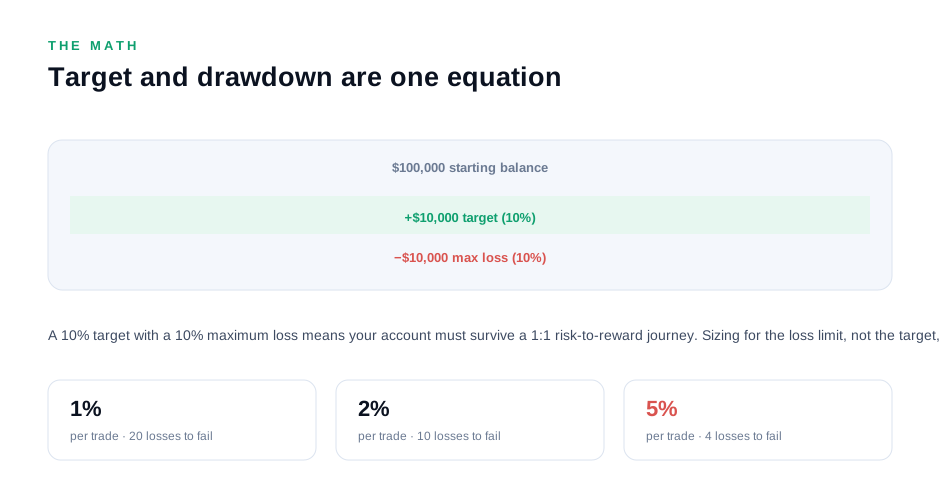
The plan therefore treats the daily limit as a ceiling to stay well under, not a boundary to reach. Risk per trade is sized at a third of the daily limit at most, and the session stops at 80% of that budget, so the fifth that remains absorbs slippage rather than the last trade of the day. On Select the same discipline is applied voluntarily: no daily limit exists, and the plan imposes one anyway, because a session with no floor is a session where a single position can end the evaluation.
The 4:45 PM flatten, and the session you actually get
Every position has to be closed by 4:45 PM ET, with 12:59 PM ET on holiday half-days. There is no overnight, weekend or swing holding on any account, including funded ones, and no exception for a position that is winning.
That single rule removes a category of risk most traders underestimate. A position held through the close is exposed to everything that happens between sessions, and on a trailing floor that exposure is taken against a limit that cannot be adjusted until the next morning. Flattening at 4:45 turns every session into a closed book: the day's result is known, the floor is recalculated, and the next session starts from a number rather than from a hope.
The rule interacts with news in a way worth stating. Tradeify permits news trading without restriction, which is unusual — most firms restrict the minutes around scheduled releases — and it means the session is defined by the clock rather than by an events calendar. The plan still avoids initiating a position into a release, not because the rules forbid it but because the slippage is real and the stop is honoured at whatever price fills.
What the usable session looks like: the cash equity index session from the open to the flatten, minus the first minutes while the plan reads the opening range, and minus any period when the daily budget is already spent. On a normal day that is a handful of decisions rather than continuous trading, which is what makes a 4:45 flatten a feature rather than a constraint. A plan with thirty decisions a day cannot be replicated by a service; a plan with four can.
Hedging and correlated positions are prohibited, and the prohibition runs across accounts as well as within one. Two accounts on the same instrument in opposite directions are one position with two fees, and firms that treat correlated exposure as a single risk will treat it as a violation. For a client running a second evaluation elsewhere, that is worth knowing before the first trade rather than at the payout.
The plan a Tradeify pass runs on
Six constraints write the plan, and the first two differ depending on the family.
The daily limit sets risk per trade on Growth. Risk is a third of the daily limit at most, so three consecutive losses leave the session survivable, and the session stops at 80% of the budget spent. On Select the same rule is applied voluntarily as a self-imposed cap.
The trailing floor sets the total loss count. Room to the floor divided by risk per trade gives the number of losses the account can absorb. If that number is under six, the risk is too large for the account and the plan is revised before the first session.
The target sets the pace. Target divided by sessions available gives a required daily rate, which is then checked against the daily budget. A pace that consumes more than a fifth of the budget is a pace that depends on the market, and the schedule is extended rather than the size raised.
The consistency rate sets the daily profit cap on Select. With a 40% limit, no day may exceed 40% of the eventual total, so the cap is set as a fraction of the target and the ratio is never computed live because it cannot fail.
The flatten sets the session end. Positions are closed before 4:45 PM ET, and the last fifteen minutes are used to verify flat rather than to add.
The conduct rules set the instruments and the pairs. Permitted products, position caps and the hedging prohibition are treated as walls. News is permitted, so the plan does not avoid sessions around releases, but it does avoid opening into one.
Failure handling is part of the plan. A lost attempt is reported the day it happens, classified as a floor breach, a daily-limit exhaustion or a conduct breach, and retried under the same rules at no additional service fee while the evaluation is open. Classification decides the fix: a floor breach at the end of a good week means the unit did not fall after the close, and a daily-limit exhaustion means the size per trade was set from the wrong number.
The terms check, before anything is bought
Before payment we read Tradeify's current terms for the specific family and confirm in writing whether the evaluation may be traded by a third party. The check is free and it decides whether a pass produces a payout or a voided account.
- Third-party trading on the evaluation. If the rules forbid it we decline the job rather than take the fee and hope, and you get that refusal in writing before spending anything.
- Third-party trading on the funded account. Some firms permit the evaluation to be traded externally and restrict the funded account. The funded account is the asset, so the two clauses are checked separately.
- Conduct rules. The flatten time, the hedging prohibition, the position caps and the permitted product list decide which sessions are usable and which instruments are tradable.
- Ownership requirements. The evaluation is bought in the client's name with the client's payment details and identity verification is completed by the client. A provider holding the account is running a managed account, which most firms prohibit.
The answer comes back as permitted, prohibited or silent, and silent is treated as prohibited unless Tradeify confirms otherwise in writing — a firm that has not addressed the question can address it at the payout. Send the family, the size and any support reply you already have.
How long a Tradeify pass takes
Tradeify publishes no minimum day count on either family, so the calendar is set by the target and the limits rather than by the firm. A Growth account can in principle be passed in one strong session; a service pass will not attempt that, and the reason is worth stating plainly.
A single-session pass is a variance bet. It requires a position large enough to produce the whole target inside one day, against a trailing floor that does not move until the close. The expected value of that bet is negative once the probability of a breach is priced in, which is why the plan trades a paced series of sessions on both families.
Select is target-bound by design. With a 40% consistency rate, the day that produces the most profit cannot exceed two-fifths of the total, so the minimum number of sessions is a mathematical floor rather than a preference. At a plausible weekly rate, a $100,000 Select attempt runs four to six weeks, with the consistency cap determining the shape rather than the speed.
Growth is daily-limit bound. The daily limit caps what a session can produce on the way up as well as down, so a $6,000 target on a $100,000 Growth account with a $2,500 daily limit takes at least three productive sessions and usually six to eight. The cheapest family is also the slower one at the top tier, which is the opposite of its reputation.
Reporting is weekly at minimum. Progress is reported at agreed checkpoints and a failed attempt the day it happens, because silence during an evaluation is indistinguishable from a failure.
What the flat fee covers
The fee is $220 for any Tradeify family and any account size. The scope is stated in full because a vague scope is the usual source of dispute.
| Item | Covered | Notes |
|---|---|---|
| The evaluation attempt | Yes | Traded to the target inside Tradeify's rules |
| Retries while the evaluation runs | Yes | No additional service fee |
| Terms check before payment | Yes | Confirmed in writing, free |
| Tradeify's own evaluation and reset fees | No | Paid by the client to the firm; sales are final |
| The funded account after handover | No | Traded by the client under the firm's terms |
| Identity verification | No | Completed personally, as the account holder |
| Profit split | None taken | Payouts belong to the client |
The comparison against doing it yourself cuts both ways, and Tradeify makes one side starker than most firms: sales are final, with no refund on a failed account. A self-traded failure therefore costs the full evaluation fee again, while a service pass absorbs the retry. On a first-attempt pass the service costs $220 more than trading it yourself and buys nothing you could not have done; from the second attempt the arithmetic reverses.
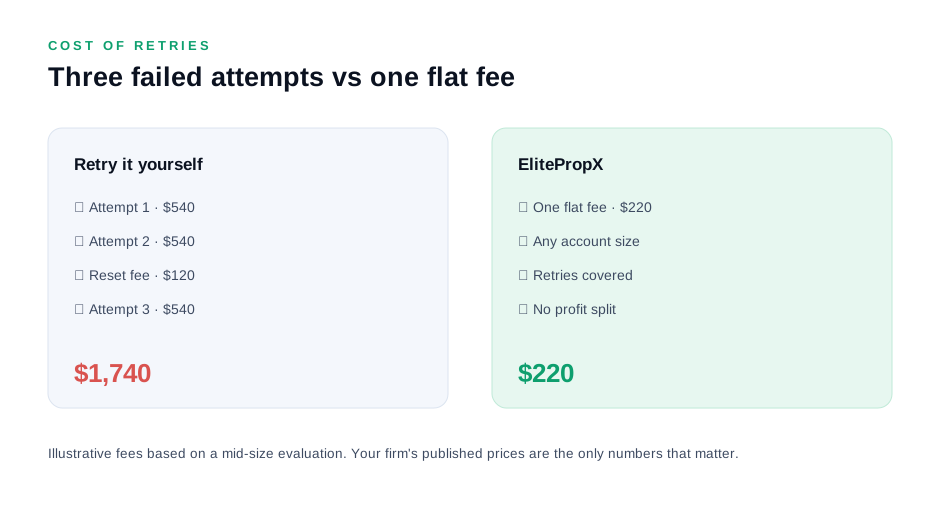
Three costs the fee does not remove are worth naming. Tradeify's evaluation fee is unaffected and non-refundable. A reset, where the firm offers one, is the client's cost. And the calendar is not shortened: the flatten time and the daily limit apply to a service pass exactly as they apply to anyone else.
A worked Tradeify pass, week by week
An illustration on a $100,000 Select account with a $6,000 target, a $3,000 trailing drawdown and a 40% consistency rate, traded to a self-imposed $2,500 daily budget and a 4:45 PM ET flatten.
Week one — establish the pace. Five sessions at $350 risk per trade, a 12-tick stop on MES, and a session closed at 80% of the daily budget. Three green days and two small red days leave the account near $101,800. The floor rises to $98,800 after Friday's close, so the room from the floor is unchanged and the room from the start has fallen to $1,800.
Week two — the unit falls. With the floor now $1,200 below the balance, size is recalculated from the current room rather than the opening room. The unit drops to $300 and four green sessions take the balance to about $103,400. The best day so far is $900, comfortably inside 40% of the eventual total.
Week three — the consistency check. The plan needs $6,000 in total, so no single day may exceed $2,400. Three sessions produce $2,100, $1,600 and $900, and the cap is respected by design rather than by restraint. The balance reaches roughly $105,500 with the floor at $102,500.
Week four — finish small. The last $500 of target is taken at a $200 unit across two sessions, with a third session used only to confirm flat by 4:45 each day. The attempt closes with the best day at roughly 25% of total profit, which satisfies the funded-stage test before it is applied.
| Week | Balance at start | Floor | Unit | Work |
|---|---|---|---|---|
| One | $100,000 | $97,000 | $350 | Five sessions, three green |
| Two | $101,800 | $98,800 | $300 | Four green sessions, unit cut |
| Three | $103,400 | $100,400 | $250 | Three sessions inside the 40% cap |
| Four | $105,500 | $102,500 | $200 | Two sessions to the target |
What is worth noticing is the unit falling every week and the best day staying small. A trader who held $350 through week four would have risked the same dollars against a floor $5,500 higher, which is how a nearly-finished attempt becomes a failed one. The consistency guide works the 40% arithmetic through, and the daily drawdown guide covers how a trailing floor is measured and enforced.
What a failed attempt costs
A failure is not the service fee — that is spent and covers the retry. What it costs is Tradeify's charge to start again, plus the calendar, and Tradeify's no-refund policy makes that first number unavoidable.
The evaluation fee is not returned. Sales are final, including for a failed account, so a breach in week three costs the full fee again. On the smaller tiers that is a small number relative to the service fee; on the $150,000 tier it is not.
The calendar restarts in full. There is no minimum day count, so a restart is not obliged to repeat a schedule — but the consistency rate and the trailing floor both have to be satisfied from a new balance, which means the same four to six weeks in practice.
| What ends the attempt | How it happens | What the restart costs |
|---|---|---|
| Trailing drawdown | Floor reached intraday, often on an open position | Full evaluation fee, no refund, calendar from zero |
| Daily limit exhausted repeatedly | Two full daily losses inside a small drawdown | The same, without any single rule having been broken |
| Consistency rate missed | One dominant day above 40% of total profit | The same, and the profit pattern has to be rebuilt |
| Conduct breach | Position held past 4:45 PM, hedging, product not permitted | The same, and a funded account can be questioned later |
Two things follow. The retry clause is worth more here than the fee, because Tradeify does not refund and does not offer a free reset on a failed attempt. And the cheapest attempt is the one that finishes slowly: a fifth week of small sessions costs a week, while a restart costs the fee and the month.
The funded stage: Flex or Daily
Passing a Select evaluation does not end the choice — it moves it. The funded path is selected once and kept permanently, and the two paths have different limits.
Select Flex carries no daily loss limit and no consistency rule, with the wider drawdown of the two paths. It suits a trader who wants the evaluation's conditions to continue unchanged.
Select Daily imposes a daily loss limit — $500 on the $25,000, $1,000 on the $50,000, $1,250 on the $100,000 and $1,750 on the $150,000 — with a tighter drawdown and a buffer system: profit above the buffer is eligible for withdrawal up to the payout cap, and payouts are eligible daily at a 90/10 split.
Growth funded accounts work differently again, with a consistency rule at the funded stage and a daily loss limit that persists until the 6% threshold. The consistent thread across all three is that the drawdown locks: once the end-of-day balance exceeds the drawdown amount by $100, or a payout is requested, the floor stops trailing. That is the moment the account becomes an income account rather than a treadmill, and it is the milestone to plan for rather than the pass itself.
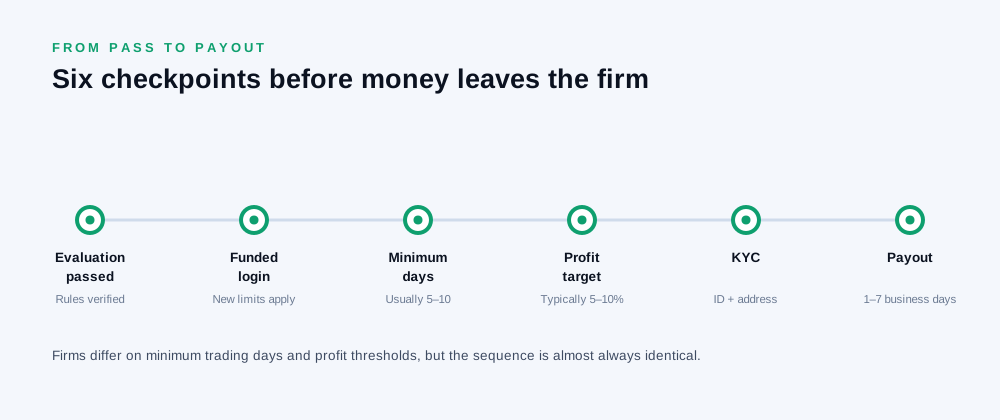
Four things to do in the first week after handover, in order. Change the password regardless of how access was provided. Confirm the account is in your name with your payment details and verification complete. Read the funded terms for the path you selected rather than for the evaluation. And write the funded plan — unit, daily stop, daily profit cap, payout target — before the first trade rather than after the first loss. The payout process guide covers the withdrawal sequence and the delays that block first requests.
Frequently asked about the Tradeify evaluation
Does the $220 fee change with account size or family?
No. The fee is flat for any Tradeify evaluation, Growth or Select, at any size, because the work is the same process applied to different numbers. Size changes the payout ceiling and the firm's own evaluation fee, not ours.
Should I buy Growth or Select?
Select for $100,000 and above, Growth for the smaller tiers, in our default sizing. Growth caps the damage per session but its daily limit sits close to the drawdown on small accounts; Select has no daily limit, so the consistency rate and the trailing floor do all the work and the plan has to impose its own daily stop.
Can a Tradeify evaluation be passed in one day?
Growth can in principle be finished in a single strong session, and we do not attempt it. Reaching the whole target in one day requires a position large enough to breach the trailing floor on a normal losing sequence, and the floor does not move until the close. The plan trades a paced series instead.
Does hitting the daily loss limit fail the account?
No. On Growth it is a soft breach: trading pauses until the next session and the account stays active, provided the trailing drawdown was not also hit. It is still a serious event on the smaller tiers, where two full daily losses leave almost no room in the drawdown.
How does the consistency rule work on Select?
No single day's profit may exceed 40% of total profit, with a 50% add-on available. Because the rate is measured against the eventual total, a large day raises the profit required rather than reducing it — which is why the plan caps daily profit as a fraction of the target instead of checking the ratio afterwards.
Do you check the terms before I pay?
Yes, and it is free. Send the family, the account size and any support reply you have, and we confirm in writing whether third-party trading is permitted on the evaluation and on the funded account. Silent terms are treated as prohibited unless Tradeify confirms otherwise in writing.
Who owns the funded account?
You do. The account is bought in your name with your card, the verification is yours to complete, and at handover access either comes back to you or is removed — then change the password, whatever method was used to hand it over.
What happens if the evaluation fails?
You are told the day it happens, the failure is classified, and the attempt is retried at no additional service fee while the evaluation is running. Tradeify's own evaluation fee remains your cost, and its sales are final, so a failed evaluation is not refunded by the firm.
Is the service cheaper than doing it myself?
On a first-attempt pass, no: it is $220 more and you give up the experience. From the second attempt it is cheaper, because the service absorbs retries while a self-traded retry means paying the evaluation fee again with no refund. Break-even is one failure.
What do you need from me to start?
Your family and size, plus any support reply you already hold for the terms check. Once that clears you buy the account yourself, we fix the access scope in writing, and the first session follows it. Verification remains yours from beginning to end.
Check your Tradeify terms first
Send the family and account size and we confirm in writing whether third-party trading is permitted — before you pay anything. If it is not, we say so in writing before you pay.
Related reading
- Apex Trader Funding evaluation
- Topstep Combine
- Lucid Trading evaluation
- FundedNext evaluation
- How futures evaluations differ from forex
- Daily drawdown explained
- The consistency rule guide
- Recently passed evaluations
- Challenge calculator: target, risk and pace
Tradeify is named for identification only. ElitePropX is an independent evaluation service and is not affiliated with, endorsed by or sponsored by Tradeify or any other proprietary trading firm. The service is offered only where a firm's terms permit third-party trading. A funded account is not a guarantee of income, and trading involves substantial risk of loss. Verify current terms before purchasing an evaluation.