
Reviewed · how we check firm rules
Evaluation service · reviewed November 2026
We pass your Upcomers evaluation for a flat $220
We pass Upcomers evaluations for a flat $220, at any account size, and hand the funded account back to you. Upcomers sells a single-phase futures evaluation with a 6% target and a daily limit that is 3% while you are being assessed and 2% once you are funded — a tightening that catches traders who plan the pass and not the account after it. This page covers the one-step arithmetic, the trailing floor, the Best Day Rule that gates payouts, the instant-funding alternative we usually advise against, and the terms check that happens before you pay anything.
Key takeaways
- The futures evaluation is one step with a 6% target — $3,000 on a $50,000 account — and can be passed in a single qualifying day.
- The daily drawdown limit is 3% during the challenge and 2% once funded, so the account gets tighter the moment it becomes valuable.
- Drawdown trails from the highest equity, which means profit raises the level the account cannot fall below.
- Payouts are gated by a Best Day Rule — a soft limit that delays a withdrawal rather than failing an account.
- The instant-funding line, Vanguard, has no evaluation to pass, so it is not something a passing service can sell you.
- A flat $220 for any futures evaluation at any size, with retries inside the engagement and no slice of your payouts.
Contents
- What Upcomers sells, and what a service can trade
- Thunderbolt Classic: 6% in one step
- The daily limit that halves when funded
- The trailing floor against a one-day pass
- The Best Day Rule at payout
- The plan an Upcomers pass runs on
- The terms check, before anything is bought
- What the flat fee covers
- A worked pass, week by week
- What a failed attempt costs
- Why we refuse the one-day pass
- What a payout request actually requires
- A two-week schedule, session by session
- Horizon, and the other Upcomers lines
- The five clauses we read before starting
- Four ways an Upcomers attempt ends
- Frequently asked questions
What Upcomers sells, and what a service can trade
Upcomers runs several products under one roof: CFD evaluations in one and two phases, perpetual futures, and a futures line on CME contracts. The futures products are the ones this page covers, because they are the ones a passing service can trade to a defined target.
Within futures there are two routes. Thunderbolt Classic is a one-step evaluation with a 6% target, a 3% daily limit during the challenge and a trailing floor. Vanguard is instant funding — no evaluation, no target to pass, a funded account from the day you buy it. A third line, Horizon, has its own published rules and is worth reading separately rather than assuming it matches Classic.
The distinction matters commercially, and it is worth being plain about it. A passing service can only sell the evaluation route, because the instant route has nothing to pass. Anyone offering to "pass" a Vanguard account is either selling you nothing or planning to trade a funded account in breach of the terms, which is a different and worse product.
| Route | Assessment | Target | Daily limit | Service relevance |
|---|---|---|---|---|
| Thunderbolt Classic | One step | 6% | 3% challenge, 2% funded | Yes — this is the page |
| Vanguard | None, instant | None to pass | 2% funded | No — nothing to pass |
| Horizon | Separate rules | Programme-specific | Programme-specific | Read the rules first |
| CFD programmes | One or two steps | 2%–10% depending on programme | 2%–5% | Traded only where terms permit |
One further property of the futures line shapes the economics: accounts are bought once, with no monthly subscription and no recurring platform or data fee. That removes the calendar pressure that a monthly-billed evaluation carries, and it also removes the argument that a slow pass is expensive. On Upcomers the cost of taking an extra fortnight is opportunity, not billing.
Thunderbolt Classic: 6% in one step
A 6% target on a single phase is a moderate ask by futures standards, and the one-day minimum is what makes the programme unusual. There is no requirement to trade a set number of sessions: a single qualifying day can complete the evaluation, provided the target is reached without touching the daily limit or the trailing floor.
The published numbers on a $50,000 account are a $3,000 target, a $1,500 daily limit during the challenge and a $1,000 daily limit once funded. Account sizes run to $400,000 funded, and the contract limit on a funded account matches the evaluation's cap.
| Tier | Target at 6% | Daily limit at 3% (challenge) | Daily limit at 2% (funded) |
|---|---|---|---|
| $25,000 | $1,500 | $750 | $500 |
| $50,000 | $3,000 | $1,500 | $1,000 |
| $100,000 | $6,000 | $3,000 | $2,000 |
| $150,000 | $9,000 | $4,500 | $3,000 |
The one-day pass is the programme's marketing claim and its biggest trap. Reaching 6% inside one session requires a position large enough that the daily limit is the binding constraint rather than the target: on a $50,000 account the target is twice the daily limit, so a single day that produces $3,000 has to produce two full daily budgets of profit without ever spending one on the downside. That is possible; it is also a variance bet, and a service pass does not need to take it.
The plan therefore treats the one-day option as available and unused. The evaluation is a single phase with no calendar, so the schedule is set by the target and the daily limit, and a pass that takes two or three weeks is the same pass as one that takes a day — with a far smaller chance of a breach along the way.
The daily limit that halves when funded
The daily drawdown limit is 3% of the account during the challenge and 2% once funded, resetting at 5:00 PM ET. That reduction is the single most under-planned rule in the programme, because it changes the account on the day it becomes worth something.
On a $50,000 account the limit falls from $1,500 to $1,000 at the moment of funding. A trader who has spent three weeks sizing to the challenge's daily budget now has a budget two-thirds the size, with no change in the target they are pursuing at the payout stage. The plan's unit has to be recalculated at handover, not carried over.
The daily limit is also the reason the one-day pass is riskier than it reads. A session that must produce $3,000 of profit against a $1,500 daily budget is a session where a single reversal can consume the entire day's allowance before the target is reached. The evaluation survives that — a daily breach pauses the day rather than failing the account on most futures programmes of this shape — but the calendar does not, and a lost day on a one-phase evaluation is a lost day with nothing to show for it.
The handover recalc: the first thing to do after funding is not to trade, it is to divide the new 2% daily limit by the same risk unit and check that the old position size still fits. On a $50,000 account it usually does not.
Because there is no minimum day count and no monthly billing, a slow pass costs nothing except time. That is the argument for pacing the attempt across sessions rather than chasing the one-day headline: the programme's structure rewards a trader who treats the daily limit as a budget rather than as an obstacle.
The trailing floor against a one-day pass
The drawdown trails from the highest equity the account has reached. Profit raises the floor, so the room to fail stays constant in dollars while the room above the starting balance shrinks — the same mechanic as every trailing futures evaluation, and the reason a good week can leave an account closer to failure than a flat one.
On a one-day attempt the mechanic is compressed into a single session. A position that runs $2,000 into profit before reversing can carry the account back through a floor that has already been raised by the intraday peak, depending on whether the trailing measure uses equity or balance and when it updates. The plan does not rely on the distinction: it treats the peak as the floor, which is the conservative reading and the one that survives either interpretation.
| Session state | Peak reached | Conservative floor | Room left |
|---|---|---|---|
| Open | $50,000 | $47,000 on a $3,000 trail | $3,000 |
| Up $1,500 intraday | $51,500 | $48,500 | $3,000, but only $0 above the start |
| Up $3,000 — target | $53,000 | $50,000 | Break-even is now the failure level |
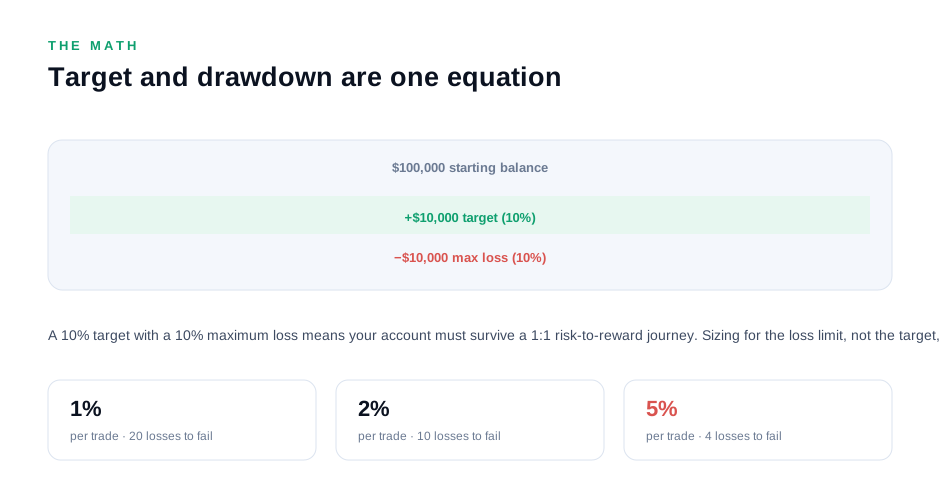
Two practical consequences. The first is that a session which reaches the target and keeps trading is a session that has converted a completed evaluation into an open risk; the plan closes at the target rather than pressing a good day. The second is that the position unit falls through the attempt, because the floor rises while the account's tolerance in dollars does not.
The Best Day Rule at payout
Upcomers gates payouts with a Best Day Rule: no single day may account for more than a set share of total profit in the payout period. On the futures line the threshold is published per programme and has moved recently — the Classic threshold was tightened for accounts purchased from late October 2026, with a lower rate for older purchases.
The rule is soft, which is the detail that matters. Exceeding it does not fail the account or void the profit; it delays the withdrawal until the ratio comes back inside the limit, which means the fix is more balanced trading rather than a reset.
A soft rule still changes the plan, because it changes what a good day is worth. A pass that produces its target in three sessions, one of which is dominant, satisfies the evaluation and creates a payout problem on the same day. The plan caps daily profit as a fraction of the eventual total from the first session, so the ratio is satisfied by construction and the payout request does not have to wait for a rebalancing period.

Payout conditions on the futures line also include a minimum profit since the previous payout and a minimum number of qualifying trading days at a set percentage each, with the exact figures published per programme. The sequence is: close all positions, satisfy the profit minimum, satisfy the Best Day share, then request. Any of the three can be the binding constraint on a given cycle, and the plan aims to satisfy all three simultaneously rather than one at a time.
The plan an Upcomers pass runs on
Five constraints write the plan, and the first is unique to a one-phase programme.
The target sets the whole schedule. With no minimum days and no monthly billing, there is nothing to pace against except the daily limit, so the target is divided into session-sized slices deliberately smaller than the budget. A 6% target is taken in five to eight slices rather than one.
The daily limit sets risk per trade. Risk is a third of the daily limit at most, so three consecutive losses leave the session survivable, and the session closes at 80% of the budget. On a $50,000 account that is $500 of risk per trade and a $1,200 session stop.
The trailing floor sets the unit through the attempt. As the floor rises, the unit falls, recalculated each morning from the distance between balance and floor. Holding the opening unit into the final week is the commonest way a one-phase pass is lost.
The Best Day share sets the daily profit cap. No day is allowed to exceed the published share of the eventual total, so the payout gate is satisfied before it is tested.
The conduct rules set the instruments. Permitted products, contract caps and the ban on hedging within and across accounts are walls. Prohibited strategies on the futures line include high-frequency and latency approaches and the firm's named quick-strike method; purchased expert advisors are permitted where they follow the rules.
Failure handling is part of the plan. A lost attempt is reported the day it happens and classified as a floor breach, a daily-limit day or a conduct breach, and the retry runs under the same rules at no additional service fee while the evaluation is open. Classification decides the correction rather than the excuse.
The terms check, before anything is bought
Before payment we read Upcomers' current terms for the specific futures programme and confirm in writing whether the evaluation may be traded by a third party. The check is free and it is the step that decides whether a pass produces a payout or a voided account.
- Third-party trading on the evaluation. Where the rules say no we turn the job down rather than trade it quietly, and that answer reaches you in writing first.
- Third-party trading on the funded account. The two are governed by different clauses at most firms, and the funded account is the asset.
- Conduct rules. The prohibited-strategy list, the contract caps and the hedging prohibition decide which sessions and instruments are usable.
- Ownership requirements. You buy the account with your own payment details and complete verification yourself; a provider holding the login is running a managed account.
Silent is treated as prohibited unless the firm confirms otherwise in writing, because a firm that has not addressed the question can address it at the payout.
What the flat fee covers
The fee is $220 for any Upcomers futures evaluation and any account size.
| Item | Covered | Notes |
|---|---|---|
| The evaluation attempt | Yes | Traded to the 6% target inside the programme rules |
| Retries while the evaluation runs | Yes | No additional service fee |
| Terms check before payment | Yes | Confirmed in writing, free |
| Upcomers' own account fee | No | Paid by the client; one-time, not a subscription |
| The funded account after handover | No | Traded by the client at the tighter 2% limit |
| Identity verification | No | Completed personally, as the account holder |
| Profit split | None taken | Payouts belong to the client |
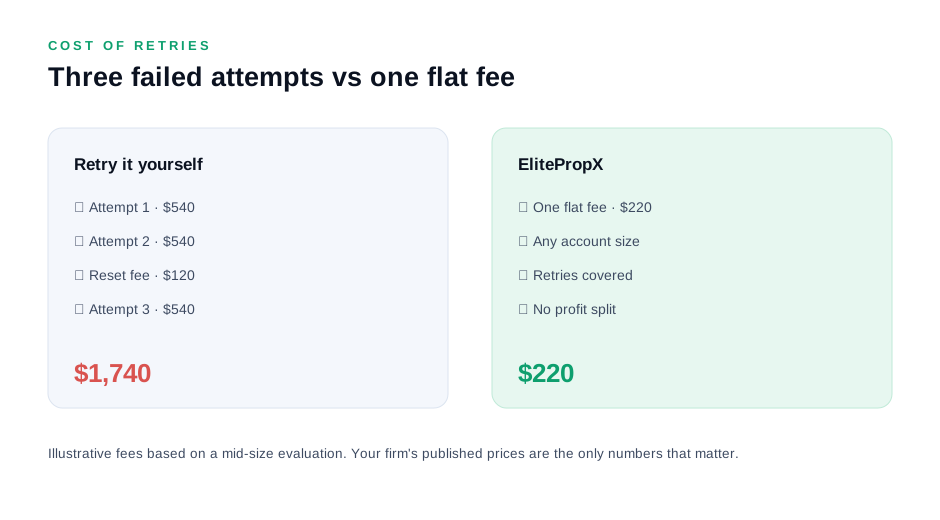
Because the account is bought once rather than billed monthly, the comparison with self-trading is cleaner than at a subscription firm: a failed attempt costs the account fee again, while a service pass absorbs the retry. On a first-attempt pass the service is $220 worse; from the second it reverses.
A worked pass, week by week
An illustration on a $50,000 Thunderbolt Classic account with a $3,000 target, a $1,500 daily limit and a $500 risk unit, traded across three weeks rather than the single day the rules permit.
Week one — three slices. Four sessions, two green and one red, each risking $500 against a $1,200 session stop. The account reaches about $51,000. The floor has trailed to $48,000, so the room from the floor is unchanged and the room above the start is $1,000.
Week two — the unit falls. With the floor $1,000 above the starting balance, size is recalculated from the current room. The unit drops to $400 and three green sessions take the balance to roughly $52,100. The best day so far is $700, well inside any published Best Day share.
Week three — finish at the target. The last $900 is taken in two sessions at a $300 unit, and the account closes the evaluation at the target with a best day around 23% of total profit. Nothing about the pass needed the one-day option the programme allows.
| Week | Balance at start | Floor | Unit | Work |
|---|---|---|---|---|
| One | $50,000 | $47,000 | $500 | Four sessions, two green |
| Two | $51,000 | $48,000 | $400 | Three green sessions, unit cut |
| Three | $52,100 | $49,100 | $300 | Two sessions to the target |
The features worth noticing are the falling unit, the refusal of the one-day route, and a best day small enough to clear the payout gate. A trader who took the 6% in one session would have finished earlier and arrived at the funded stage with a dominant day to explain.
What a failed attempt costs
A failure is not the service fee, which is spent and covers the retry. What it costs is Upcomers' account fee plus the calendar, and the one-phase structure makes the calendar cheaper than at most firms because there is no subscription running.
The account fee is not returned. A breach costs the fee again, and because the account is one-time rather than monthly, the marginal cost of a slow attempt is low and the marginal cost of a fast failure is the whole fee.
The floor restarts at the widest point. A restart begins with the full trail distance below the starting balance, which is the easiest the account will ever be, and it will tighten in the same place. A trader who fails in week three has demonstrated the failure mode and not corrected it.
| What ends the attempt | How it happens | What the restart costs |
|---|---|---|
| Trailing floor | Floor reached after a good week with the unit unchanged | Account fee again, calendar from zero |
| Daily limit | A session that spent the whole budget | The day, not the account — unless the floor was also hit |
| Prohibited strategy | HFT, latency or the firm's named quick-strike method | Account voided, and a funded account can be questioned later |
Why we refuse the one-day pass
The programme's headline is that Thunderbolt Classic can be passed in a single trading day, and the arithmetic behind that claim is worth writing out, because it explains why a service pass never attempts it.
On a $50,000 account the target is $3,000 and the challenge's daily limit is $1,500. A single session that completes the evaluation therefore has to produce twice the daily allowance in profit without ever spending the allowance on the way. That is not a pacing decision; it is a position large enough that a normal adverse move consumes the day before the target is reached.
Put probability on it and the shape becomes clear. A session that can produce $3,000 must be sized so that a winning sequence pays roughly 2% of the account, which means a losing sequence of the same size also costs about 2%. The daily limit stops the account at 3% of loss, so the plan has room for roughly one and a half such sequences — which is a coin-flip with a fee attached, not a plan.
The alternative is the same evaluation taken in five to eight slices. The target is unchanged, the floor behaves the same way, and the only cost is calendar — which on Upcomers is close to free, because the account is bought once rather than billed monthly. The one-day route trades a real risk for a marketing claim; the sliced route trades a few days for a buffer that survives an ordinary bad morning.
What a payout request actually requires
Passing the evaluation is the first gate. The payout stage has its own conditions, and on this programme several of them apply at once, so the plan aims to satisfy them together rather than discovering one at a time.
| Condition | What it asks | What it does if missed |
|---|---|---|
| Positions closed | All trades flat before the request | Request is not processed |
| Minimum profit since the last payout | A set percentage of new profit each cycle | The cycle has not qualified yet |
| Qualifying trading days | A number of days each producing at least half a percent | The clock extends, not the account |
| Best Day Rule | The largest day inside a published share of total profit | Soft: payout delayed until the ratio recovers |
| Minimum payout amount | A floor of around $100 per request | The balance carries to the next request |
Two of those conditions are the ones that surprise traders. The qualifying-day requirement means a large single day followed by a pause produces profit but not eligibility, so the plan trades a steady sequence rather than a burst. And the Best Day Rule is soft by design: exceeding it never closes the account, it only delays the withdrawal, which turns an aggressive week into a waiting period rather than a loss.
The directed sequence for each cycle is short. Close everything, check that new profit since the previous payout clears the minimum, check that the qualifying days are on the record, check the best day against the published share, then request. Any one of the five can be the binding constraint, and the plan's job during the funded stage is to make sure it is never the one the trader forgot.
A two-week schedule, session by session
The plan is easier to judge as a timetable than as a set of principles, so here is a fortnight on a $50,000 Thunderbolt Classic account, with a $3,000 target, a $1,500 daily limit and a $500 risk unit that falls as the floor climbs.
| Session | Risk unit | Session budget | Result | Balance |
|---|---|---|---|---|
| Mon, week one | $500 | $1,200 | Two trades, one win, one scratch | $50,320 |
| Tue, week one | $500 | $1,200 | One loss, session closed early | $49,860 |
| Wed, week one | $500 | $1,200 | Three trades, two wins | $50,610 |
| Thu, week one | $500 | $1,200 | No qualifying setup | $50,610 |
| Fri, week one | $500 | $1,200 | One win, one loss | $50,790 |
| Mon, week two | $450 | $1,200 | Two wins, unit cut after Friday's close | $51,240 |
| Tue, week two | $450 | $1,200 | One loss, budget respected | $50,790 |
| Wed, week two | $450 | $1,200 | Three wins | $51,690 |
| Thu, week two | $450 | $1,200 | Session skipped, release window | $51,690 |
| Fri, week two | $450 | $1,200 | Two wins, one loss | $52,100 |
Ten sessions produced $2,100 of the $6,000 target, which is a third of the evaluation in two weeks with no session coming close to the daily limit. The largest single day was $900, well inside any published Best Day share, and the worst was a $540 loss that closed the session at 45% of the budget rather than at the stop.
Two details in the table are the ones that decide the pass. The unit fell from $500 to $450 because Friday's close raised the trailing floor, which is the discipline most traders skip. And Thursday of week two was skipped entirely, because a scheduled release sat inside the session and the rules on that programme restrict certain conduct windows — a day with no trade costs nothing on a one-time-fee account, while a conduct breach costs the evaluation.
At that rate the evaluation completes in five to six weeks rather than the single day the programme permits. Nothing about the timetable is clever: it is the same four trades a day, sized from the floor, with the target sliced small enough that no session has to be exceptional.
Horizon, and the other Upcomers lines
Upcomers runs more than one product family, and the rules are not interchangeable between them. A trader who reads the futures overview and then buys a CFD evaluation is reading the wrong rulebook.
Horizon is a separate line with its own published parameters, including its own minimum profit and best-day conditions at payout. It should be read from its own rules page rather than inferred from Classic.
The CFD programmes include one-step and two-step evaluations, with Phoenix as the two-phase route: 4% in the first phase, 4% in the second, a 6% static maximum loss across both, no time limit and no minimum trading days. The percentages are smaller than the futures target and the leverage is different, so a pass there is a different exercise, not a smaller one.
Signals is a prediction-market product rather than a trading evaluation: a 9% target, a 3% trailing drawdown, no daily drawdown, a 14-day payout cycle and an 80% split. It is a separate ruleset again, and a passing service should not quote a futures plan against it.
The scope of this page is the futures evaluation and, where the terms permit, the CFD evaluation lines. Instant funding is not part of it, because there is nothing to pass — and a page that promised to pass one would be selling a managed account, which is not the product.
The five clauses we read before starting
Upcomers publishes a short rules page, and five of its clauses decide whether a service pass is legitimate rather than merely possible. They are read in this order, and each one can end the conversation before a fee is quoted.
- Third-party trading. The clause that decides whether the job exists. If the rules prohibit another party trading the evaluation, the answer is no, in writing, before payment.
- Hedging across accounts. The firm bans hedging inside an account and between accounts, including accounts held by different people. A service that runs several clients at once has to keep every position strictly independent, and the plan logs that it does.
- Prohibited methods. High-frequency, latency and quick-strike approaches are named as prohibited. The strategy has to be describable as ordinary discretionary or systematic trading without any of those characteristics.
- The Best Day Rule. Whether it is soft or hard, and which percentage applies to the account in question, decides how a funded week is shaped. Soft means a delayed payout; hard would mean a breach.
- Activation and reset terms. The one-time fee, the activation charge on funding and whether a reset exists at all decide the cost of a failed attempt — which is the number the plan is protecting.
Two of those five are specific to this firm rather than generic. The cross-account hedging ban is unusual in how far it reaches, and the named prohibition on quick-strike trading covers a family of short-hold strategies that many traders run without thinking of them as a distinct method. Both are the kind of clause that a client discovers after the account is closed, which is why they are read first rather than last.
Four ways an Upcomers attempt ends
Taking the one-day route on a bad morning. The single-phase structure makes the fast pass tempting, and the fast pass is the one configuration where a normal adverse move consumes the daily budget before the target. The evaluation is not faster for being riskier; it is just shorter or dead.
Keeping the challenge unit after funding. The daily limit falls from 3% to 2% at the moment the account becomes funded. A unit sized to the looser limit is a third too large for the tighter one, and the first losing session after handover is where that shows up.
Spending the Best Day allowance early. A dominant winning day feels like progress on a one-phase evaluation. It is also the day that decides whether the first payout request is processed or deferred, and the deferral is measured in weeks of balanced trading.
Running a prohibited method. The futures line bans high-frequency and latency approaches and the firm's named quick-strike method, and it bans hedging within an account and across accounts. These are account-ending findings rather than warnings, and they can be raised against a funded account after a pass.
Frequently asked about the Upcomers evaluation
Can the $220 fee change with account size?
No. The fee is flat for any Upcomers futures evaluation at any size. Size changes the payout ceiling and the firm's account fee, not ours.
Can you pass Thunderbolt Classic in one day?
The rules permit it and we do not attempt it. A one-day pass means producing twice the daily limit in profit without spending the limit once, which is a variance bet rather than a plan. The same evaluation is passed in two or three weeks at a fraction of the risk.
What happens to the daily limit after funding?
It falls from 3% to 2% of the account. On a $50,000 account that is $1,500 to $1,000, so the unit has to be recalculated at handover rather than carried over. It is the most commonly missed rule on the programme.
Is the Best Day Rule a breach?
No. It is soft: it delays a payout until the largest day is back inside the published share of total profit. It never closes the account. The plan still caps daily profit so the delay never happens.
Can you trade Vanguard, the instant funding account?
No, and nobody honestly can. Vanguard has no evaluation to pass, so a passing service has nothing to sell you. What we cover is the evaluation route, where a target exists and a pass is a real event.
Do you check the terms before I pay?
Yes, and it is free. Send the programme, the size and any support reply you have, and we confirm in writing whether third-party trading is permitted on the evaluation and on the funded account.
What happens if the evaluation fails?
You are told the day it happens, the failure is classified, and the attempt is retried at no additional service fee while the evaluation runs. Upcomers' own account fee stays your cost.
Is the service cheaper than doing it myself?
On a first-attempt pass, no: it is $220 more and you give up the experience. From the second attempt it is cheaper, because the service absorbs retries while a self-traded retry pays the account fee again.
What do I need to send you to begin?
The programme name and account size for the terms check, plus any support reply you already hold. If the check clears, the account is bought in your name, the access scope is agreed in writing, and trading starts on the next session.
Check your Upcomers terms first
Send the programme and account size and we confirm in writing whether third-party trading is permitted — before you pay anything. If it is not, we say so in writing before you pay.
Related reading
- Tradeify evaluation
- Phidias evaluation
- Apex Trader Funding evaluation
- Topstep Combine
- How futures evaluations differ
- Daily drawdown explained
- Recently passed evaluations
- Challenge calculator: target, risk and pace
Upcomers is named for identification only. ElitePropX is an independent evaluation service and is not affiliated with, endorsed by or sponsored by Upcomers or any other proprietary trading firm. The service is offered only where a firm's terms permit third-party trading. A funded account is not a guarantee of income, and trading involves substantial risk of loss. Verify current terms before purchasing an evaluation.