
Reviewed · how we check firm rules
Evaluation service · reviewed November 2026
We pass your Phidias evaluation for a flat $220
We pass Phidias Propfirm evaluations for a flat $220, at any size, and hand the funded account back to you. Phidias sells three families that differ in the one thing a service pass cares about most: whether the failure floor moves. Express to Live uses a static floor that never trails, Fundamental and Premium trail from the end of day, and none of the three imposes a daily loss limit. This page works through which family suits which attempt, the static-versus-trailing arithmetic, the terms check before payment, the pace a pass actually runs at, and the Cash-to-Live handover.
Key takeaways
- Express to Live has a static drawdown: the floor is the starting balance minus a fixed amount and never moves, so profit cannot reduce the room to fail.
- Fundamental and Premium use an end-of-day trailing floor, which tightens as the account earns, exactly like a standard futures evaluation.
- None of the three families applies a daily loss limit, so the only intraday stop is the one the plan imposes on itself.
- Express to Live has zero minimum trading days; Fundamental requires three; Premium requires one and allows overnight and weekend holds.
- A consistency rate applies only at the funded Cash stage — 30% best day on Fundamental and Premium — and never during an evaluation.
- Flat $220 at any size, retries covered while the evaluation runs, no profit split, and the third-party clause confirmed in writing before you pay.
Contents
- Three families, one decision
- Express to Live: the floor that never moves
- Fundamental and Premium: the floor that follows
- Sizing contracts when there is no daily stop
- The plan a Phidias pass runs on
- The terms check, before anything is bought
- How long a Phidias pass takes
- What the flat fee covers
- A worked pass, week by week
- What a failed attempt costs
- From Cash account to Live
- Target against buffer: the tier arithmetic
- Splits, cadence and what the pass actually costs
- Platforms, data and the activation fee
- Four ways a Phidias attempt ends
- Frequently asked questions
Three families, one decision
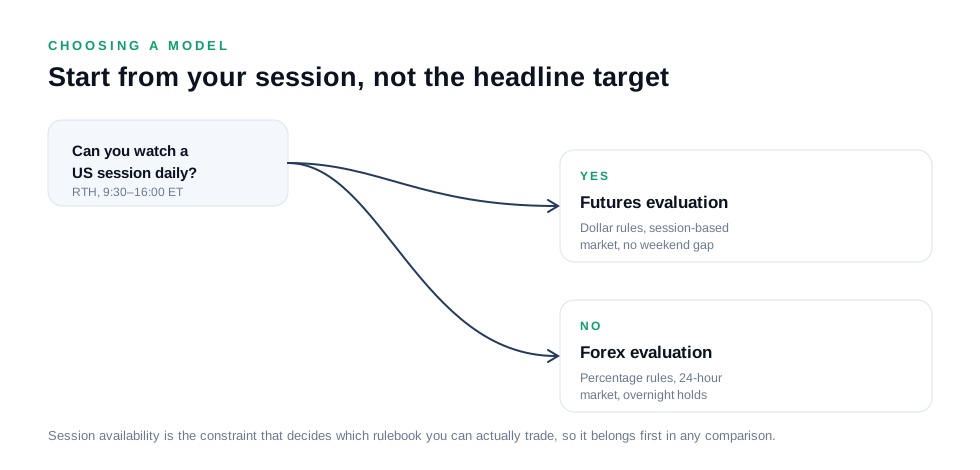
The family choice at Phidias is really a question about the floor. A static floor is the easiest rulebook in this market to trade against, because the room to fail is fixed at purchase and every dollar of profit is banked. A trailing floor is harder, because profit raises the level the account cannot fall below, and a good week leaves less margin than it appears to.
Express to Live is the static family, sold from $25,000 to $150,000 with a drawdown of $500 to $1,000. It has no minimum trading days, no consistency rate and no daily loss limit. Passing the evaluation moves the account to a Cash stage, and reaching the Cash target unlocks the switch to a live funded account.
Fundamental is the conventional family, from $50,000 to $150,000, with an end-of-day trailing drawdown of $2,500 to $4,500 and a three-day minimum. It trades intraday only and pays 80/20.
Premium shares Fundamental's targets and drawdown but allows overnight and weekend holds, requires a single trading day, funds the Cash account in a day, pays out every five days and escalates the split from 75% to 100% across the first five payouts.
| Feature | Express to Live | Fundamental | Premium |
|---|---|---|---|
| Drawdown | Static, $500–$1,000 | EOD trailing, $2,500–$4,500 | EOD trailing, $2,500–$4,500 |
| Profit target | $1,500–$4,500 | $4,000–$9,000 | $4,000–$9,000 |
| Minimum days | None | Three | One |
| Daily loss limit | None | None | None |
| Overnight and weekend | Not permitted | Not permitted | Permitted |
| Consistency at Cash | None | 30% best day | 30% best day |
| Profit split | 80/20 | 80/20 | 75% rising to 100% |
For a service pass the ordering is unusual. The family with the smallest target and the easiest rulebook is Express to Live, but its drawdown is tiny in dollar terms — $500 on a $25,000 account, $1,000 on a $150,000 one — so the difficulty is concentrated in position sizing rather than in the target. Fundamental and Premium are more forgiving in dollars and less forgiving in structure, because the floor moves.
Express to Live: the floor that never moves
A static drawdown is a fixed liquidation level: starting capital minus the drawdown amount, and it stays there for the whole evaluation. On a $50,000 Express to Live account with a $650 drawdown, the failure level is $49,350 from the first session to the last, whether the balance is $49,400 or $54,000.
That single property changes the plan more than any other rule in this market. A trailing floor tightens as the account earns, so risk per trade has to fall through the attempt. A static floor does not, so risk per trade can stay constant, and the losing sequence the account can absorb is the same in week four as in week one.
| Balance | Static floor | Room to fail | Absorbed with a $65 risk |
|---|---|---|---|
| $50,000 | $49,350 | $650 | 10 losses |
| $51,500 | $49,350 | $2,150 | 33 losses |
| $53,000 | $49,350 | $3,650 | 56 losses |
The consequence is a different failure mode. A trailing floor punishes a trader at the end of a good attempt; a static floor punishes one at the start, when the room is smallest. A $650 buffer on a 6-tick MES stop supports about ten losses at $65 of risk each, which is a workable but unforgiving start, and the first week is the only week in which the account is genuinely fragile.
The plan handles that by treating the early sessions as the expensive ones. Risk per trade in week one is set from the static buffer rather than from the target, and the pace is deliberately slower than the arithmetic allows, because the buffer does not grow with profit — it only appears to. A trader who increases size once the account is $1,500 up is not risking the same money; they are risking a gain that the floor never recognised.
There is one more wrinkle worth knowing before a purchase. Express to Live's drawdown is small relative to its target — $650 against $2,500 on the $50,000 — which is a ratio of under 4:1. That ratio is why the family can be passed in a handful of sessions and also why a single oversized position is fatal. The plan's job on this account is to reach a target that is nearly four times the buffer without ever letting one trade risk more than a tenth of it.
Fundamental and Premium: the floor that follows
Fundamental and Premium use an end-of-day trailing drawdown, calculated from the day's closing balance. The drawdown only moves up, and only after a close that sets a new peak, so an intraday gain that is given back before the bell does not raise the floor.
Take a $100,000 Fundamental account with a $3,000 drawdown and a $6,000 target. On day one it fails at $97,000. If the account closes at $101,000, the floor moves to $98,000; at $103,000, to $100,000. The distance from the peak is always $3,000, and the distance from the starting balance falls by exactly the profit booked.
| Closing balance | Floor after the close | Room from the floor | Room above the start |
|---|---|---|---|
| $100,000 | $97,000 | $3,000 | $3,000 |
| $101,000 | $98,000 | $3,000 | $2,000 |
| $103,000 | $100,000 | $3,000 | $0 |
| $106,000 — target | $103,000 | $3,000 | Negative |
The table is the argument for reducing size through the attempt. A $300 risk per trade is ten losses of tolerance at the start and ten losses at the end, because the distance to the floor never changes — but the equity cushion above the starting balance disappears, which means the last ten losses are paid out of profit rather than out of the firm's buffer.
Premium differs from Fundamental in three ways that matter to a plan. It permits overnight and weekend holds, so a position can be carried through a gap rather than flattened; it requires a single trading day, so the calendar is compressed; and its split escalates across the first five payouts, from 75% to 100%, which changes the economics of the funded stage rather than the evaluation.
Sizing contracts when there is no daily stop
With no daily loss limit on any Phidias family, the only intraday brake is the one written into the plan. That makes sizing the entire risk system rather than half of it, and it makes the position cap the second check rather than the first.
Position caps scale with the account. Express to Live runs from two E-minis or twenty micros on the $25,000 to nine E-minis or ninety micros on the $150,000. Premium runs to ten E-minis or one hundred micros on the $50,000 and seventeen or one hundred seventy on the $150,000. Those numbers are ceilings, not targets, and a plan that reaches them routinely is a plan with no margin for a wider stop.
The method is the same as at any futures firm and worth restating because it decides the outcome. A tick is a fixed dollar amount — $1.25 on MES, $2 on MNQ, $0.50 on MYM — so a stop distance converts to a dollar risk per contract, and division gives the contract count. On a $650 Express buffer with $65 of risk per trade, a 12-tick MES stop supports four contracts; on a $3,000 Fundamental buffer with $300 of risk, the same stop supports twenty.
| Account | Buffer | Risk per trade | MES contracts at 12 ticks | MNQ contracts at 12 ticks |
|---|---|---|---|---|
| E2L $50,000 | $650 | $65 | 4 | 2 |
| E2L $150,000 | $1,000 | $100 | 6 | 4 |
| Fundamental $100,000 | $3,000 | $300 | 20 | 12 |
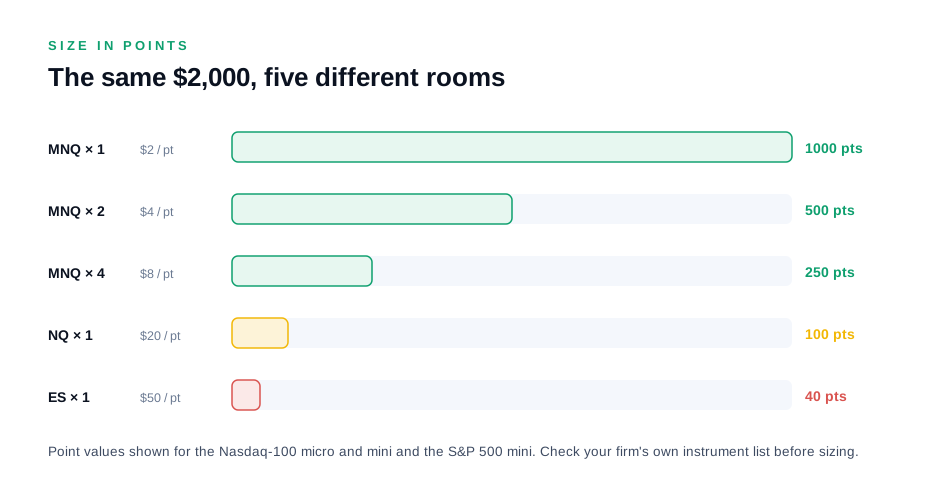
Two rules keep the system honest. The first is that the daily budget is self-imposed even though the firm does not impose one: the session closes at a fixed fraction of the buffer, typically a fifth, so a bad morning cannot become a failed evaluation by lunchtime. The second is that the position cap is checked before the sizing formula, not after, because a cap that is only discovered by the order ticket is a cap that fails silently.
The plan a Phidias pass runs on
Six constraints write the plan, and the first is the only one that changes between families.
The floor sets risk per trade. On Express to Live the floor is static, so the unit stays constant through the attempt. On Fundamental and Premium the unit falls as the floor rises, recalculated each morning from the distance between balance and floor.
The target sets the pace. Target divided by sessions available gives a required daily rate, checked against the self-imposed daily budget. A pace that requires more than a fifth of the buffer per session is a pace that depends on the market, and the schedule is extended rather than the size increased.
The minimum day count sets the calendar where one exists. Fundamental's three days and Premium's single day are satisfied by small closed trades rather than by forcing volume, and Express to Live has no count at all, so its calendar is purely a function of the target.
The holding rule sets the flatten. Fundamental and Express to Live are intraday, so positions close before the session ends. Premium permits overnight and weekend holds, which the plan uses only when the position is already at its risk limit and the gap risk is smaller than the cost of closing.
The consistency rate sets the funded-stage cap, not the evaluation's. Since no evaluation applies one, the daily profit cap is set for the Cash stage from the first day, so the pass does not create a payout problem it then has to solve.
The conduct rules set the instruments. Permitted products and position caps are walls, and news trading is authorised at every stage, so the plan does not avoid release windows — it avoids opening into one.
Failure handling is part of the plan. A lost attempt is reported the day it happens, classified as a floor breach or a conduct breach, and retried under the same rules at no additional service fee while the evaluation is open. On Express to Live a floor breach is almost always a sizing error in the first week; on Fundamental it is almost always a failure to reduce the unit after a good week.
The terms check, before anything is bought
Before payment we read Phidias's current terms for the specific family and confirm in writing whether the evaluation may be traded by a third party. The service is offered only where that answer is yes, and the check is free.
- Third-party trading on the evaluation. If it is prohibited, the job does not start, and the client is told in writing before any money moves.
- Third-party trading on the funded account. Some firms permit the evaluation to be traded externally and restrict the Cash or Live stage. The funded account is the asset, so the clauses are checked separately.
- Conduct rules. Holding restrictions, position caps and permitted products decide which sessions are usable and which instruments are tradable.
- Ownership requirements. The evaluation is bought in the client's name with the client's payment details, and identity verification is completed by the client.
The answer comes back as permitted, prohibited or silent, and silent is treated as prohibited unless Phidias confirms otherwise in writing. Send the family, the size and any support reply you already have.
How long a Phidias pass takes
The calendar differs by family, and the difference is larger than the targets suggest.
Express to Live is target-bound and fast. With no minimum days and no daily limit, a $2,500 target on a $50,000 account is reachable in two to four weeks at a disciplined pace, and a faster attempt is possible but not advisable given the static floor's narrow start.
Fundamental is target-bound plus three days. The three-day minimum is rarely the constraint; the trailing floor's effect on size is. Four to six weeks is the realistic window at a pace that leaves the buffer intact.
Premium is the fastest of the trailing pair because it needs a single day and permits overnight holds, which lets a position work across sessions rather than being flattened at the bell. That speed has a cost: a gap through the floor is a hard breach, and the plan only carries a position when the gap risk is inside the daily budget.
Reporting is weekly at minimum, and a failed attempt is reported the day it happens.
What the flat fee covers
The fee is $220 for any Phidias family and any account size.
| Item | Covered | Notes |
|---|---|---|
| The evaluation attempt | Yes | Traded to the target inside the family's rules |
| Retries while the evaluation runs | Yes | No additional service fee |
| Terms check before payment | Yes | Confirmed in writing, free |
| Phidias's own fees, activation and resets | No | Paid by the client to the firm; subscriptions are final |
| The Cash or Live account after handover | No | Traded by the client under the firm's terms |
| Identity verification | No | Completed personally, as the account holder |
| Profit split | None taken | Payouts belong to the client |
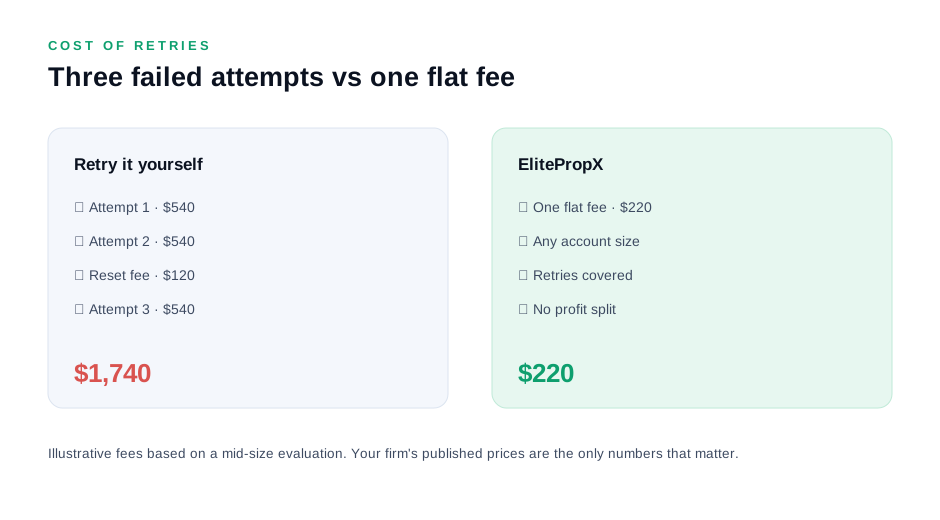
Phidias charges an activation fee on passing for some routes, which is worth naming because it is easy to miss in a price comparison: the evaluation fee is not the whole cost of a funded account. A self-traded pass therefore costs the evaluation plus the activation, while the service pass costs the same firm charges plus $220 and absorbs the retries in between.
A worked pass, week by week
An illustration on a $50,000 Express to Live account with a $650 static drawdown and a $2,500 target, traded at $65 of risk per session and a self-imposed $130 daily budget.
Week one — the narrow start. Four contracts of MES at a 12-tick stop, one position a day, two green days and one small red one. The account closes the week near $50,700. The floor has not moved, because it cannot, and the buffer is now $1,350 rather than $650.
Week two — the unit stays. The temptation is to double size because the buffer looks larger. The plan does not, because the floor is still $49,350 and the account is still one bad sequence from liquidation in dollar terms. Three green sessions take the balance to about $51,600.
Week three — the pace holds. The target needs $2,500 and the account is $900 short. Two sessions at the same unit finish it, with the third session of the week unused. The pass is complete with the best day at roughly a fifth of the total, which matters later at the Cash stage.
| Week | Balance at start | Floor | Unit | Work |
|---|---|---|---|---|
| One | $50,000 | $49,350 | $65 | Four sessions, two green |
| Two | $50,700 | $49,350 | $65 | Three green sessions |
| Three | $51,600 | $49,350 | $65 | Two sessions to the target |
The contrast with a trailing family is the point of the illustration. Here the unit never falls, because the floor never rises; on Fundamental the same pass would have cut the unit twice, and the final week would have been traded at half the opening size. Neither approach is better in the abstract — the static family rewards consistency of risk, the trailing family demands consistency of tolerance.
What a failed attempt costs
The service fee is not the cost of a failure; it is already spent and covers the retry. What a failure costs is Phidias's charge to start again plus the calendar, and on Express to Live the restart has a particular shape.
Subscriptions are final. Phidias states that all subscriptions are final and non-refundable, so a breach costs the evaluation fee again, and the activation fee on a second pass is charged again too.
A reset is not offered on every family. Express to Live and the 10K Drawdown Challenge do not offer a reset in the same way the trailing families do, so a failed E2L attempt usually means a new purchase rather than a discounted restart. That is the strongest argument for trading E2L small in the first week.
| What ends the attempt | How it happens | What the restart costs |
|---|---|---|
| Static floor (E2L) | Liquidation level reached, usually early in the attempt | New evaluation fee, no reset route, calendar from zero |
| Trailing floor | Floor reached after a good week, with the unit unchanged | Evaluation fee and reset where offered |
| Conduct breach | Holding past the flatten, product not permitted, cap exceeded | The same, and a Cash or Live account can be questioned later |
From Cash account to Live
Passing the evaluation produces a Cash account rather than an income account, and the distinction matters. The Cash stage has its own target, and reaching it is what unlocks the switch to a live funded account for Express to Live; for Fundamental and Premium, the Cash account is funded and pays out on the family's schedule.
At the Cash stage a consistency rate applies to Fundamental and Premium: no single day may exceed 30% of total profit, measured over at least four trading days. Express to Live is exempt, which is one more reason the family suits a trader whose edge is concentrated in a few sessions.

Four things to do in the first week after handover. Change the password regardless of how access was provided. Confirm the account is in your name with your payment details and verification complete. Read the Cash-stage terms for the family rather than the evaluation terms. And write the funded plan — unit, daily stop, daily profit cap, payout target — before the first trade rather than after the first loss.
Target against buffer: the tier arithmetic
Two numbers decide how hard a Phidias evaluation is, and neither is the target on its own. The figure that predicts difficulty is the ratio between the profit required and the buffer available to earn it in, because a target twice the drawdown demands a pace that a target of one and a half times does not.
| Family and tier | Target | Buffer | Target per dollar of buffer |
|---|---|---|---|
| Express to Live $25,000 | $1,500 | $500 | 3.0 |
| Express to Live $50,000 | $2,500 | $650 | 3.8 |
| Express to Live $100,000 | $3,500 | $800 | 4.4 |
| Express to Live $150,000 | $4,500 | $1,000 | 4.5 |
| Fundamental or Premium $50,000 | $4,000 | $2,500 | 1.6 |
| Fundamental or Premium $100,000 | $6,000 | $3,000 | 2.0 |
| Fundamental or Premium $150,000 | $9,000 | $4,500 | 2.0 |
The table produces a result that contradicts the usual instinct about account size. On Express to Live the ratio worsens as the account grows: 3.0 at $25,000, 4.5 at $150,000. A larger E2L account is not an easier one — it asks for 4.5 dollars of profit for every dollar of buffer, against 3 on the smallest tier, because the drawdown does not scale with the target.
The trailing families sit at half that burden. Fundamental and Premium ask for 1.6 to 2.0 dollars of target per dollar of buffer, which is why they can absorb a normal losing week that would end an E2L attempt. The compensation they take is the trailing floor: the buffer is larger, and it follows the balance.
For a service pass the ratio decides sizing rather than the target. On a 4.5 ratio the plan needs a high win rate at small risk per trade, so the unit is set from the buffer and the pace is allowed to run long. On a 1.6 ratio the unit can be larger and the calendar shorter, because the account can survive a week that goes wrong. The ratio, not the headline target, is what the schedule is built from.
Splits, cadence and what the pass actually costs
The evaluation fee is not the whole cost of a Phidias account, and the difference sits in three places: the activation charge on passing, the payout cadence once funded, and the split that applies to whatever the account earns.
Activation. Some routes charge on passing rather than at purchase, and the amount is published per family — the Premium $50,000 account lists $149. A client comparing a one-time purchase against a subscription route should compare the two totals including activation, because the cheaper first payment is often the more expensive complete purchase.
Cadence. Premium processes payouts every five days, Fundamental runs on a longer cycle, and Express to Live pays after the switch to a live account rather than during the Cash stage. A payout cadence is worth as much as a split in practice: a 90% share paid every five days is a different product from an 80% share paid once a month, and the plan's funded-stage targets are set from whichever applies.
Split. Fundamental and Express to Live pay 80/20. Premium escalates across the first five payouts — 75%, then 80%, 85%, 90% and 100% from the fifth — which means the family is worth least in its first cycle and most in its sixth. That shape rewards a client who keeps the account alive rather than maximising the first withdrawal, and it changes the advice at handover: take a modest first payout, keep the account, and let the escalation do its work.
Resets. Phidias offers a reset on some families and not others, with a published Cash Account Reset on Premium accounts for example. Express to Live sits at the other end: no reset route in the same sense, so a failed E2L attempt is usually a new purchase. That asymmetry is the strongest argument for trading the static family small in its first week.
Platforms, data and the activation fee
Phidias runs on DeepCharts with dxFeed, on any platform compatible with Rithmic, and on NinjaTrader or Tradovate. That matters to a pass for a practical reason rather than a technical one: the platform decides how the flatten is executed, how stops are held and whether a position can be closed in the last minute of the session without an interface problem.
The plan uses the platform the client already trades, because switching platforms mid-attempt is measured in mistakes rather than in fees. Where there is no preference, the choice is made on two things: whether the DOM shows the working orders clearly enough to verify a flatten, and whether the data feed's tick behaviour matches the instrument's real liquidity. A thin feed can make a stop look safer than it is.
Two cost items are worth naming before a purchase. Phidias charges an activation fee on passing for some routes, published per family — the Premium $50,000 account carries $149, for example — and the fee is charged on top of the evaluation. The firm also states that its subscriptions are final, with no returns or exchanges.
What the terms do not restrict is news. News trading is authorised at every stage on every family, which removes the release-window constraint that shapes a pass at most futures firms. The plan still avoids opening a position into a scheduled release, not because the rules forbid it but because slippage on the stop is real, and on a $650 buffer a single wide fill is a meaningful share of the tolerance.
Four ways a Phidias attempt ends
Carrying the Express to Live unit past the halfway mark. On a static floor the buffer does not grow, yet the balance does, and a trader who reads a larger balance as more room will double a position that was sized for the original $650. The floor never moved; the risk doubled.
Reading the absence of a daily limit as an absence of risk. None of the three families stops trading inside a session. A single position can therefore consume the whole buffer before anyone is told to stop, which is why the plan spends a fixed fraction of the buffer per session and closes at 80% of that fraction.
Holding a Premium position through a gap. Overnight and weekend holding are permitted on Premium and prohibited on the other two, and permitted is not the same as safe. A gap through the trailing floor is a hard breach, so the plan only carries a position when the gap risk sits inside the session's own budget.
Discovering the 30% rule at the payout request. No evaluation applies a consistency rate, so the first time it bites is the Cash stage on Fundamental and Premium. The plan caps daily profit from the first session of the evaluation, so the ratio is already satisfied when the funded stage begins.
Frequently asked about the Phidias evaluation
Does the $220 fee depend on the family or the size?
No. The fee is flat for any Phidias family and any account size, because the work is the same process applied to different numbers. Size changes the payout ceiling and the firm's own fees, not ours.
Which family is easiest to pass?
Express to Live has the simplest rulebook — a static floor, no daily limit, no minimum days and no consistency rate — but the smallest dollar buffer, so it rewards tight sizing rather than a bold attempt. Fundamental and Premium are more forgiving in dollars and harder to keep inside once the floor starts trailing.
Is there a daily loss limit?
No, on any family. The only intraday stop is the one the plan imposes, which is set at a fifth of the drawdown per session and closed at 80% of that budget. On a $650 Express buffer that is a $130 session budget.
How does the static drawdown work in practice?
The liquidation level is starting capital minus the drawdown and it never moves. On a $50,000 Express account with $650 of drawdown the floor is $49,350 for the entire evaluation, so profit increases the cushion but never relaxes the level the account cannot fall below.
What is the 30% consistency rule for?
It applies at the funded Cash stage on Fundamental and Premium, not during any evaluation. No single day may be more than 30% of total profit, so one dominant session delays a payout rather than failing an account. The plan caps daily profit for that stage from the start of the evaluation.
Do you check the terms before I pay?
Yes, and it is free. Send the family, the account size and any support reply you have, and we confirm in writing whether third-party trading is permitted on the evaluation and on the funded stage. Silent terms are treated as prohibited unless Phidias confirms otherwise in writing.
What happens if the evaluation fails?
You are told the day it happens, the failure is classified, and the attempt is retried at no additional service fee while the evaluation is running. Phidias's own fees remain your cost, and subscriptions are final, so a failed attempt is not refunded by the firm.
Is the service cheaper than doing it myself?
On a first-attempt pass, no: it is $220 more and you give up the experience. From the second attempt it is cheaper, because the service absorbs retries while a self-traded retry means another evaluation fee and, on Express to Live, no reset route at all.
What do you need from me to start?
The family, the account size and any support reply you have for the terms check. If the check clears, you buy the evaluation in your own name, we agree the scope of access in writing, and the plan starts on the next session. Identity verification stays with you throughout.
Check your Phidias terms first
Send the family and account size and we confirm in writing whether third-party trading is permitted — before you pay anything. If it is not, we say so in writing before you pay.
Related reading
- Apex Trader Funding evaluation
- Topstep Combine
- Lucid Trading evaluation
- Tradeify evaluation
- How futures evaluations differ
- Daily drawdown explained
- Recently passed evaluations
- Challenge calculator: target, risk and pace
Phidias Propfirm is named for identification only. ElitePropX is an independent evaluation service and is not affiliated with, endorsed by or sponsored by Phidias or any other proprietary trading firm. The service is offered only where a firm's terms permit third-party trading. A funded account is not a guarantee of income, and trading involves substantial risk of loss. Verify current terms before purchasing an evaluation.