
Reviewed · how we check firm rules
Evaluation service · reviewed October 2026
Futures prop firm passing service: contracts, dollars, one flat fee
A futures evaluation is not a forex challenge with different instruments. Size is counted in whole contracts, the target and the drawdown are dollar figures rather than percentages, and the failure level usually trails a peak rather than sitting at a fixed balance. That changes the sizing arithmetic, the pacing and the way an account dies. This page covers the service for futures evaluations specifically: how the arithmetic differs, which rulebook features decide the plan, what the terms check involves, the realistic calendar, and what the funded stage asks of the account holder afterwards. One flat $220 for any futures evaluation and any account size, retries covered while it runs, no profit split.
Key takeaways
- Futures size is quantised: risk comes in whole contracts, so a plan cannot be trimmed by fractions when the cushion shrinks.
- Targets and drawdowns are dollar figures, which means the same contract count is a different risk on every account size.
- A trailing threshold that follows intraday equity is the rule that ends most futures attempts, because it tightens while the trade is open.
- Platform and market-data subscriptions are part of the cost of a futures evaluation and are not covered by any service fee.
- The daily loss limit usually binds before the profit target, so risk per trade is set from the session budget rather than from the target.
- Flat $220 at any size, retries covered, no profit share, and the firm's third-party clause confirmed in writing before you pay.
Contents
- Why a futures pass is a different job
- The arithmetic: points, ticks and dollars
- What the rulebooks actually constrain
- Which firms this covers
- The terms check
- The plan
- The timeline, honestly
- Price, scope and comparison
- At the funded stage
- What we will not do
- Before you buy the evaluation
- Frequently asked questions
Why a futures pass is a different job
The two products look interchangeable from the outside: pay a fee, hit a target, receive a funded account. Underneath, the arithmetic is not the same, and three differences change the work rather than merely decorating it.
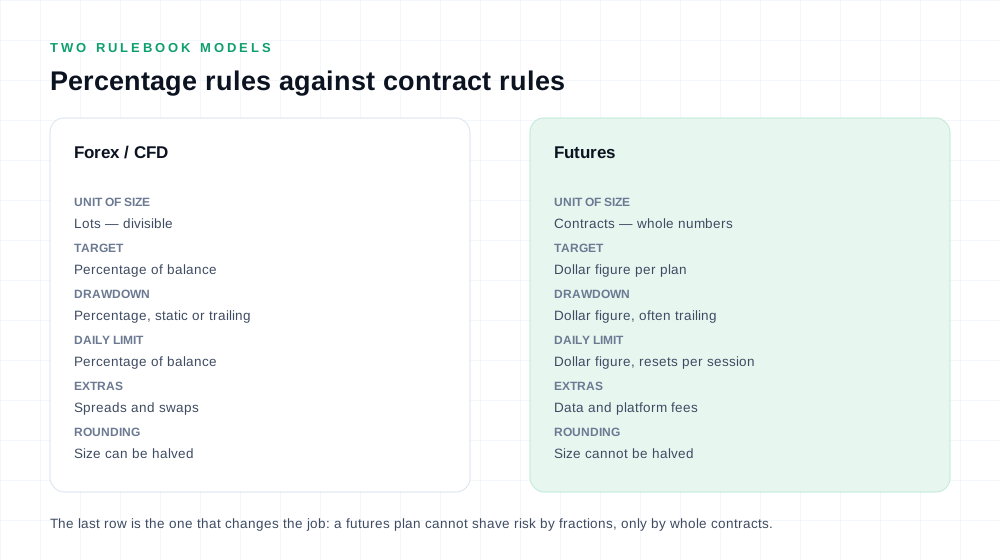
Size is quantised. A forex account can be risked at 0.37 lots if the arithmetic says so. A futures account trades in whole contracts. If the correct size is 1.4 contracts, the choice is one contract or two, which means the plan's precision is bounded by the instrument rather than by the analysis. On small accounts this is a genuine constraint: at one micro contract the minimum increment may be larger than the risk the plan wants to take.
The rules are denominated in dollars. A percentage target and a percentage drawdown scale together, so a $50,000 account and a $200,000 account are the same difficulty. Futures plans often state a dollar target and a dollar drawdown instead, and those do not scale with the balance in the same way. The consequence is that the same contract count is a materially different risk at $25,000 and at $150,000, and a plan written for one size cannot be carried to the other.
The failure level usually trails. Many futures evaluations use a threshold that rises with peak equity rather than a fixed floor. On an intraday trailing structure it rises with unrealised equity, which means an open position in profit has already tightened the account before it is closed. This is the single most important mechanical difference from a static-drawdown challenge, and it is the rule that most attempts breach in the middle of a good run rather than at the start of a bad one.
There is a fourth difference that is commercial rather than mathematical: the extras. A futures evaluation carries platform and market-data subscriptions that a forex account does not. Those costs sit outside both the firm's fee and any service fee, they recur monthly, and they are the reason a cheap evaluation on an expensive data package is not cheap. The futures firm guide covers that cost stack in full.
The arithmetic: points, ticks and dollars
Every futures plan reduces to a single conversion: how many points of adverse movement the account can survive at the chosen contract count. The profit target is not the number that decides survival; the drawdown in points is.
Work it in one direction and the whole plan falls out. Take the dollar drawdown, divide by the dollar value per point at the intended size, and the result is the number of points of room. That number, not the account size, is what the stop and the daily budget are written against.
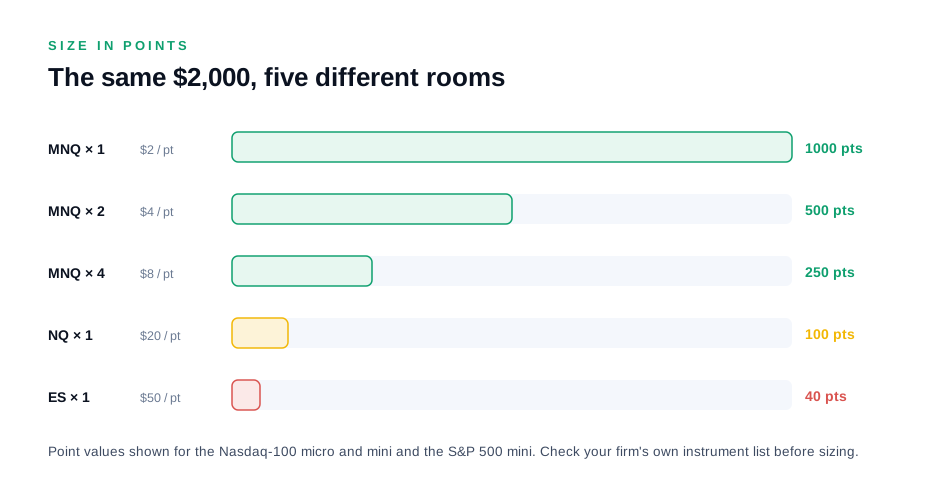
A $2,000 drawdown is 1,000 points at one micro Nasdaq contract and 100 points at one full-size contract. The account is identical; the room is ten times smaller. Multiply the micro position to four contracts and the room falls to 250 points — still larger than the full-size single contract, which is why micros are the right instrument for a tightly sized plan and the wrong instrument for a plan that wants a large notional exposure on a small cushion.
Three consequences follow, and each one has a practical instruction attached.
Stop distance determines size, not the reverse. Decide where the setup invalidates, convert that distance into dollars at the intended contract count, and check it against the per-trade budget. A trader who picks a contract count first and then looks for a stop is sizing from the wrong end and will breach on an ordinary stop-out.
The daily limit is a separate budget. Most futures plans state a daily loss limit alongside the account drawdown. Risk per trade should be a fraction of the daily budget rather than of the total, so that a normal losing session leaves the account intact and the following session still funded.
Contract caps apply on top. Many plans limit the maximum number of contracts held at once, independently of risk. The smaller of the two constraints governs: a plan sized to four micros by arithmetic but capped at two by the rulebook is a two-micro plan, and the stop has to be widened or the setup skipped rather than the cap ignored.
One rule that saves accounts. On a trailing threshold, recompute the remaining room every morning from the current floor. After a profitable session the floor has moved and the size that was correct yesterday may exceed what the new cushion supports.
What the rulebooks actually constrain
Futures rulebooks differ from firm to firm, but they constrain from the same short list, and the difference between two firms is usually the tightness of one item rather than the presence of a new one.
| Constraint | How it usually appears | Planning consequence |
|---|---|---|
| Profit target | A dollar figure per plan size | Convert to points at the chosen size and divide by sessions |
| Drawdown mechanism | Dollar figure, static or trailing a peak | Trailing means the floor moves with equity, so room shrinks as you progress |
| Daily loss limit | A dollar figure, reset each session | Risk per trade at a fraction of it, not of the account |
| Contract cap | Maximum contracts held at once | The binding size wherever it is lower than the arithmetic size |
| Consistency | Best-day expectation, at review or at payout | No single session should dominate total profit |
| Minimum days | Set by the plan's current terms | Pace the target to arrive on or after the count |
| Payout threshold | A dollar figure above the starting balance | Decides whether a passed account pays without further work |
The drawdown mechanism deserves more than a row in a table, because it is where the arithmetic becomes counter-intuitive.
On a static threshold, the failure level is fixed at a distance below the starting balance. Profit does not tighten it, so a run of gains is pure advantage. This is the more forgiving structure and it is increasingly the minority on futures.
On a trailing threshold measured at end of day, the floor follows closed profit upward. A session that banks $800 raises the floor by $800, which means the cushion above it is unchanged in dollars but the distance from the current balance to failure has not improved. The trader is no safer for having earned.
On a trailing threshold measured on intraday equity, the floor follows unrealised profit. A position $1,500 in the money has already moved the floor before anything is closed. If it retraces and closes at $400, the floor stays where the peak put it and the account is materially worse off for having been right. This structure is the one that produces the characteristic futures failure: a good trade, closed slightly late, followed by an ordinary stop-out that breaches.
The instruction that follows is not subtle. On an intraday trailing structure, closing earlier is correct behaviour rather than timid behaviour, because the floor has already moved and the unbanked profit is not available to be given back. A sizing plan that assumes it can carry an open winner through a retracement is written against the wrong mechanic.
The challenge rules guide sets the same constraints out across both asset classes, and the rules matrix records which firms use which mechanism, with a check date against each row.
Which firms this covers
The service applies to any futures evaluation whose terms permit third-party trading. In practice the request comes against a small set of plans, because futures is a more concentrated market than forex, and it is worth describing what differs between them rather than which is best — the right plan depends on the strategy, and the strategy is the client's.
The trailing-threshold plans. The largest group. A dollar drawdown that follows peak equity, a daily loss limit stated separately, and a dollar target. The differences that matter between two such firms are whether the threshold trails intraday or at end of day, and whether the floor stops rising after a certain profit level. The second detail is worth asking about explicitly, because a floor that stops trailing converts a tight account into a manageable one partway through the evaluation.
The consistency-constrained plans. A subset applies a best-day expectation, either to the evaluation itself or at the payout review. On those, a plan that produces one dominant session has completed the target and created a review problem at the same time. The pace has to be flattened deliberately, which lengthens the calendar and raises the completion rate.
The instant or fast-track plans. Larger fee, fewer gates, sometimes no day count. These suit a trader whose edge is concentrated rather than distributed, and they are the plans where the trailing mechanic bites hardest, because there is no gradual runway during which to build cushion.
Two planning notes apply to all three groups. The instrument must be on the firm's permitted list, which is not universal — some plans exclude certain contracts or restrict trading to specific products. And the platform and data subscriptions are separate purchases, so a plan that works on one platform's data feed may need re-testing on another's.
The FTMO against Apex comparison sets the percentage model against the contract model directly, and the futures firm guide ranks plans on what actually fails accounts rather than on headline fees.
The terms check
Before payment, we read the current terms for the specific plan and confirm in writing whether the evaluation can be traded by a third party. The check is free and it happens before anything is bought.
Futures firms are, on the whole, more explicit about this than forex firms, and the answer is more often a plain prohibition rather than silence. That is useful: an explicit no ends the conversation cleanly and saves the client the firm's fee. Where the answer is ambiguous the treatment is the same as elsewhere — silence is a no, because the firm can answer the question at the payout, which is the worst possible moment to learn it.
Three details are checked alongside the main question, and the first two are particular to futures.
Which instruments are permitted. Some plans restrict trading to a named list, and an evaluation traded outside it can be voided for that reason alone, independently of who traded it.
Whether the account is shared or single-session. Several futures plans restrict an account to one active session or prohibit simultaneous positions across correlated products. That constrains the plan's structure rather than its size, and it has to be known before a strategy is chosen.
What ownership evidence is required. The account has to be bought in the client's name with the client's payment method, and verification completed personally, for the funded account to belong to the client at payout.
Where a firm permits third-party trading on the evaluation but prohibits it on the funded account, the permission expires at the point of value and the job should be declined. A completed evaluation that converts into an account the client cannot operate is not a delivered outcome.
The plan
The evaluation is traded to the firm's rules, so the plan is written from the rulebook rather than from a market view. Seven numbers define it, and each one is recomputed rather than carried forward.
- Contract count: the lower of the arithmetic size from the per-trade budget and the plan's contract cap.
- Per-trade budget: a third of the daily loss limit at most, expressed in dollars and converted to a stop distance in points at the chosen size.
- Daily stop: stop opening positions once 80% of the daily budget is realised, so the closing trade has room to slip.
- Daily profit cap: a fraction of the target per session, which keeps the equity curve flat enough to stay inside a consistency expectation and keeps the pace sustainable.
- Floor recomputation: the remaining room recalculated every morning from the current threshold, not from the starting balance.
- Pace: the target in points divided by the sessions available, checked against the daily profit cap. If the required pace exceeds the cap, the plan is mis-set rather than the cap being wrong.
- Weekly pause: a hard stop after two losing sessions, which on a trailing structure costs a few days and prevents the sequence that closes most accounts.
The fifth number is the one that distinguishes a futures plan from a forex plan, and it is the one most often skipped. On a trailing threshold the remaining room is a moving quantity. A plan written once at the start of the evaluation is correct on day one and increasingly wrong after a profitable week, because the floor has risen and the cushion has not grown with it. Recomputing takes a minute; skipping it is the most common cause of a breach in the final third of an evaluation.
The second number is where contract quantisation bites. If the per-trade budget allows 1.4 contracts, the plan trades one. Trading two to use the budget is a 43% oversize, and it converts an ordinary stop-out into a session that consumes the daily limit. Rounding down is not caution, it is arithmetic.
The position size calculator converts a stop distance and a dollar budget into a size, and the risk management guide covers the budget structure behind it.
The timeline, honestly
A futures evaluation is not completed in a day, and any provider promising otherwise has found a plan with no day count and is describing a different product. The realistic window on a plan carrying a minimum day requirement is two to five weeks.
Week one sets the pace. At a per-trade budget that keeps three losses survivable, a good week produces a modest fraction of the target. That is the plan working, not the plan underperforming. A first week that produces a large fraction of the target is a warning sign rather than a good start, because it means the size is large enough to breach on the same variance that produced the gain.
Day counts bind before targets do. Where a plan requires a minimum number of qualifying days, the calendar is the constraint. A single small closed position satisfies a day without adding meaningful risk; using those days to press for profit is adding risk to a requirement that needed none.
Losing weeks are budgeted, not avoided. The weekly pause costs two sessions when it triggers, which is calendar spent deliberately to protect an account whose floor has already moved. On an intraday trailing structure, a bad week is more expensive than the same week on a static one, because the losses lower the balance while the floor stays where the peak left it.
Reporting runs at agreed checkpoints, at minimum weekly, with immediate notice if an attempt fails. Silence during an evaluation is indistinguishable from a failure, and on a trailing account a failed attempt needs to be reported the day it happens rather than at the end of the week.
Price, scope and comparison
The fee is $220 for any futures evaluation and any account size. The scope is narrow and stated in full, because an unstated scope is the most common source of dispute in this industry.
| Item | Covered | Notes |
|---|---|---|
| The evaluation, traded to the plan's rules | Yes | Contract count and pacing set from the rulebook |
| Retries while the evaluation runs | Yes | No additional service fee |
| Terms check before payment | Yes | Confirmed in writing, free of charge |
| The firm's evaluation and reset fees | No | Paid by the client directly to the firm |
| Platform and market-data subscriptions | No | Paid by the client; a real part of the futures cost stack |
| The funded account after handover | No | Traded by the client under the firm's terms |
| Identity verification | No | Completed personally, as the account holder |
| Profit share | None taken | Payouts belong to the client |
The comparison that matters is against doing it yourself, and the case against the service should be stated as plainly as the case for it. If the firm's fee is $300 and you pass first time, self-trading costs $300 plus data and the service costs $520 plus data. The service is worse by $220 and you gave up the experience of trading the evaluation.
From the second attempt onward the arithmetic reverses, because the service absorbs retries while your own attempts are billed each time. Two attempts self-traded is $600 against a flat $220 fee on top of one $300 evaluation; three attempts is $900. Break-even is a single failure, which is a low bar — and it is why the honest statement of the case is that the flat fee is worth it below roughly a 70% first-attempt success rate and not above it.
Two futures-specific costs sit outside that comparison entirely. The monthly platform and data subscriptions continue for the duration of the evaluation whoever trades it, so a longer pass costs more in subscriptions. And the firm's reset charge, where a plan offers a reduced restart rather than a full repurchase, is the client's cost on every attempt. Neither is affected by the service fee, and both belong in the budget before the decision rather than after it.
The pay-to-pass cost breakdown works the same comparison across all three payment models, and the fee comparison sets the firm side out separately.
At the funded stage
The pass produces a funded account and responsibility transfers with it. The service covers the evaluation; the funded account is governed by the firm's payout conditions, which on futures plans are usually more specific than on the evaluation itself.
Three things carry over and three are new. Carried over in some form: the contract cap, the permitted-instrument list, and the session restrictions. New: a profit threshold above the starting balance before anything is withdrawable, a minimum number of trading days per payout cycle, and a consistency or best-day expectation applied at review.
The trailing threshold usually keeps trailing on the funded account. That is the detail clients most often miss. An evaluation that ended with the floor a certain distance below the peak does not reset at handover, and a funded account that gives back profit before the first payout can breach on the same mechanics that governed the evaluation. The remaining room at handover is the number to write down on day one.
The first payout threshold is a second target. Many futures plans require a stated profit above the starting balance before the first withdrawal, which means a passed evaluation is not immediately a payable account. Plan the first request around that threshold rather than around what the account happens to be worth.
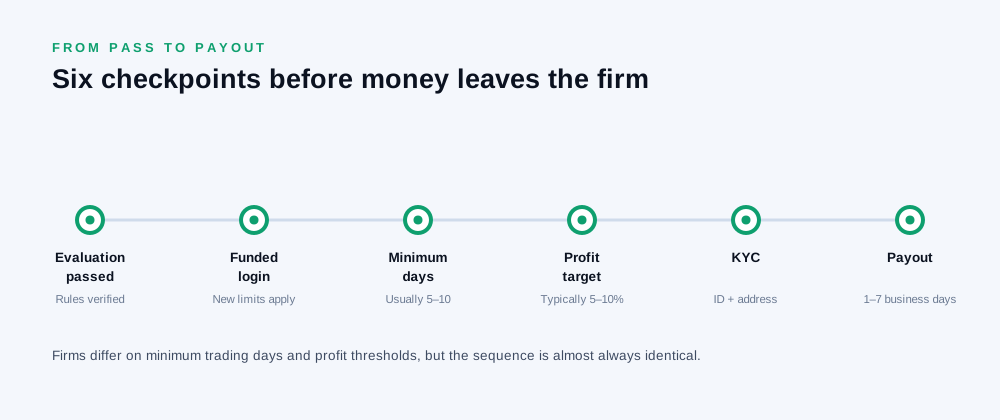
Four steps in the first week after handover, in order. Change the account password regardless of how access was provided. Confirm the account is in your name with your payment details and verification complete. Read the funded terms yourself rather than relying on a summary. And write the funded plan — contract count, per-trade budget, daily stop, remaining room from the floor — before the first trade rather than after the first loss.
The payout process guide covers the withdrawal sequence and the delays that block first requests. The short version: complete verification early, request the first payout on the earliest permitted date rather than at the largest available amount, and treat the first payment as a test of the process rather than as income.
What we will not do
Four lines are drawn around this service, and each one exists because crossing it would move risk onto the client without them seeing it move.
We will not trade a plan whose terms prohibit third-party trading. Not quietly, not for a higher fee. Futures firms tend to be explicit about this, and an account voided at payout costs the client the firm's fee, the service fee and the calendar.
We will not exceed the contract cap. A plan sized to four micros but capped at two is a two-micro plan. Using the budget the arithmetic allows and the rulebook forbids is a conduct breach waiting for a review.
We will not keep trading the account after the pass. Ownership and access go back to you at handover, because a provider that keeps the login is running a managed account under a different name, which futures firms ban about as clearly as anything in their terms.
We will not take a profit share. A provider paid a percentage of earnings has a reason to keep trading after the job is done, which extends the exposure and can lose the account in pursuit of a larger fee.
Two practices are worth stating because they are the industry's usual shortcuts. We do not buy evaluations on the client's behalf; the purchase is made in the client's name with the client's payment method, because ownership is what keeps a funded account valid. And we do not ask for identity documents, because verification is the account holder's step and cannot be delegated.
Before you buy the evaluation
Six steps, in order, and most of them take minutes. They are the difference between a futures evaluation that can be passed and one that cannot, regardless of who trades it.
- Establish the drawdown mechanism. Static, trailing at end of day, or trailing intraday. The three produce very different plans from identical headline numbers.
- Convert the drawdown to points at your intended size. The dollar figure is meaningless until it is expressed in the room it actually gives you.
- Check the instrument list and the contract cap. Both can make a strategy inadmissible independently of risk.
- Get the permission question answered in writing. Ask it twice — once for the evaluation, once for the funded account — and keep the reply, because the two answers differ more often than providers admit.
- Budget the subscriptions. Platform and data fees recur monthly and are part of the cost of the attempt, not of the service.
- Write the funded plan before the pass. Contract count, per-trade budget, daily stop, remaining room from the floor. Writing it after the pass is how funded accounts are lost in week one.
Five of the six take under an hour in total. The sixth — a plan for the funded account — is the one that decides whether the fee produces income or a screenshot. The service comparison sets out how the flat-fee model compares with the alternatives, and the passed challenges page shows what a completed evaluation looks like.
Frequently asked about the futures service
Does the $220 fee depend on the account size or the plan?
No. The fee is flat for any futures evaluation and any account size, because the work is the same process applied to different numbers. Size affects the payout ceiling and the firm's own fee, not ours.
Which futures firms can you trade?
Any plan whose terms permit third-party trading. In practice the request is usually against a plan with a dollar drawdown and a daily loss limit. The firm, the plan name and the account size are enough for the terms check, which is free and happens before you pay.
Why does contract count matter so much?
Because risk moves in whole contracts rather than in fractions. A per-trade budget that allows 1.4 contracts supports one contract, and choosing two is a 43% oversize on the same setup. That rounding decision is the difference between an ordinary stop-out and a session that consumes the daily limit.
What is a trailing drawdown and why does it matter?
A failure level that rises with peak equity instead of sitting at a fixed balance. Measured intraday, it rises with unrealised profit, so a position in the money has already tightened the account before it closes. That is why closing earlier is correct behaviour on a trailing structure and why the remaining room has to be recomputed every morning.
How long does a futures pass take?
Two to five weeks on a plan with a minimum day requirement. The calendar is set by the day count and by how much of the daily budget a sustainable pace consumes, not by how aggressively the account is traded. A pass completed in a few days means a plan with no day count rather than an efficient one.
Do you trade the funded account afterwards?
No. The service ends at handover, and continuing to trade a funded account is managed account activity that most firms prohibit. Access is returned or removed at handover, and the funded plan belongs to the account holder.
Are platform and data fees included?
No, and they are a real cost. Futures evaluations run on platforms with monthly subscriptions and market-data fees that are paid by the client and are unaffected by the service fee. They recur for the length of the evaluation, so a slower pass costs more in subscriptions.
What happens if an attempt fails?
We tell you the same day, say whether it failed on a loss rule or on conduct, and rerun it at no extra service fee while the evaluation is still running. Any reset charge the firm levies stays yours, and so does any month of platform or data subscription spent on the attempt.
Can you trade a consistency-constrained plan?
Yes, and the pace is flattened deliberately to clear it. A best-day expectation applied to the evaluation or at payout means no single session should dominate total profit, so the plan trades more sessions at smaller size rather than fewer at larger size.
Is it cheaper than trading it myself?
If you pass first time, no: your own attempt costs the firm's fee plus subscriptions, and the service adds $220. From the second attempt onward it reverses, because retries are covered rather than billed each time. Break-even is a single failure.
Which instruments can be traded?
Only those on the plan's permitted list, which is not universal. Some plans restrict trading to named products or exclude others entirely, and an evaluation traded outside the list can be voided for that reason independently of who traded it.
What do you need from me to start?
The firm, the plan name and the account size for the terms check. If it clears, you buy the evaluation in your own name with your own payment method, then we agree the scope of access in writing and begin. Identity verification stays with you throughout.
A worked futures pass, by session
An illustration of the pace a compliant futures pass runs at, using a $2,500 dollar drawdown that trails intraday, a $1,000 daily loss limit, a per-trade budget of a third of the session limit, and a contract count fixed at the start of each attempt.
Session one. One setup, one contract, stop and target defined before entry. The trade works and closes at the target. Banked profit raises the floor, so the remaining room is now smaller than it was at the open — a fact recorded before the next session rather than discovered during it.
Session two. Two setups, the first stopped out for the planned loss, the second closed at a small gain. Net flat. The floor has not moved, the daily budget has been used, and the account is where it started.
Session three. A position runs further than planned. Closed deliberately before the natural retracement, because on an intraday trailing structure the floor has already followed the peak and the unbanked portion is not available to give back. A smaller gain than the maximum, and the correct one.
Session four. A losing session that uses half the daily budget on two stop-outs. The weekly pause is not triggered, and the plan resumes the following morning with the floor recomputed from the current level rather than from the starting balance.
| Session | Setups | Outcome | Room to floor after |
|---|---|---|---|
| One | One, one contract | Target reached, closed | Reduced by the gain |
| Two | Two, one contract | One small loss, one small gain | Unchanged |
| Three | One, one contract | Closed early, below the peak | Reduced by the banked gain |
| Four | Two, one contract | Two stop-outs, half the budget | Reduced by the losses |
Two features are worth noticing. The contract count never rises, even in the sessions that worked, because the arithmetic size is set by the floor and not by confidence. And every session starts with the room recomputed, which is the practice that separates a plan that survives a trailing threshold from one that breaches in its final third after a good week.
The contrast is instructive. A trader who increases size after a winning session is adding risk at the moment the cushion is thinnest, because the floor has already moved up behind the profit. On a trailing structure that is the most expensive available mistake, and it is the reason the trailing drawdown arithmetic treats the mechanic as the deciding factor rather than a detail.
Where these rules come from
Firm figures on this page are read from the rulebooks below rather than from other comparison sites. Every link was opened and checked on . Firms revise targets and drawdown rules without notice, so confirm the figures on the plan you are buying before paying. How we check firm rules sets out what a checked date means, what we publish when a figure cannot be confirmed, and how corrections are handled.
- Apex Trader Funding — EOD evaluation parameters, intraday trailing drawdown, 50% consistency requirement
- Topstep — maximum loss limit, daily loss limit, consistency targets
- MyFundedFutures — help centre — evaluation rules and parameters
Check your futures terms first
Send the firm, the plan name and the account size, and we confirm in writing whether third-party trading is permitted — before you pay anything. If it is not, we say so in writing.
Related reading
- The best futures prop firms, judged on what fails accounts
- Percentage rules against contract rules
- The trailing drawdown, worked in dollars
- Choosing micro contracts for a small cushion
- How the flat-fee passing model works
- What paying to pass actually costs
- Prop firm rules matrix
- Position size calculator
- From funded account to first payout
- Recently passed evaluations
Firm names are used for identification only. ElitePropX is an independent evaluation service and is not affiliated with, endorsed by or sponsored by Apex, Topstep, MyFundedFutures or any other proprietary trading firm. The service is offered only where a firm's terms permit third-party trading. Contract values and firm rules are checked against published documentation and may change without notice. A funded account is not a guarantee of income, and trading futures involves substantial risk of loss.