
Reviewed · how we check firm rules
Evaluation service · reviewed November 2026
We pass your Lucid Trading evaluation for a flat $220
We pass Lucid Trading evaluations for a flat $220, at any account size, and hand the funded account back to you. Lucid's futures rulebook has one property that decides the whole attempt: the failure floor trails the peak, so the room to fail shrinks as the account earns. This page sets out how that arithmetic is planned around, how contracts are sized against a moving floor, what the daily stop does to a session, the terms check that happens before payment, and what the funded stage looks like after the pass.
Key takeaways
- Lucid measures drawdown from the peak, not from the starting balance. Every dollar of profit raises the floor by a dollar until it reaches the balance, which means a profitable attempt can breach at break-even.
- The daily stop is an equity rule, so a position that is merely underwater has already spent part of the day's allowance.
- Contract size has to fall as the buffer compresses. A plan that holds its opening size to the target is trading a different risk by week four.
- Before any payment we confirm in writing whether the evaluation, and separately the funded account, may each be traded by a third party.
- A Lucid pass is target-bound rather than calendar-bound, which makes it faster than a two-phase evaluation and less forgiving of a slow week.
- Flat $220 at any size, retries covered while the evaluation runs, no profit split, and the firm's clause on third-party trading confirmed in writing first.
Contents
- What the Lucid rulebook measures
- The trailing threshold, and why it tightens as you profit
- Sizing contracts against a moving floor
- Where the daily stop actually binds
- The plan a Lucid pass runs on
- The terms check, before anything is bought
- How long a Lucid pass takes
- What the flat fee covers
- A worked Lucid pass, week by week
- What a failed attempt costs
- Four ways a Lucid attempt ends
- After the pass: the funded account
- Frequently asked questions
What the Lucid rulebook measures
Lucid Trading is a futures firm, and futures rulebooks are read in ticks rather than in percentages. That single difference changes how an evaluation is planned, because the numbers that matter are dollar amounts per contract, and the risk of a position is fixed at the moment it is opened rather than floating with a position size in lots.
Five measurements decide whether an attempt survives. The profit target is the amount that has to be earned. The trailing threshold is the distance the failure floor sits below the highest balance the account has reached. The daily stop is the loss allowed inside one session, measured on equity. The position cap limits how many contracts can be held at once. And a consistency share, where it applies, caps the largest day relative to the total at the point of payout.
What Lucid does not impose is a minimum trading day count. That is the detail most traders skim past, and it is the one that shapes the schedule: an attempt is finished when the target is reached, not when a calendar has elapsed. A trader who reaches the target in three well-planned weeks is done in three weeks. The same absence of a day count removes the safety net a two-phase evaluation provides, because there is no checkpoint between the start and the finish — one arc, one floor, one target.
Two consequences follow immediately. The first is that pacing is chosen rather than dictated: without a day count there is no reason to trade small for the sake of the calendar, so the plan optimises purely for surviving the floor. The second is that a slow week is expensive. On a staged evaluation a quiet week costs nothing but a week; on Lucid it costs a week of a monthly subscription and leaves the target further away in relative terms, because the floor trails the peak rather than the clock.
The trailing threshold, and why it tightens as you profit
Take the example the Lucid guide on this site works through: a $100,000 futures account with a $3,000 trailing threshold and a $6,000 target. On the first morning the account fails at $97,000, so the room to fail is $3,000 in both directions. That is the widest the account will ever be.
After the balance reaches $103,000 the floor has climbed to $100,000. The distance from the peak is still $3,000, but the distance from the original balance is now zero: an account that is $3,000 up can fall back to its starting balance and breach. This is the property that catches traders who treat the evaluation as a target to sprint at. The further ahead the attempt gets, the less room it has, because the floor is following it.
Now add a normal losing sequence to see what it does. Three trades at $500 each consume $1,500 of the original $3,000 buffer, which is half. The same three trades after the account has run to $103,000 also consume $1,500 — but that $1,500 now takes the account from $3,000 of profit to break-even and, with a little more, to failure. Nothing about the trades changed. The account changed underneath them.
| Account state | Failure floor | Room from the floor | Room from the starting balance |
|---|---|---|---|
| Day one, $100,000 | $97,000 | $3,000 | $3,000 |
| Balance $102,000 | $99,000 | $3,000 | $1,000 |
| Balance $103,000 | $100,000 | $3,000 | $0 |
| Balance $106,000 | $103,000 | $3,000 | Negative — the floor is above the start |
The table is the whole strategy in four rows. Room from the floor never grows, room from the start falls to nothing, and past $103,000 the account is protected only by the peak it has already reached. There is no version of a traversing floor where a trader can bank a gain and then trade as though the original buffer were still available.
The planning consequence is that risk per trade has to be set from the buffer as it will be at the worst moment, not as it is on the first morning. A dollar risk that is comfortable at $3,000 of room is a third of the tolerance it was once the floor has climbed to the balance, and the standard failure on this rulebook is a trader who keeps the opening size into the final week and hands back the entire gain in three sessions.
The remedy is mechanical. Size is recalculated from the current distance between balance and floor at the start of every session, so the number of contracts falls as the buffer compresses, and the loss tolerance stays constant in dollars. That has an unglamorous implication: the last week of a Lucid attempt is traded smaller than the first, which is the opposite of how most traders behave when an account is nearly passed.
Sizing contracts against a moving floor
Futures sizing starts from the tick value, because a stop is a distance and the account is a dollar amount. On the Micro E-mini S&P (MES) a tick pays $1.25, on the Micro E-mini Nasdaq (MNQ) a tick pays $2, and on the Micro E-mini Dow (MYM) a tick pays $0.50. A 12-tick stop therefore risks $15 per contract on MES, $24 on MNQ and $6 on MYM — the same stop distance, three different dollar risks.
Suppose a per-trade dollar risk of $375 is chosen, which is one-eighth of a $3,000 buffer and allows eight consecutive losses. On MES with a 12-tick stop that is 25 contracts, on MNQ it is 15, and on MYM it is 62. Those numbers are arithmetic, not recommendation: 25 micro contracts on a $100,000 account is a large position for a discretionary trader, and most plans will use a wider stop, which reduces the contract count proportionally.
| Instrument | Tick value | 12-tick stop | Contracts at $375 risk | Contracts at $150 risk |
|---|---|---|---|---|
| MES | $1.25 | $15 | 25 | 10 |
| MNQ | $2.00 | $24 | 15 | 6 |
| MYM | $0.50 | $6 | 62 | 25 |
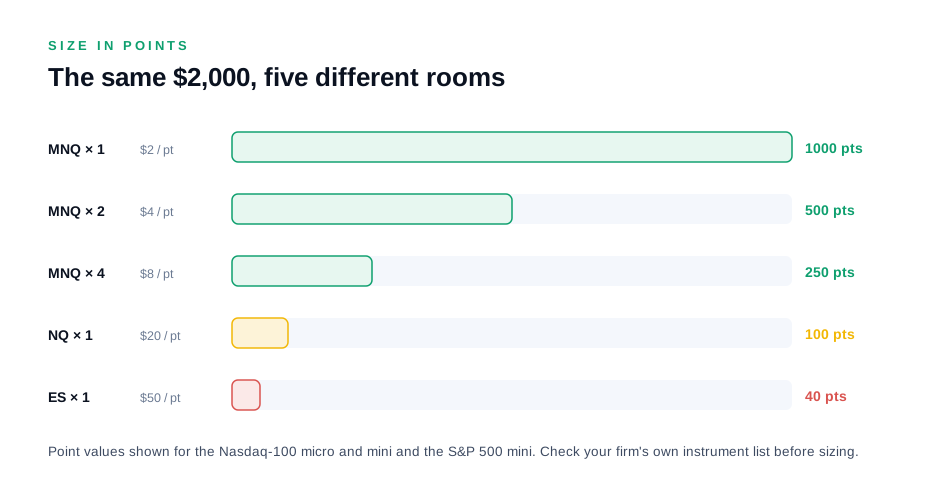
The second column pair is the one that matters in practice. Once the floor has climbed so that the usable buffer is $1,200 rather than $3,000, the same eight-loss tolerance implies a unit of $150, not $375. A plan that holds 25 MES contracts turns an eight-loss buffer into a three-loss buffer without changing a single other setting, and three losses is inside the range of an ordinary bad morning.
Two practical rules come out of this. The first is that the position cap protects against arithmetic rather than against judgement: a cap of ten contracts on a $375 unit is not conservative, it is a second, independent limit that stops the sizing formula from producing a position the trader would never choose deliberately. The second is that the recalc happens before the session, not during it. Sizing by feel inside a live session is how a plan's risk doubles in the last hour of a day that is already green.
For traders who prefer index futures but want the granularity of a smaller unit, the micro contracts make this arithmetic tractable at $100,000. On a full-size contract the same stop distance moves ten times the money, so the contract count falls to two or three and the rounding error in sizing becomes a real percentage of the risk budget. That is worth knowing before choosing an instrument, because a plan can be sound and still be untradeable at a given account size.
Where the daily stop actually binds
A daily stop on a futures account is measured on equity, which means floating losses count immediately. A position that is $1,200 underwater has consumed 60% of an illustrative $2,000 allowance even if it recovers before the close, and a plan that waits for the position to come back is a plan that has stopped sizing losses and started hoping.
The session budget is therefore set before the first trade, in dollars, from the daily stop rather than from the target. With a $375 unit and a $2,000 daily stop the session allows five losses before it closes; with the same stop and a $150 unit it allows thirteen. The second configuration is not more aggressive — it is the same money at a lower unit, which is exactly what the compressed buffer calls for later in the attempt.
The 80% rule completes the design. The session closes when four-fifths of the daily budget is spent, leaving the remaining fifth for slippage on the closing trade and for the possibility that the last loss is larger than planned. On a rulebook where the daily stop is a hard reset rather than a warning, the reserve is not caution, it is what stops a normal day from becoming a failed evaluation.
What a green day must not do: it must not raise the next session's size. On a trailing floor, a green day raises the failure floor too, so the account's tolerance is unchanged in dollars while its room from the starting balance has fallen. Increasing size after a good day is the fastest way to convert a profitable attempt into a breach.
The interaction between the two limits is where most failures happen. A trader who is up $800 for the day and then takes a full-size position is risking the day's gain against the daily stop with no plan for the equity rule. The plan treats a day that has reached its profit cap as finished, for the same reason the evaluation does: the remaining allowance belongs to the floor, not to the target.
The plan a Lucid pass runs on
Six constraints write the plan, and none of them is a view on the market.
The trailing floor sets dollar risk per trade. Risk is a fixed fraction of the usable buffer, recalculated each session from the distance between the balance and the current floor. On a $3,000 buffer that is $375; on $1,200 it is $150. The unit never rises during an attempt.
The target sets the pace. The target is divided by the sessions available in the subscription window and checked against the daily stop. A required pace that consumes more than a fifth of the daily allowance is a pace that depends on the market cooperating, and the schedule is either extended or the unit is left alone and the attempt runs longer.
The daily stop sets the session. Budget, 80% stop, and a hard rule that the session ends at the budget rather than at a feeling. Floating equity is monitored during the session because the rule is an equity rule.
The position cap sets the ceiling. A second limit on contracts that catches a sizing formula gone wrong and keeps the largest position inside what the trader would choose on a calm day.
The consistency share sets the daily profit cap. Where a best-day percentage applies at payout, the cap is set so the ratio is satisfied by construction: no day larger than the share of the total it must be. The ratio is never computed live because it cannot fail.
The conduct rules set the clock and the instruments. Restricted windows, permitted products and any overnight or weekend holding rule are treated as fixed walls. A breach voids the attempt regardless of profit, and a futures rulebook generally enforces these automatically.
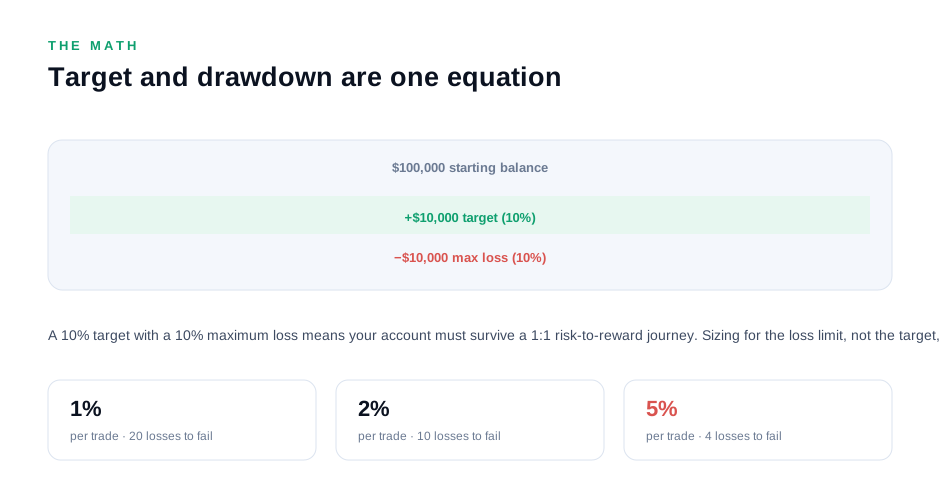
Failure handling is part of the plan rather than an afterthought. If an attempt is lost, the client is told the same day, the failure is classified as a floor breach or a conduct breach, and the retry runs under the same rules at no additional service fee while the evaluation is open. Classification matters because the two failures have different causes: a floor breach is usually a sizing error at the end of a good week, and a conduct breach is a process error that will repeat on the next attempt unless the session rules change.
The plan is deliberately unremarkable. It produces modest winning days, small losing days, and a series that reaches the target slightly later than a trader taking a large position at the open would. That is the trade being made: the flat fee purchases a process whose expected outcome is a pass rather than a story, and the process has to survive the week in which the floor is closest to the balance.
The terms check, before anything is bought
Before payment we read Lucid's current terms for the specific program and confirm in writing whether the evaluation may be traded by a third party. This is the step that decides whether a pass produces a payout or a voided account, and it is free.
- Third-party trading on the evaluation. If it is prohibited, the job does not start. Accepting quietly would put the client's funded account at risk to protect a service fee, which is the wrong way round.
- Third-party trading on the funded account. Some firms allow the evaluation to be traded externally and prohibit it after the pass. The funded account is the asset, so the distinction changes the answer.
- Conduct rules. News windows, permitted instruments, maximum contracts and holding restrictions decide which sessions are usable and therefore how many weeks the attempt needs.
- Ownership requirements. The evaluation is bought in the client's name with the client's payment details, and identity verification is completed by the client. A provider holding the account is running a managed account, which most firms prohibit.
The check returns permitted, prohibited or silent, and silent is treated as prohibited unless the firm confirms in writing, because a firm that has not addressed the question can address it at the payout. Send the program name, the account size and any support reply you already have, and the answer comes back before you spend anything.
How long a Lucid pass takes
Without a minimum day count the calendar is set by the target and the daily stop rather than by the firm, so a Lucid attempt is usually quicker than a two-phase evaluation and less forgiving of a week that produces nothing.
The target is the binding constraint. A plan producing a modest percentage a week reaches a $6,000 target on a $100,000 account in three to six weeks depending on how many sessions are traded and how the losing days fall. The variable is not skill, it is the distribution of results: a week with three losing sessions pushes the finish out by a week, and no amount of sizing up recovers that without endangering the floor.
The daily stop limits the pace. With risk at one-eighth of the buffer and the session closing at 80% of the daily budget, a good week is a fraction of the target rather than a large slice of it. Sizing up to shorten the calendar raises variance at exactly the point where the floor is closest, which is why the plan extends the schedule instead.
Monthly billing makes the calendar a cost. Lucid charges a subscription, so every extra week is a week of fees on an account that has not yet produced a payout. That is an argument for a plan that finishes in four weeks rather than six, and it is also the argument against a plan that trades every session: the marginal session near the target carries the same risk as the first one and much less room.
Reporting is weekly at minimum. Progress is reported at agreed checkpoints and a failed attempt the day it happens. Silence during an evaluation is indistinguishable from a failure.
What the flat fee covers
The fee is $220 for any Lucid program and any account size. The scope is stated in full because a vague scope is the usual source of dispute.
| Item | Covered | Notes |
|---|---|---|
| The evaluation attempt | Yes | Traded to the target within Lucid's rules |
| Retries while the evaluation runs | Yes | No additional service fee |
| Terms check before payment | Yes | Confirmed in writing, free |
| Lucid's own subscription and reset charges | No | Paid by the client directly to the firm |
| The funded account after handover | No | Traded by the client under the firm's terms |
| Identity verification | No | Completed personally, as the account holder |
| Profit split | None taken | Payouts belong to the client |
The comparison that matters is against doing it yourself, and it cuts both ways. On a first-attempt pass the service costs $220 more than trading the evaluation yourself, and you give up the experience. From the second attempt the arithmetic reverses, because the service absorbs the retries while a self-traded retry means another subscription and another reset — and a trailing-floor rulebook produces second attempts at a higher rate than a staged one, because a profitable account can breach.
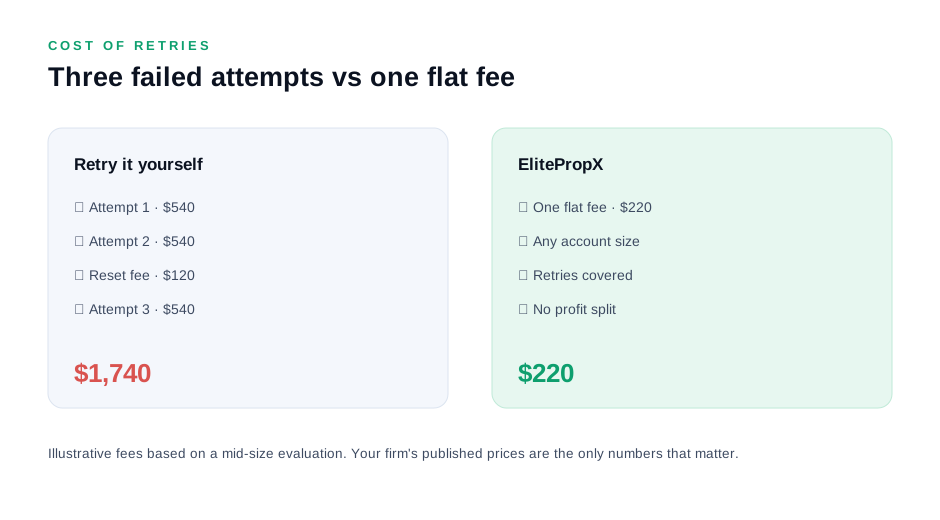
Three costs the fee does not remove are worth naming. Lucid's subscription continues while the account is open. A reset, where the firm offers one, is the client's cost. And the calendar is not shortened, because the daily stop applies to a service pass exactly as it applies to anyone else.
A worked Lucid pass, week by week
An illustration on a $100,000 account with a $3,000 trailing threshold, a $6,000 target, a $375 opening unit and an illustrative $2,000 daily stop. The unit is recalculated every Monday from the distance between balance and floor.
Week one — the floor is wide. Five sessions at $375 risk, a 12-tick stop on MES, and a session that closes at 80% of the daily budget. Two green days, two small red days and one flat day leave the account around $101,200. The floor has climbed to $98,200, so the room from the start is $1,200 while the room from the peak is unchanged.
Week two — the unit starts to fall. With the buffer to the floor still $3,000 but only $1,200 of it above the starting balance, the plan keeps the unit at $375 because the risk is measured from the floor rather than from the start. Three green sessions and one red take the balance to roughly $103,000 — the point at which the floor reaches the original balance.
Week three — the compression week. Every session now starts with a floor above the amount the account began with, so a red week hands back profit rather than the firm's money. The unit drops to $250 and the target for the week is halved. Two green sessions and two flat ones leave the balance near $104,500 with no day anywhere near the daily stop.
\nWeek four — the finish, small. The remaining target is taken in three sessions at a $200 unit, with a fourth session used to satisfy nothing at all because there is no minimum day count. The best day across the attempt is a small fraction of the total, so a consistency share at payout would clear without adjustment.
| Week | Balance at start | Floor | Unit | Work |
|---|---|---|---|---|
| One | $100,000 | $97,000 | $375 | Five sessions, two green, two red |
| Two | $101,200 | $98,200 | $375 | Four sessions, target on pace |
| Three | $103,000 | $100,000 | $250 | Compression week, unit cut, pace halved |
| Four | $104,500 | $101,500 | $200 | Three sessions to the target |
The features worth noticing are the falling unit, the absence of a large day, and the deliberate refusal to trade the last session for its own sake. A trader who held $375 through week four would have risked the same dollars against a floor that had risen $4,500, which is the precise mechanism by which a near-pass becomes a breach. The Lucid challenge guide works the trailing arithmetic in more detail, and the consistency guide covers the payout-side ratio.
What a failed attempt costs
A failure is not the service fee — that is already spent and covers the retry. What a failure costs is the firm's charge to start again, plus the calendar the restart consumes, and on a trailing floor the second cost is larger than it looks because the restart begins with the widest buffer the account will ever have.
The subscription is not returned. Lucid bills monthly, so an attempt lost in week five has already cost more than a month's subscription, and a reset or a fresh account is charged on top. The calendar restarts from zero because the floor does too.
The second attempt is not the same attempt. It begins at $100,000 with a $3,000 buffer, which is the easiest the account will be, and it will compress in exactly the same place. A trader who fails in week four of the first attempt has demonstrated the failure mode and not corrected it, which is why the retry runs a smaller unit and a slower pace rather than the same plan again.
| What ends the attempt | How it happens | What the restart costs |
|---|---|---|
| Trailing floor | The floor reaches the balance and a normal losing sequence follows | Subscription period, a reset or new account, and the calendar from zero |
| Daily stop | Equity through the daily allowance, often on a position left to recover | The same, plus the day's loss |
| Conduct breach | News window, contract cap, holding rule | The same, and a funded account can be questioned later |
| Nothing — the pace is slow | Target not reached inside the subscription window | Calendar only; no breach, no reset |
Two things follow. The first is that the retry clause is worth more than the fee on a rulebook where a profitable attempt can still fail. The second is that the cheapest attempt is the one that finishes slowly and legitimately, because a fourth week of small sessions costs a week of subscription while a restart costs the subscription, the reset and the month.
Four ways a Lucid attempt ends
Holding the opening size to the target. The commonest failure and the most avoidable. The unit is right on day one and wrong by week four, and the trader who does not recalculate is running three losses of tolerance while believing they have eight.
Adding after a green day. A good session raises the floor, so the account's tolerance in dollars is unchanged while its room above the starting balance has fallen. Raising size on the back of a good day spends the only buffer the account has left.
Treating the daily stop as a target. A session that has spent 80% of its allowance is finished, not close to a limit to be pushed. The remaining fifth exists for slippage, and a day that uses it has converted a normal loss into a breach.
Trading a restricted window. A news rule or a holding restriction is enforced automatically, and the breach voids the attempt regardless of profit. The plan abandons a session rather than finishes a position when a window opens inside it.
After the pass: the funded account
The pass produces a funded account and a change of responsibility. The service covers the evaluation; the funded account is the client's and is governed by Lucid's payout conditions, which are usually stricter than the evaluation.
Three conditions carry over and three are new. Carried over: the trailing threshold or its funded-stage equivalent, the daily stop, and the conduct rules. New: a profit threshold before any withdrawal, a payout cadence, and — where the plan applies one — a consistency share that caps the largest winning day relative to the total.

Where a consistency share applies, it catches the trader who assumes the hard part is over. Required total profit equals the largest day divided by the permitted share, so one dominant session can multiply the requirement. The remedy is the same as during the evaluation: cap daily profit at a fraction of the threshold and the gate is satisfied by construction.
Four things to do in the first week after handover, in order. Change the password regardless of how access was provided. Confirm the account is in your name with your payment details and verification complete. Read the funded terms yourself rather than a summary. And write the funded plan — unit, daily stop, daily profit cap, payout target — before the first trade rather than after the first loss. The payout process guide covers the withdrawal sequence and the delays that block first requests.
Frequently asked about the Lucid Trading evaluation
Does the $220 fee change with account size?
No. The fee is flat for any Lucid program and any account size, because the work is the same process applied to different numbers. Size changes the payout ceiling and the firm's own subscription, not ours.
Can you pass a Lucid evaluation if the trailing floor is tight?
Yes, and the method is sizing rather than speed. Risk is set from the distance between balance and floor at the start of each session, so the contract count falls as the floor rises and the loss tolerance stays constant. A plan that holds its opening size is the plan that fails.
How long does a Lucid pass take?
Usually three to six weeks. There is no minimum day count, so the target and the daily stop set the calendar rather than the firm. A week that produces nothing pushes the finish out by a week, and sizing up to recover it endangers the floor exactly when the floor is closest.
Do you check the terms before I pay?
Yes, and it is free. Send the program name, the account size and any support reply you have, and we confirm in writing whether third-party trading is permitted on the evaluation and on the funded account. Silent terms are treated as prohibited unless the firm confirms otherwise in writing.
Who owns the funded account?
The client. The evaluation is purchased in the client's name with the client's payment method, identity verification is completed personally, and access is returned or removed at handover. Change the password after handover regardless of how access was given.
What happens if the evaluation fails?
You are told the day it happens, the failure is classified as a floor breach or a conduct breach, and the attempt is retried at no additional service fee while the evaluation is running. Lucid's own subscription and reset charges remain your cost.
Do you take a share of the payouts?
No. The funded account and its payouts belong to the client and no profit share is taken. A provider paid a percentage has a reason to keep trading an account after the pass, which is a conflict the flat fee removes.
Is the service cheaper than doing it myself?
On a first-attempt pass, no: it is $220 more and you give up the experience. From the second attempt it is cheaper, because the service absorbs retries while a self-traded retry means another subscription and another reset. On a trailing-floor rulebook, second attempts are common.
Which instruments do you trade on a Lucid account?
Index futures, sized from tick value: MES at $1.25 a tick, MNQ at $2 and MYM at $0.50. The instrument list is confirmed against the firm's permitted products during the terms check, because a restricted product is a conduct breach however well it trades.
What do you need from me to start?
The program name and account size for the terms check. If the check clears, you buy the evaluation in your own name, we agree the scope of access in writing, and the plan starts on the next session. Identity verification stays with you throughout.
Check your Lucid Trading terms first
Send the program and account size and we confirm in writing whether third-party trading is permitted — before you pay anything. If it is not, we say so in writing before you pay.
Related reading
- Passing a Lucid Trading challenge: the rulebook
- Apex Trader Funding evaluation
- Topstep Combine
- FundedNext evaluation
- How the flat-fee model works
- From funded account to first payout
- Recently passed evaluations
- Challenge calculator: target, risk and pace
Lucid Trading is named for identification only. ElitePropX is an independent evaluation service and is not affiliated with, endorsed by or sponsored by Lucid Trading or any other proprietary trading firm. The service is offered only where a firm's terms permit third-party trading. A funded account is not a guarantee of income, and trading involves substantial risk of loss. Verify current terms before purchasing an evaluation.