
Lucid Trading · firm profile · figures checked November 2026
Lucid Trading prop firm: the programs, the rules and the real cost
Lucid Trading is a futures-only proprietary trading firm that sells evaluations from $25,000 to $150,000 and runs five separate programs rather than one. That last detail is the one most traders get wrong: the rules that decide whether an account survives depend on which program the account was bought under, and two Lucid accounts of the same size can carry different drawdown types, different consistency caps and different payout gates. This page sets out what the firm actually sells, what each program measures, what an attempt costs once resets are counted, and which parts of the rulebook decide the outcome.
Every figure here is described as published when this page was checked in . Lucid revises parameters, and the plan page in your own dashboard is the only version that binds. If you want the trading plan rather than the rulebook, the Lucid challenge passing guide works through the attempt itself, and the Lucid evaluation service page covers what a flat-fee pass involves.
Key takeaways
- Lucid runs five programs — LucidPro, LucidFlex, LucidDaily, LucidDirect and LucidMaxx — and the rulebook differs between them at the same account size.
- Account sizes are $25K, $50K, $100K and $150K. Profit targets run from $1,250 to $9,000 and maximum loss from $1,000 to $4,500 depending on size.
- Drawdown is either end-of-day trailing or intraday trailing. The intraday version stops trailing once the account is $100 above its starting balance, which changes how the last week of an attempt is traded.
- The daily loss limit is soft where it applies: hitting it pauses trading for the day rather than closing the account.
- Consistency is three different numbers in three places: up to 50% on an evaluation, 40% on LucidPro funded accounts, 20% on LucidDirect, and none at all once an account goes live.
- Payouts are 90/10 in the trader's favour, with a $500 minimum, a profit goal that resets each cycle, and a cap on how much of the profit can be withdrawn at once.
Contents
- What Lucid Trading actually is
- The five programs, and why they are not interchangeable
- What an evaluation costs, including the resets
- The drawdown mechanic: end-of-day versus intraday
- The daily loss limit and what "soft" means
- Consistency: three different percentages
- The payout gate, in full
- The live transition after five payouts
- Who Lucid fits, and who it wastes money on
- How a Lucid pass is planned
- How Lucid compares with Apex, Topstep and FundedNext
- Verifying the terms before you pay
- Frequently asked questions
What Lucid Trading actually is
Lucid Trading is a proprietary trading firm in the futures segment. Traders buy an evaluation, trade a simulated account against a set of rules, and on reaching the target are moved to a funded simulated account that pays a share of the profit. The firm also runs a live-account stage for traders who reach a payout threshold, and that stage has its own, much simpler rulebook.
The product is built around index futures rather than forex pairs. That single choice shapes everything downstream: risk is measured in ticks and dollars per contract rather than in lots and pip values, position caps are expressed as so many minis or micros, and the permitted platforms are the ones futures traders already use — Tradovate, TradingView and NinjaTrader among them. A trader arriving from a CFD prop firm will find the arithmetic simpler and the position limits much more concrete.
Lucid's commercial model is a one-time evaluation fee plus a reset fee where an attempt is lost, rather than the monthly subscription model several futures firms use. That matters more than it looks. On a subscription, the cost of a slow attempt rises with the calendar; on a one-time fee, the cost of a failed attempt rises with the number of attempts. A trader who expects to fail once should price the reset, and a trader who expects to take six weeks should price nothing extra at all.
The firm is not a broker and does not custody client money. Evaluations are simulated, the funded stage is simulated until the live promotion, and payouts are made by the firm from its own revenue. That is the standard structure across the industry, and it is worth stating plainly because the marketing language around "funded" accounts often implies otherwise.
Where Lucid differs from its closest competitors is breadth. Apex and Topstep each sell a narrower ladder of products; Lucid sells five programs that overlap in price but not in rules. Two accounts at $50,000 can have different drawdown mechanics depending on whether they were bought as LucidPro, LucidFlex or LucidDaily. Comparing on the headline account size alone is therefore a mistake, and it is the mistake this page exists to prevent.
The five programs, and why they are not interchangeable
Lucid's programs fall into three groups: evaluations that lead to a funded account (LucidPro, LucidFlex, LucidDaily), a straight-to-funded product with no evaluation at all (LucidDirect), and an expanded or promotional structure (LucidMaxx). Each carries a different drawdown style, and some carry an optional consistency add-on at checkout.
| Program | Stage | Drawdown style | Consistency | Best fit |
|---|---|---|---|---|
| LucidPro | Evaluation, then funded | Trailing, end-of-day | 40% at payout when funded | Traders who want the standard ladder and a clean payout path |
| LucidFlex | Evaluation, then funded | Trailing | 40% to pass (50% as a paid add-on) | Traders who want a looser evaluation consistency test |
| LucidDaily | Evaluation, then funded | End-of-day or intraday, chosen at purchase | 50% standard, 40% on some configurations | Traders with a view on intraday versus close-of-day risk |
| LucidDirect | Straight to funded | End-of-day | 20% per payout cycle | Traders who will pay more to skip the evaluation |
| LucidMaxx | Expanded structure | Per plan | Per plan | Traders buying size rather than a first account |
The table is a map, not a specification. The parameters that actually decide an attempt — the exact drawdown style at your size, whether a daily loss limit applies, and which consistency figure is attached — vary within a program by account size and by the options selected at checkout. Lucid sells 32 distinct plans across the five programs for that reason. The only reliable method is to read the plan you are about to buy, not the program's marketing page.
The practical consequence is that "Lucid rules" is not a single answer. A trader comparing a LucidDirect account's 20% consistency cap against a LucidPro evaluation's 40% evaluation test is comparing a payout condition against a pass condition, which are different hurdles at different points in the process. The first limits how much you can withdraw in a cycle; the second limits how the profit can be distributed before the account is upgraded.
A second consequence is pricing confusion. Because five programs overlap at the same sizes, an evaluation can look expensive next to a straight-to-funded product at the same headline price, when in reality one includes an extra stage with its own failure risk and the other front-loads the cost. The right comparison is cost per funded account actually reached, which is a function of pass rate and reset price, not of the sticker price on the plan page.
What an evaluation costs, including the resets
Published evaluation prices run from roughly $89 at the smallest size to about $410 at $150,000, depending on program and options. Reset fees, where a lost attempt can be restarted, run from about $50 to $250 by size and program. Both figures are before promotions, and Lucid runs promotions often enough that the list price is rarely what a trader pays.
| Cost line | Published range | When it applies |
|---|---|---|
| Evaluation fee | $89 – $410 | Once, at purchase, by size and program |
| Reset fee | $50 – $250 | After a lost attempt, where a reset is offered |
| Activation fee | Program-dependent | On moving to the funded stage, where charged |
| Consistency add-on | Optional, extra | Only where a looser evaluation cap is bought at checkout |
| Monthly subscription | Not the model | Lucid prices evaluations one-time rather than monthly |
The number that matters is not the evaluation fee. It is the evaluation fee multiplied by the expected number of attempts, plus the reset fees for the attempts that fail. A $150 evaluation that takes three attempts plus two resets at $100 costs $650, not $150. A $300 evaluation that passes first time costs $300. Firms compete on the first number because it is visible at checkout, and traders compare on it because it is easy, but the second number is the one that leaves the bank account.
Two structural features push Lucid's expected cost in opposite directions. The trailing drawdown raises the chance of a second attempt, because a profitable account can breach; the one-time fee model removes the calendar penalty that subscriptions impose, so a slow but disciplined attempt costs nothing extra. A trader who plans to take six weeks is better served here than on a monthly-billed firm, and a trader who expects to fail twice is worse served than they would be on a firm with cheap resets.
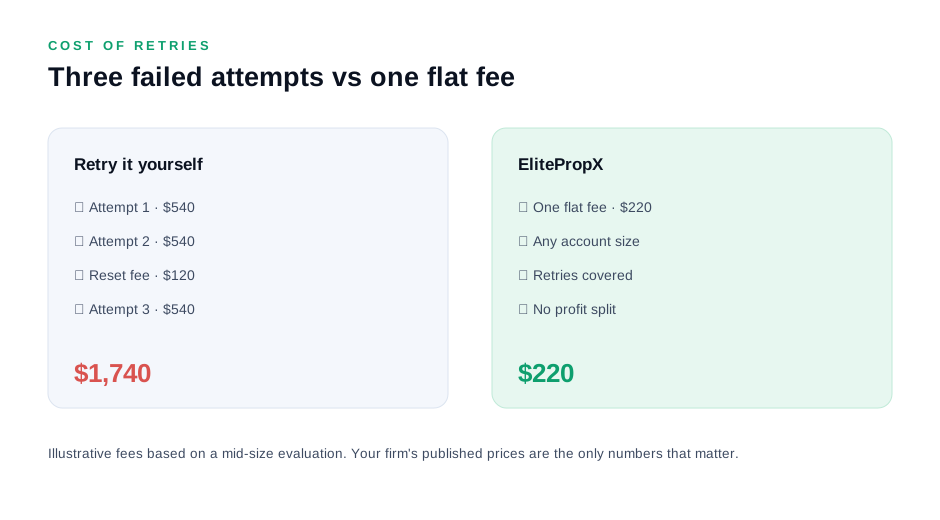
There is also a cost that never appears on a plan page: the value of the time. A 150K evaluation that takes four weeks and three attempts consumes three months of a trader's attention. If the same trader could have passed a 50K account in a fortnight, the larger account may still be the worse purchase, because the funded payout on a smaller account arrives sooner and the profit split is a percentage rather than a fixed prize.
The drawdown mechanic: end-of-day versus intraday
Drawdown is the rule that ends most attempts at every futures firm, and Lucid sells two versions of it. The end-of-day version measures the maximum loss limit against the closing balance, so an intraday excursion that recovers before the close does not move the floor. The intraday version measures it continuously, so the worst moment of the day counts even if the session finishes green.
The intraday version carries a detail that changes the arithmetic more than the headline suggests: the maximum loss limit stops trailing once the account is $100 above its starting balance. A trader on a $50,000 account therefore has a fixed floor at $50,100 once that level is reached, rather than a floor that follows every new peak. That is materially more forgiving at the end of an attempt than an unlimited trail, and it is the single most important line in the LucidDaily rulebook.
| Account | Profit target | Maximum loss | Position cap (minis / micros) |
|---|---|---|---|
| $25,000 | $1,250 | $1,000 | 2 / 20 |
| $50,000 | $2,500 – $3,000 | $2,000 | 4 / 40 |
| $100,000 | $6,000 | $3,000 | 6 / 60 |
| $150,000 | $9,000 | $4,500 | 10 / 100 |
The ranges in the second column are not sloppiness: target figures differ between the evaluation programs and the straight-to-funded product at the same size, and they have changed more than once. The maximum loss column is the more stable figure and the one to plan from, because it defines the risk budget rather than the finish line.
Read the ratio between the two columns and the firm's design intent becomes visible. At $25,000 the target is $1,250 against $1,000 of maximum loss: a trader has to make 1.25 times the risk budget to pass. At $150,000 the target is $9,000 against $4,500, so the requirement is twice the risk budget. Larger accounts are therefore not simply scaled copies of smaller ones; they ask for more in proportion, which is why pass difficulty is not constant across the ladder.
Position caps complete the picture. Ten minis on a $150,000 account is a modest position; ten minis on a $25,000 account would be an account-ending position, which is why the small size is capped at two. The caps are not advice, they are ceilings, and a plan that sizes to the cap on every trade is running the maximum risk the firm allows rather than the risk its own buffer supports.
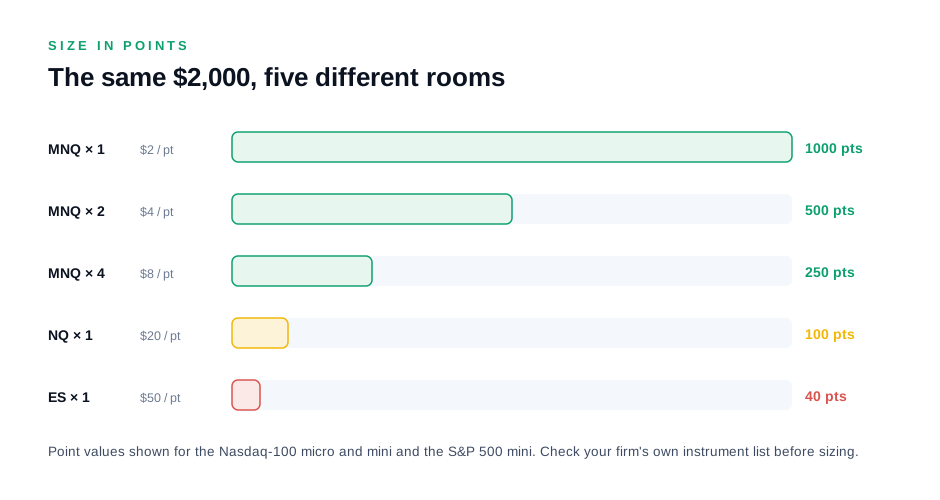
The planning rule that follows is the same on both drawdown styles and is not obvious to most traders: size from the distance between balance and floor, not from the account size. On an end-of-day trail that distance stays at the full maximum loss until the account is up by that amount, which is why the first two weeks feel generous. On an intraday trail it can compress within a single session, which is why a plan that recalculates only weekly is a plan that is wrong by Wednesday.
The daily loss limit and what "soft" means
Most Lucid plans carry a daily loss limit, and it is a soft limit: reaching it pauses trading for the remainder of the day rather than closing the account. Published limits run from about $600 at $25,000 to $2,700 at $150,000, and a handful of plans are sold without one, usually as the more expensive configuration of the same size.
The distinction between soft and hard matters because it changes the failure mode rather than the rule. A hard limit ends the account; a soft limit ends the day. A trader who hits a soft limit has lost the session and can trade again tomorrow, which means the limit is a scheduling constraint rather than an existential one. That is a real advantage over firms where a bad morning is fatal, and it is frequently overlooked when traders compare headline maximum loss figures.
What the soft limit does not do is protect the account from the trader's own sizing. A session that halves the daily budget and then doubles position size to recover it has converted a scheduling constraint into a drawdown problem, and the maximum loss limit is still there underneath. The daily limit decides how the day ends; the maximum loss decides whether there is another day.
The measurement basis is equity, not realised profit, which means floating losses count the moment they exist. A position $1,200 underwater has consumed $1,200 of a $2,700 allowance even if it recovers before the close, and a trader waiting for a position to come back is watching the day's budget drain rather than waiting for a signal. On an intraday-drawdown plan the same floating loss is also consuming the maximum loss limit, so the two rules bite together.
Practical consequence: the session budget is set from the daily limit before the first trade, not from the target, and the day closes at a fraction of the budget rather than at the limit itself. Leaving a reserve means the last trade of the session cannot turn an ordinary losing day into a paused day, and it means the sizing formula never has to be improvised under pressure.
Consistency: three different percentages
Lucid's consistency rules are the most misquoted part of the firm, because there are three separate figures operating at three separate stages. They are frequently collapsed into one number in comparison tables, which produces bad decisions.
| Stage | Consistency figure | What it gates | Resets? |
|---|---|---|---|
| LucidPro evaluation | 40% (some configurations 50%) | Whether the evaluation is considered passed cleanly | Continue trading until the ratio falls |
| LucidFlex evaluation | 40% standard, 50% as a paid add-on | The upgrade to funded | Continue trading until the ratio falls |
| LucidPro funded | 40% | Whether a payout can be requested | Yes, each payout cycle |
| LucidDirect funded | 20% | Whether a payout can be requested | Yes, each payout cycle |
| Live account | None | Nothing | Not applicable |
The formula is the standard one: the largest single day's profit divided by the account's total profit over the cycle must not exceed the cap. If a trader makes $4,000 in total and $1,000 of it came on one day, the ratio is 25%, which clears a 40% cap and fails a 20% cap. The ratio is dimensionless, so it does not depend on account size — a $25,000 account and a $150,000 account are judged on the same proportion.
The 20% cap on LucidDirect is the strictest number in the firm's rulebook and the one that catches traders who buy straight to funded. A single dominant session that produces half the cycle's profit will block a payout until further trading dilutes it. The remedy is arithmetic rather than discipline: cap the daily profit at a fixed fraction of the cycle goal, and the ratio is satisfied by construction rather than corrected afterwards.
Two nuances are worth carrying into a plan. First, going over an evaluation cap does not fail the attempt at Lucid — the trader keeps trading until the largest day is small enough relative to the total, which means the cost of an oversized day is a delay rather than a loss. Second, the funded caps reset after every approved payout, so a comfortable ratio in one cycle says nothing about the next. A trader who withdraws and then has one enormous day has re-created the problem from zero.
The live stage removes consistency entirely, which creates an odd incentive: the constraint that shapes the whole funded stage disappears at exactly the point where the trader has proved they can meet it. That is deliberate. Consistency exists to make simulated results look like a repeatable process before the firm takes on live risk; once it has, the risk is real and the rule is redundant.
The payout gate, in full
A payout at Lucid is not a withdrawal from a balance; it is a request that has to clear a set of conditions, and the conditions are more specific than most traders expect. Across the funded programs the pattern is: a profit goal that resets each cycle, a consistency test, a minimum number of trading days, a minimum request size, a maximum request size expressed as a share of profit, and a flat-by time at the end of each session.
| Payout term | Published position |
|---|---|
| Profit split | 90% trader, 10% Lucid |
| Minimum request | $500 |
| Profit goal, first cycle (Direct) | $1,500 / $3,000 / $6,000 / $9,000 by size |
| Profit goal, later cycles (Direct) | $1,250 / $2,500 / $3,500 / $4,500 by size |
| Maximum request | Up to 50% of profit, capped by size |
| Minimum trading days | 5 before a payout on Direct |
| Session close | All positions flat by 4:45 PM ET |
| Disbursement | Within about two business days of approval |
The maximum request is the term that surprises people. A trader who clears a $6,000 profit goal on a $100,000 account cannot necessarily withdraw $6,000: the request is limited to a share of profit and capped by account size, so the first payout is often smaller than the goal that unlocked it. The remaining profit stays in the account and counts toward the next cycle, which is why the second cycle's goal is lower than the first.
The five-day minimum is a floor rather than a target. It means an account that reaches its profit goal in two large sessions still waits before requesting, and those extra days are the point: the firm is buying evidence that the result was not a single event. For a trader planning an attempt, the minimum day count belongs in the schedule from the start, because a plan that ignores it finishes trading with days still to run.
The flat-by time is the rule most likely to cost money without any trading error at all. Positions held past 4:45 PM ET are a breach regardless of whether they would have been profitable, and a breach can void a payout request that was otherwise clean. The same applies to the news rule on funded accounts, where positions must be flat for a short window around high-impact USD releases. Both rules are mechanical, both are enforced automatically, and both are ignored by traders who read the profit target and stop there.
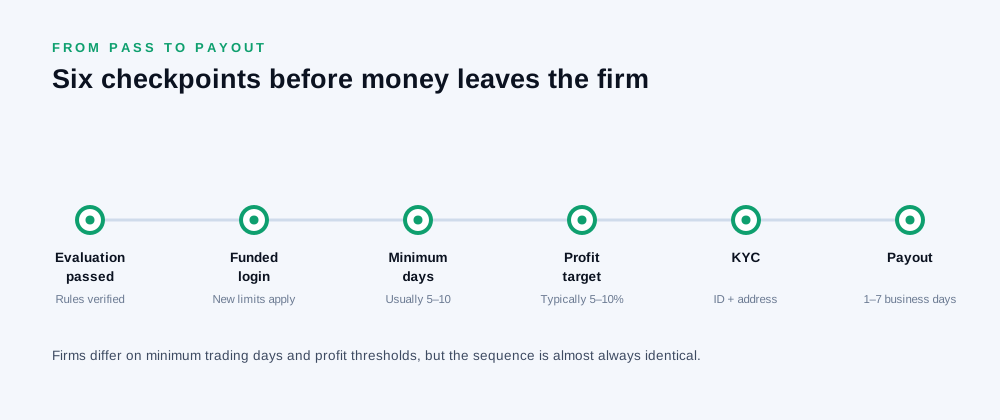
One more condition deserves naming because it is easy to trip while waiting: taking a trade that drops the account below the profit goal after the request is submitted can cause the request to be denied. A trader who reaches the goal and then keeps trading is gambling the payout on a session that adds nothing to the cycle. The disciplined version is to stop trading once the request is in.
The live transition after five payouts
Lucid's funded accounts are simulated, and the firm promotes traders to a live account once an account has received five payouts. The live structure is deliberately simpler than the funded one: the account starts at a zero balance, payouts are available daily, drawdown is measured end-of-day, and there is no daily loss limit and no consistency requirement.
What replaces those rules is a hard drawdown tied to account size, and a contract cap expressed in both minis and micros. The published ladder runs from a $1,000 live drawdown with a cap of 2 minis or 20 micros at $25,000, up to $4,500 with 10 minis or 100 micros at $150,000. Volatile contracts can carry reduced sizing, which is the firm's way of keeping a single instrument from blowing through the live drawdown.
The economics of the live stage are different in kind rather than degree. A simulated funded account pays from the firm's revenue against a profit split; a live account pays from actual market profit, and the firm's exposure is real. That is why the drawdown is fixed rather than trailing and why the contract caps are stricter in proportion: the firm is no longer modelling risk, it is carrying it.
For a trader, the practical implications are three. The consistency discipline learned during the funded stage stops being a rule and becomes a choice, which is exactly when it tends to disappear. The daily payout cadence changes the value of a good day, because profit can leave the account immediately instead of accumulating against a cycle goal. And the drawdown, being fixed, can be planned against with far more confidence than any trailing version, since the floor does not move when the account profits.
Who Lucid fits, and who it wastes money on
Lucid fits traders who trade index futures on a modern platform stack, who prefer a one-time fee to a subscription, and who are willing to read which program they are buying rather than assume the rules are uniform. The intraday-drawdown plans in particular suit traders whose risk is concentrated early in the session, because the floor stops trailing at a known point rather than following every new high.
It fits less well in three cases. A trader who needs a monthly subscription to make the arithmetic work will find the one-time fee front-loaded. A trader who wants identical rules across every account will find five programs confusing and will probably buy the wrong one. And a trader whose strategy produces one or two very large days will struggle with a 20% consistency cap on the straight-to-funded product, because the payout gate is designed to penalise exactly that shape of result.
The size decision is where most money is wasted. A $150,000 evaluation has a $9,000 target and a $4,500 buffer, and the ratio between them is harsher than at $25,000. Traders routinely buy the largest account they can afford, fail it twice, and spend more than a $50,000 account would have cost with a realistic chance of reaching a payout. The correct question is not "which size can I afford" but "which size can I pass without changing how I trade".
There is also a category of trader for whom no prop firm is the right purchase: someone who has not yet traded a sim account profitably for a sustained period. An evaluation is a test of an existing process, not a place to develop one. Passing a Lucid account requires a plan that already works and a risk framework that survives a trailing floor — both of which are cheaper to build on a demo than on a paid evaluation.
How a Lucid pass is planned
A Lucid attempt is planned backwards from the floor rather than forwards from the target. The floor sets the dollar risk per trade; the target sets the minimum pace; the daily limit sets the session; the consistency cap sets the daily profit ceiling; and the conduct rules — flat by 4:45 PM ET, news windows, permitted contracts — set the walls that cannot be crossed at any price.
The sizing step is mechanical. Take the distance between the current balance and the maximum loss floor, divide it by the number of consecutive losses the plan is willing to absorb, and that is the dollar risk per trade. Convert it to contracts using tick value and stop distance: a 12-tick stop is $15 per contract on MES, $24 on MNQ and $6 on MYM. Then cap the result at the firm's position limit, because the cap exists precisely for the case where the formula produces a number larger than a sane trader would choose.
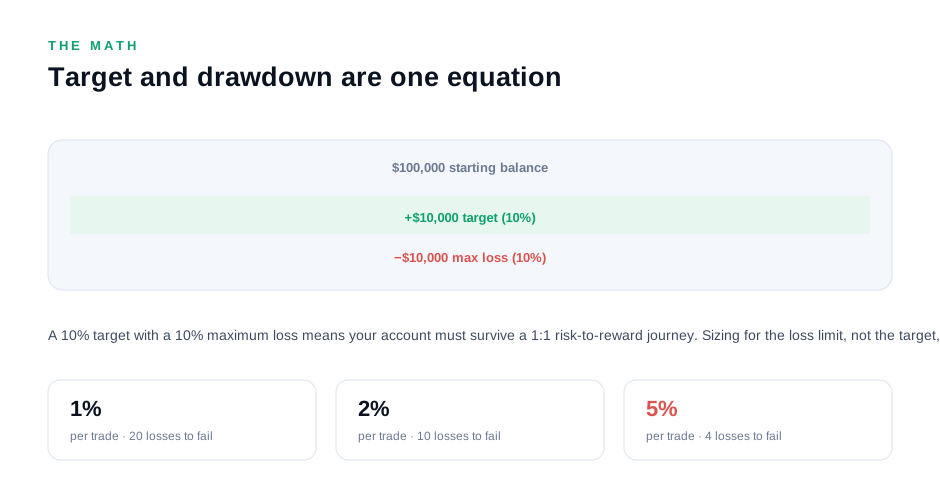
The tricky part is that the unit has to fall as the account progresses, because the floor follows the peak. A plan that keeps its opening size into the final week is running a fraction of the loss tolerance it had at the start, and that is the most common way a nearly-passed Lucid account dies. Recalculating weekly is the minimum; recalculating before each session is better on the intraday-drawdown plans, where the floor can move inside a day.
Pacing is chosen, not dictated. With no monthly subscription there is no calendar penalty for taking an extra week, so the plan can optimise purely for survival. That is an unusual luxury in this industry and it should be used: a six-week attempt at a constant unit is a better expected outcome than a three-week attempt that doubles size in week two to hit a self-imposed deadline.
Where a trader would rather not run the attempt personally, the Lucid evaluation service page sets out the flat-fee model, the terms check that happens before payment, and what the funded handover looks like. The rules that apply are the same ones described on this page; what changes is who is at the keyboard. The challenge passing guide covers the week-by-week version for anyone trading it themselves, and the challenge calculator turns a target and a buffer into a pace.
How Lucid compares with Apex, Topstep and FundedNext
The three firms Lucid is most often weighed against are Apex Trader Funding, Topstep and FundedNext, and the comparison is rarely about headline price. It is about which rule is most likely to end your attempt, and that answer differs by firm and by program within each firm.
Against Apex Trader Funding, the difference is the drawdown mechanic and the reset economics. Apex is known for a trailing threshold with a defined lock point and for frequent discounting, and its evaluation ladder is narrower. Lucid's five-program structure gives more choice at the same size, at the cost of more reading. A trader who wants one obvious product should prefer Apex; a trader who wants to choose between end-of-day and intraday risk should prefer Lucid.
Against Topstep, the difference is the product shape. Topstep's Combine is a monthly subscription with a well-documented consistency target and a defined maximum loss, and it is built for traders who want a single familiar format. Lucid's one-time fee and multiple programs appeal to traders who dislike recurring cost or who want a payout structure with an explicit profit goal per cycle. The rules matrix puts the thresholds side by side.
Against FundedNext, the difference is the asset class. FundedNext is primarily a CFD firm with a mature evaluation structure; Lucid is futures-only. The comparison only makes sense for a trader who is genuinely indifferent between index futures and FX, which is rarer than the marketing implies — the two require different sizing arithmetic and different session discipline. A trader who has only traded FX should not buy a futures evaluation to compare the two.
Across all three, the useful comparison is not the profit target or the split. It is the interaction between maximum loss, the daily limit and the consistency cap, because those three decide whether a good month converts into money. A firm with a generous target and a tight consistency cap is harder to extract from than a firm with a smaller target and no cap at all, and the firms without a consistency rule are worth reading about for exactly that reason.
Verifying the terms before you pay
Every figure on this page is a description of published terms at a point in time, not a contract. Lucid revises parameters, adds programs and changes consistency defaults; the plan page in the dashboard after checkout is the version that binds. Ten minutes of verification is worth more than any comparison table, including this one.
- Read the plan you are buying, not the program page. The rules differ by size and by options selected at checkout, including whether a daily loss limit exists.
- Confirm the drawdown style. End-of-day and intraday are different products with the same name on some plans, and the intraday version's trailing behaviour at the lock point decides how the last week is traded.
- Confirm the consistency figure attached to your stage. An evaluation cap and a payout cap are different hurdles, and a 20% payout cap is a much tighter constraint than a 40% evaluation test.
- Confirm the payout mechanics. Profit goal, minimum days, minimum request, maximum request as a share of profit, and the flat-by time. These decide what a pass is actually worth.
- Confirm whether third-party trading is permitted if you intend to use a service, on the evaluation and separately on the funded account. Silent terms should be treated as prohibition until the firm says otherwise in writing.
If a firm's answer to any of these is unclear, the right move is to ask before buying rather than to assume the favourable reading. A payout denied on a technicality costs the whole evaluation, and the technicalities are published — they are just not on the sales page.
For anyone comparing the whole market rather than this firm, the 2026 prop firm comparison and the futures firm rankings cover the alternatives, and recently passed evaluations show what has actually been completed. The methodology page explains how rules are checked and what happens when a figure cannot be confirmed.
Frequently asked about Lucid Trading
Is Lucid Trading a prop firm or a broker?
It is a proprietary trading firm. Traders buy evaluations on simulated accounts, and profitable funded accounts pay a 90/10 split. The firm promotes funded traders to a live account after five payouts. It is not a broker and does not custody client funds.
How many programs does Lucid Trading run?
Five: LucidPro, LucidFlex, LucidDaily, LucidDirect and LucidMaxx. They overlap at the same account sizes but carry different drawdown styles, consistency figures and payout conditions, which is why the plan matters more than the program name.
What account sizes are available?
$25,000, $50,000, $100,000 and $150,000. Profit targets run from $1,250 to $9,000 and maximum loss from $1,000 to $4,500 depending on size and program.
Does Lucid Trading use a trailing drawdown?
Yes on the trailing configurations, in either end-of-day or intraday form. The intraday version stops trailing once the account is $100 above its starting balance, which fixes the floor for the remainder of the attempt. Always confirm which style your specific plan uses.
What is the consistency rule at Lucid Trading?
Three different figures apply at different stages: up to 50% on evaluations, 40% on LucidPro funded accounts, and 20% on LucidDirect payout cycles. Live accounts have no consistency requirement. The ratio is largest single-day profit divided by total profit for the cycle.
How much does a Lucid evaluation cost?
Published evaluation fees run from about $89 at the smallest size to about $410 at $150,000, before promotions. Resets, where offered, run from roughly $50 to $250. The figure that matters is the fee multiplied by the expected number of attempts.
How much can I withdraw at once?
Requests are subject to a minimum of $500 and a maximum expressed as a share of profit and capped by account size, so the first payout can be smaller than the profit goal that unlocked it. The remainder stays in the account and counts toward the next cycle.
Do I have to trade every day to get paid?
No, but a minimum number of trading days applies before a payout on the straight-to-funded product — five at the time of writing — so an account that reaches its goal in two sessions still waits. The minimum belongs in the schedule from the start.
Can someone else trade my Lucid account?
That depends on the firm's current terms for the specific program, and the answer can differ between the evaluation and the funded account. It should be confirmed in writing before any service is bought; silent terms should be treated as prohibition.
What happens after five payouts?
The account is eligible for the live stage: a zero starting balance, daily payouts, end-of-day drawdown, no daily loss limit and no consistency requirement, with contract caps scaled to account size. The drawdown becomes fixed rather than trailing, which makes it far easier to plan against.
Check your Lucid Trading terms first
Send the program and account size and we confirm in writing whether third-party trading is permitted — before you pay anything. If the terms say no, we say no.
Related reading
- Passing a Lucid Trading challenge: the rulebook and the math
- Lucid Trading evaluation passed for a flat $220
- Prop firms without a consistency rule
- How the consistency rule is calculated
- News trading rules across the major firms
- From funded account to first payout
- What happens after you pass
- How to vet a passing service
- Rules matrix: thresholds side by side
- What clients report
Lucid Trading is named for identification only. ElitePropX is an independent evaluation service and is not affiliated with, endorsed by or sponsored by Lucid Trading or any other proprietary trading firm. Figures are described as published in November 2026 and firms revise terms without notice, so confirm the parameters of the plan you are buying. The service is offered only where a firm's terms permit third-party trading. A funded account is not a guarantee of income, and trading involves substantial risk of loss.