
Account compliance · reviewed November 2026
KYC, the gate that arrives after the pass
Identity verification is the only prop firm rule that is not about trading. It does not care how good the equity curve is. It can arrive before your first trade, the moment you pass, or six weeks later when you request money — and the stage it arrives at decides whether a problem costs you an afternoon or an entire funded account. This page sets out what the check actually verifies, the six ways it fails, what a failure costs at each stage, and the order of operations that keeps a document problem away from your payout.
Key takeaways
- KYC is a firm requirement, not a trading rule, and it is enforced by the firm's compliance process rather than its risk engine.
- Timing varies: some firms verify at signup, some when the objectives are met, some only when money is requested. The later the check, the more it can cost.
- Most failures are name mismatches — a middle name, a maiden name, a transliteration, or a payment method held by someone else.
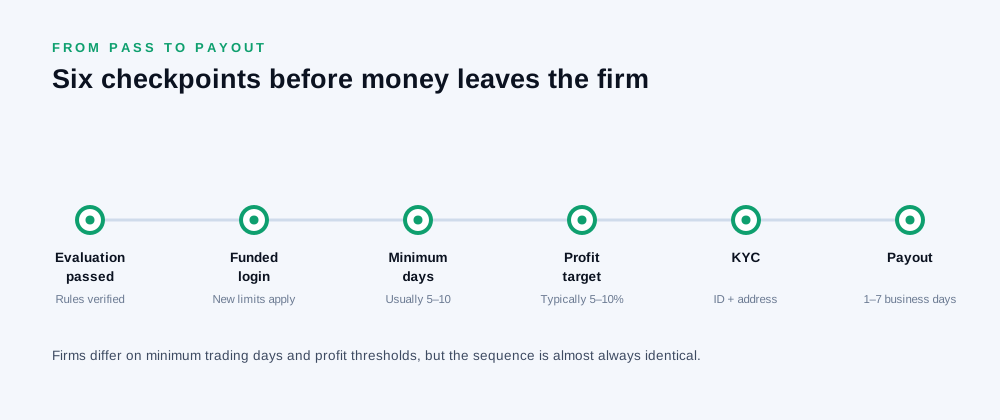
- A passed evaluation is not a paid account. KYC sits between the certificate and the transfer.
- Never send identity documents to a third-party passing service. Verification belongs on the firm's own platform, in your name.
- If a check fails, ask in writing for the specific requirement that was not met, then resubmit against that requirement rather than guessing.
Contents
- What KYC actually verifies
- The three points a firm can check
- What a failure costs at each stage
- The document set, and what it is proving
- The name-match rule, worked
- Why the payment method matters so much
- Address documents and the three-month clock
- Liveness checks and photo failures
- Country, residency and sanctions screens
- The passing-service problem
- Refunds when verification fails
- What to do when a check is rejected
- Prevention: the order of operations
- Common questions
What KYC actually verifies
KYC — know your customer — is the compliance process a firm runs to establish that the person holding the account is a real, identifiable individual, that the identity matches the payment rails, and that the person is not excluded by sanctions or jurisdiction rules. It exists because a prop firm ultimately moves money to a named human being. Every gate in the process is a question about that transfer, not about your trading.
Four separate questions are being answered, and they fail independently. The first is identity: is this document genuine, current and issued to the person claiming it? The second is address: does the person have a verifiable residential footprint, and is it recent? The third is payment provenance: was the account funded from a method the verified person controls? The fourth is eligibility: is the person resident in, or a citizen of, a country the firm can legally serve?
Understanding that the check has four independent parts changes how you prepare. A trader who believes KYC means "send a passport" prepares one document and gets rejected on an address bill from eight months ago. A trader who understands the four questions prepares a package, submits it once, and clears in a couple of days. The failure modes later in this page map onto those four questions, which is why the fix for most rejections is not a better photograph but a different document.
Two features of the process are worth stating early because they cause most of the frustration. It is not scored, and it is not negotiable in the way a trading rule is. There is no partial pass and no appeal to the risk desk. A compliance analyst either accepts the evidence or asks for something else, and the timeline runs on their queue rather than on your calendar. Treat it as a bureaucratic process that you can prepare for, not as a judgment you can argue with.
The three points a firm can check
Firms place the check at one of three moments, and the choice is a product decision as much as a compliance one. Checking early costs the firm conversions — nobody enjoys uploading a passport before they have traded. Checking late costs the trader, because by then the evaluation has been paid for and passed. The three placements produce very different risk profiles.
At signup, before the first trade. The strictest placement, and the kindest to the trader. A problem surfaces while the account is still new, before any fee has been spent on trading and before any emotional investment exists. Some firms run full verification at purchase; others run a lighter identity check at purchase and a fuller one later. If your firm does this, treat it as a gift and complete it immediately.
On passing, before the funded account is issued. The most common placement. The evaluation is complete, the certificate is issued or pending, and the firm now needs a verified person before it will open a funded account in that name. A failure here costs the evaluation fee and the passing result, and it typically happens after weeks of trading. This is the stage where traders discover that the name on their account does not exactly match their ID.
At the first payout request. The latest placement, and the one that produces the angriest emails. The trader has passed, traded the funded account, met the profit threshold and the day count, and then meets a document requirement at the moment money is requested. The account usually survives — the payout does not move until the requirement is met — but the delay can run from days to several weeks, and at some firms a failed check at this stage ends the relationship rather than delaying it.
The practical lesson is to find out which placement your firm uses before buying, not after. It is stated in the onboarding flow and usually in the help centre, and the firm rulebook pages collect what each one publishes. If it is not stated anywhere, that is itself information about how the process is run, and it is worth asking support in writing so the answer can be kept.
What a failure costs at each stage
The same rejected document produces three completely different outcomes depending on when it is rejected. The table below uses an illustrative $100,000 two-step plan at a $540 fee — the arithmetic matters more than the exact number, which differs by firm and by the promotions running at the time.
| Check placement | What has been spent by then | What a failure typically costs | Recoverable? |
|---|---|---|---|
| At signup | The fee only, no trading time | Nothing but a delay; the account is not yet in play | Usually yes — fix and resubmit |
| On passing | Fee plus weeks of trading; the pass is complete | The funded account is withheld, and at some firms the pass is voided | Sometimes, at the firm's discretion |
| At first payout | Fee, pass, funded trading, a qualified payout | The payment stops; the account may be frozen pending review | Usually the payment, rarely the time |
The columns that matter are the last two. A failure at signup is a delay. A failure on passing is a delay with the fee at risk. A failure at payout is a delay with the fee already spent, the funded phase already traded and the profit already earned on paper — the worst combination, because the sunk cost is highest and the leverage is lowest.
There is a second cost that does not appear in the table: the evidence problem. Once a firm has flagged an identity question, every subsequent request is read in that context. A trader who clears the check cleanly on the first submission never has to think about it again. A trader who has been flagged once should expect their next payout request to be reviewed manually, which adds days to every cycle. That asymmetry is the reason this page argues for submitting early and completely rather than at the last possible moment.
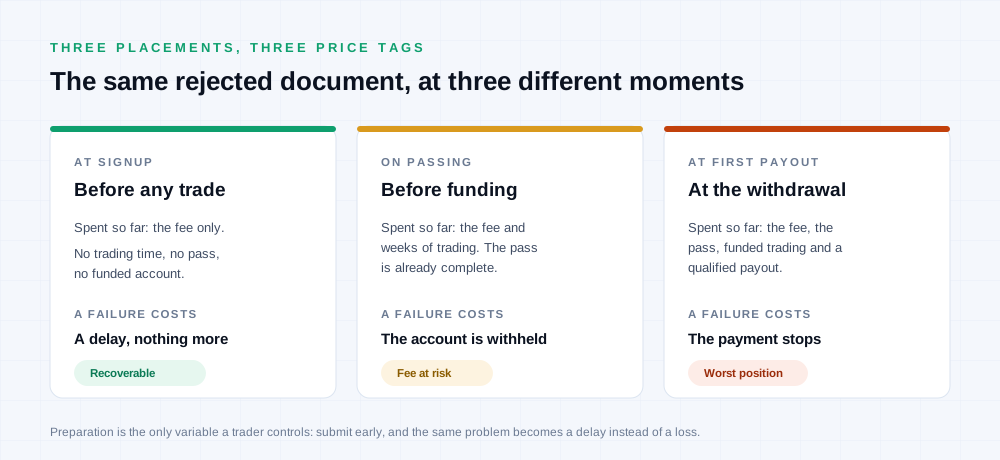
That asymmetry is worth restating in one sentence, because it is the whole argument of this page: a verification problem is cheap while the account is new and expensive once it is funded. Everything else about the process is outside the trader's control. When the check happens relative to your own preparation is not.
The document set, and what it is proving
Most firms ask for the same four things, though the exact list and the accepted substitutes vary. Reading each request as a question rather than a formality makes the preparation straightforward.
Government-issued photo ID. Passport, national identity card or driving licence. The question being answered is identity. The document must be current — an expired passport is a rejection even if the photograph is perfect — and the details must be legible without enhancement. A photograph of a photocopy is usually rejected; a scan or a clean phone photo of the original is not.
Proof of address. A utility bill, bank statement or tax document showing the name and residential address, usually dated within the last three months. The question is residency. Mobile phone bills are excluded at many firms, and so are documents that show a business address or a PO box. The date is checked as carefully as the name, and an eight-month-old statement is a common and avoidable rejection.
Proof of the payment method. A statement or screenshot showing the card, bank account or wallet used to buy the evaluation, with the holder's name visible. The question is provenance: was this purchase made by the verified person? This is the document traders least expect, and the one that causes the most friction when an account was bought with a relative's card or a payment service in a different name.
A liveness check or selfie. Increasingly automated through a vendor such as Sumsub or Veriff: hold the ID, turn your head, read a phrase. The question is that the person submitting is the person in the document. It fails on lighting, on webcams, on glasses, and on documents held too close to the camera.
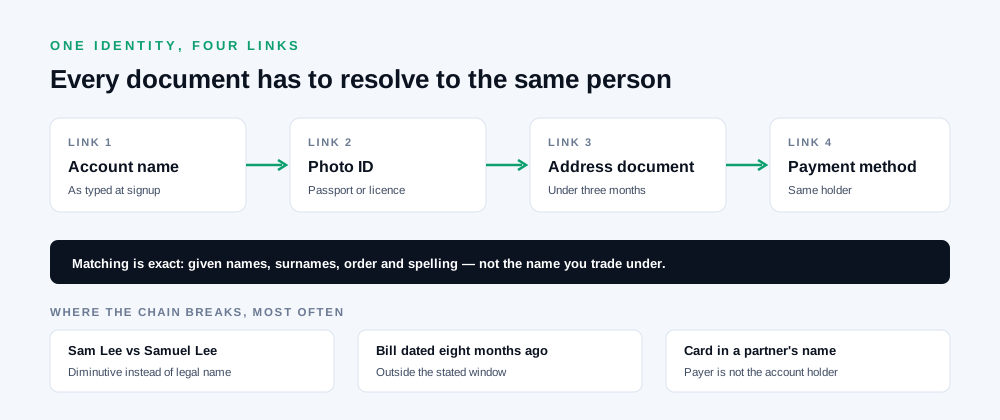
Two rules apply across the set. First, consistency: the name, date of birth and address must agree across every document. Second, currency: nothing expired, nothing older than the firm's stated window. Most rejections are not fraud flags at all; they are one of those two rules being broken by a document that would otherwise have been fine.
The rule checklist generator is a useful place to write the document set down beside the trading rules, so the paperwork and the plan are prepared in the same sitting rather than weeks apart.
The name-match rule, worked
Name matching is the single most common cause of a KYC rejection, and it is almost always innocent. Firms match the account name to the ID, then the ID to the address document, then the payment method to both. Each link is a chance for a variance that means nothing to a human and everything to an automated check.
| What the trader entered | What the passport says | Why it fails | Fix |
|---|---|---|---|
| Sam Lee | Samuel Lee | Diminutive rather than legal name | Register with the full legal name; ask support to amend before trading |
| Anna Weber | Anna Weber-Müller | Double-barrelled surname truncated | Use the full surname including both parts |
| Mohammed Rahman | Muhammad Rahman | Transliteration variant | Match the passport spelling exactly, even if it looks unusual |
| J. Okonkwo | Chinedu J. Okonkwo | Initial instead of given names | Write every given name as printed |
| Maria Silva | Maria Silva Santos | Missing maternal surname | Include all surnames in the document order |
Three habits prevent nearly all of these. Register with the name exactly as printed on the passport, including middle names, even if you never use them. Do not abbreviate, translate or reorder anything. And if you notice a mismatch after buying but before trading, contact support immediately — most firms will correct a typo on an untraded account, and almost none will treat a correction request as suspicious when it is made early.
The harder cases are genuine changes of name. A marriage certificate or a deed poll bridges the gap between the old name on an address document and the new name on an ID, and firms generally accept one as supporting evidence. The mistake is to submit the two documents without the bridge and hope the analyst infers the connection. They will not, because the process is designed not to infer.
Why the payment method matters so much
Payment provenance is the part of KYC that traders understand least, and it is where a passing service or a helpful relative can quietly create a problem. Firms care because the payment method is the rail the payout will travel back along. If the account was bought with a card in someone else's name, the firm has a documented mismatch between the payer and the account holder, and that mismatch has to be resolved before money moves.
The common variations are worth naming. A card in a parent's or partner's name is the most frequent, usually an innocent convenience. A payment through a wallet or processor that shows the processor's name rather than the trader's can be resolved with a statement showing the underlying transaction, but only if the trader supplies it rather than waiting to be asked. A crypto payment from an exchange account in a different name is the hardest to unwind, because the chain shows the transfer but not the person.
Third-party payments are also a fraud signal in their own right. Firms see a lot of stolen-card purchases in this industry, and a purchase made by someone who is not the account holder looks the same as a purchase made with a stolen card until it is explained. That is why the response is often an account freeze rather than a request for clarification. The trader experiences it as an accusation; the firm experiences it as a standard control. The pattern shows up in the mistakes that end attempts as well, usually at the payout request rather than at purchase.
The prevention is simple and worth more than any appeal: pay for the evaluation with a method in your own name, and keep the receipt. If someone else must pay, ask the firm first whether a third-party payment is accepted and what evidence they will want. Getting that answer in writing before the purchase is far cheaper than getting it during a payout review.
The payout side has a matching rule of its own. Many firms return the first withdrawal to the method used for the fee, which is why an expired card or a closed wallet triggers a manual review even when the identity is perfect. If the card has expired since purchase, tell the firm before requesting the payout rather than after the transfer fails, and expect to supply a statement for the replacement method.
Address documents and the three-month clock
Proof of address fails for boring reasons, and the boring reasons are the ones to eliminate in advance. The three-month window is the most common trap: traders grab the statement that is easiest to find rather than the most recent, and an eight-month-old utility bill is rejected even though nothing about it has changed.
Four further requirements trip people up. The document must show the full residential address as entered on the account, including the flat or unit number, because a mismatch between "12B" and "12" is a mismatch. It must show the applicant's name, which rules out a bill in a partner's name at the same address unless the firm accepts a relationship document alongside it. It must be a document type the firm lists; mobile bills, invoices and screenshots of banking apps are commonly excluded. And it must be legible end to end, including the date and the issuer's details, not just the address block.
Bank statements are usually the safest choice because they satisfy several requirements at once: a recognised issuer, a dated document, a full address and a name that matches the payment method. A statement downloaded as a PDF from online banking is normally accepted; a screenshot of the same statement is often not, because it can be edited. If a firm accepts only PDFs, sending a photograph of a printed PDF is a needless rejection.
There is a residency nuance that catches remote workers and students. The address the firm wants is the one on your identity documents and your bank, not the one you are currently sleeping in. If you have moved recently, wait until a document shows the new address rather than submitting a mismatch and explaining it. The explanation is reasonable and it still costs a review cycle.
Liveness checks and photo failures
Automated liveness checks have improved sharply and still fail on ordinary conditions. The pattern is consistent enough to be prepared for: poor front lighting, a webcam that cannot resolve the document's security features, glasses that reflect the screen, a document held at an angle, or a face that does not match the ID because the photograph is a decade old.
The practical fixes are unglamorous. Use a phone rather than a laptop webcam. Stand in daylight facing a window rather than with a window behind you. Take the photo of the document on a flat, dark surface with no glare across the laminate. Remove glasses for the liveness step if the reflection is severe. Hold the document still for a beat longer than feels necessary, because motion blur is the most common automated rejection.
The vendor matters less than the retry policy. Most firms allow several attempts before a manual review, and a manual review is slower but not hostile. If the automated step fails repeatedly, stop retrying and ask support for a manual route. Ten failed attempts in an hour read as a technical problem on the trader's side, and the queue moves faster when the request is framed that way from the start.
One warning belongs here. Never send identity documents by email to an address that is not the firm's published support address, and never send them to a passing service, a Telegram contact or anyone offering to "handle verification" for a fee. Verification is the one part of this process that must happen on the firm's own platform, and a document sent to the wrong inbox cannot be recalled.
Country, residency and sanctions screens
Eligibility is the fourth KYC question and the one that cannot be fixed with a better document. Firms publish restricted jurisdictions, usually driven by sanctions regimes and by the payment processors they rely on. A trader resident in, or a citizen of, a restricted country is not a documentation problem; the firm simply cannot serve them, and no amount of resubmission changes that.
Two adjacent issues cause avoidable trouble. The first is a mismatch between the country on the account, the country on the ID and the country of the payment method. A trader who lives in one country, holds another country's passport and pays with a third country's card will be asked to explain, and the explanation needs documents rather than a sentence. The second is the use of a VPN or proxy during onboarding. Firms log the connection, and a signup that appears to originate somewhere other than the stated residence invites a manual review even when everything else is clean.
The sensible sequence is to read the restricted list before paying, not after passing. It is usually in the terms or the help centre, it is short, and it is the cheapest check in the entire process. Where the position is ambiguous — dual citizenship, a recent move, a border town — ask support in writing and keep the answer. A written confirmation from the firm is the only thing that will help if the question resurfaces at payout.
The passing-service problem
This section is specific to the arrangement this site sells, so it is worth being precise about it. A passing service trades an evaluation that is registered in the client's name, with the client's KYC attached, and hands back a funded account that pays the client directly. That structure is what keeps the arrangement inside most firms' terms on ownership. It also means the client, not the service, must clear every identity gate.
Three consequences follow. First, identity documents are never required by the service and should never be offered to it. Verification happens on the firm's platform, in the client's name, and a service asking for a passport copy is creating a risk with no benefit. Second, the account must be bought with the client's own payment method, because the payout will travel back along that rail and the firm will match the names. Third, a KYC failure is outside the service's control in the same way the firm's challenge fee is: it is the firm's process, applied to the account holder.
Where a firm prohibits third-party trading outright, the arrangement is a different problem and a bigger one, which is why the terms check comes before payment in every engagement, and why comparing passing services on ownership terms matters more than comparing them on price. KYC does not create that risk and cannot remove it. What KYC does is make the ownership of the account visible: the account is in the client's name, the identity is the client's, and the money is paid to the client. A service that muddied any of those three would be handing the firm a reason to void the account at exactly the moment the trader asks for money.
The practical advice for anyone using a service is therefore the same as for anyone trading alone, with one addition: complete verification as early as the firm allows, and tell the service if a document problem arises before the payout request rather than after. How this service is run and what clients reported are the pages to check on that point before paying anyone. A delayed verification is a scheduling issue. A verification problem discovered during a payout review is a different conversation, and one that is much harder to have.
Refunds when verification fails
The refund question depends on which of two things failed. A failed evaluation is a trading outcome: the fee is spent, and the firm's refund policy for failures applies. A failed verification is a compliance outcome, and firms treat it separately. Many state explicitly that a fee is not refunded where verification cannot be completed, and some go further, making a false declaration a ground for termination without refund.
Three positions are common. The first is no refund at all once the account has been used, regardless of the reason. The second is a refund of the fee if the account is untraded and the failure is administrative, which is the most favourable position and the least common. The third is a discretionary outcome: the firm reviews the case, may offer a credit or a reset, and is not obliged to do either. The wording in the terms decides which applies, and the wording is usually brief. The separate question of whether a challenge fee comes back at all is covered in the challenge fee refund guide.
There is a related trap in the payout-linked refund model, where a firm returns the evaluation fee with the first, third or fourth payout. If verification fails before that payout, the refund milestone is never reached, so the fee is lost even though the firm's policy is nominally generous. Traders comparing plans by "refundable fee" should check whether the refund is triggered by passing or by a completed payout — the difference is the entire point.
One practical note on chargebacks. A chargeback filed in the first week of a verification dispute usually ends any chance of a negotiated outcome and can be treated as a breach of the terms in its own right. The sequence that preserves options is a written request for the specific requirement, a resubmission, then a formal complaint through the firm's published process, and only then a payment dispute. That sequence is slower and it keeps the account alive while it runs.
What to do when a check is rejected
The instinct after a rejection is to resubmit immediately with a different document. That instinct produces a second rejection, because the trader is guessing at the requirement. The better sequence is slower by a day and much more likely to work.
Step one: get the specific reason in writing. Ask which requirement was not met, which document failed, and what would satisfy it. A reply that says "verification failed" is not an answer; a reply that says "the address document is older than three months" is. Support can usually provide the specific clause, and the request itself creates a record.
Step two: fix that requirement and nothing else. If the address document was stale, send a current one and leave the ID alone. Changing several documents at once makes it impossible to tell which fix worked, and a new document introduces new opportunities for a mismatch.
Step three: keep everything. Save the submission, the rejection, the support thread and the terms as they stood when the account was bought. If the dispute escalates, the version of the terms that applied at purchase is the one that matters, and firms do update their pages.
Step four: escalate through the published route. Most firms have a complaints or appeals process, and using it is more effective than repeating the same support ticket. State the facts, quote the clause, attach the documents and ask for a decision in writing. Keep the tone factual; conduct clauses exist, and an abusive message gives the firm a reason to close the account that has nothing to do with the original problem.
What not to do is equally worth stating. Do not open a second account to work around a verification problem; duplicate identities are one of the most serious flags in the process, and they convert a fixable delay into a ban. Do not ask a friend or relative to verify on your behalf. And do not continue trading a funded account while a verification question is open if the firm has asked you to stop, because that can be treated as a separate breach.
Prevention: the order of operations
The whole page reduces to a sequence that costs about twenty minutes and removes most of the risk. It is worth writing down because the natural order — buy, trade, pass, then deal with paperwork — is exactly the order that puts the check at its most expensive point.
- Before buying: read the restricted-country list and the verification timing. Confirm the firm serves your residence and find out whether the check is at signup, at passing or at payout.
- At signup: enter your name exactly as printed on your passport, with every given name and surname. Do not abbreviate, translate or reorder.
- At purchase: pay with a method in your own name. Keep the receipt and a statement showing the transaction.
- Before the first trade: upload the ID, a proof of address under three months old and the payment evidence, even if the firm has not asked yet. Early submission is almost always accepted.
- At passing: confirm verification is complete before the funded account is traded, not after the profit target is reached.
- During the funded phase: do not change the payout method without telling the firm, and keep the address on file current.
- At the payout request: check the day count, the threshold, the consistency ratio and the verification status together, so the request is not blocked by a condition that was visible for weeks.
The logic behind the order is that a verification problem is cheap while the account is new and expensive once it is funded. Everything else about the process — the document types, the checks, the queues — is outside the trader's control. When the check happens relative to your own preparation is not.
One last habit is worth the two minutes it takes. After verification clears, save the confirmation. Firms change vendors and occasionally re-verify on a later payout, and a trader who can produce the earlier clearance moves through the second review quickly. The record is also useful in the event of a dispute, because it establishes that the identity question was settled before the money question arose.
Common questions
When do prop firms ask for KYC?
It varies by firm and is stated in the onboarding flow or help centre. Some verify at signup before the evaluation can be traded, some when the objectives are met and the funded account is issued, and some only when the first payout is requested. The later the check, the more a failure can cost, so find out before buying.
Can I pass a challenge and then fail KYC?
Yes. At firms that verify on passing or at the first payout, the evaluation can be completed and the funded account withheld or the payment stopped because identity verification was not satisfied. The pass is a trading result; the verification is a separate compliance result.
What is the most common reason a prop firm KYC fails?
A name mismatch, in most cases innocent: a middle name omitted, a maiden name, a transliteration difference, or an abbreviated first name. The second most common is a proof of address older than the firm's stated window, usually three months.
Can I pay for an evaluation with someone else's card?
It is the most common cause of a payment-provenance problem. The firm matches the payer to the account holder, and a third-party payment looks the same as a stolen-card purchase until it is explained. Ask the firm before buying if someone else must pay, and keep the answer in writing.
Do I need to send identity documents to a passing service?
No, and you should not. Verification happens on the firm's platform, in the account holder's name. A service that asks for a passport or a utility bill is creating a risk with no benefit, because the firm will not accept verification performed by a third party.
Does a failed KYC mean I lose the challenge fee?
Often, yes. Many firms state that a fee is not refunded where verification cannot be completed, and payout-linked refunds are never triggered if the payout never happens. Read the refund wording before buying rather than after the check fails.
How long does verification take?
Automated checks usually clear within minutes. A manual review typically takes one to three business days, and longer at month end or during a promotion. A delay is not usually a rejection; it means a person is looking at the file.
Can I trade while verification is pending?
Only if the firm allows it, and you should confirm rather than assume. At firms that verify at signup the answer is usually no. At firms that verify on passing, trading the evaluation is normally permitted while the check is outstanding, but the funded account is not issued until it clears.
Is a VPN a problem during verification?
It can be. Firms log connection data, and a signup that appears to originate outside the stated country of residence invites a manual review. Turn it off for onboarding and for the verification submission.
What if my country is on the restricted list?
Then the firm cannot serve you, and no document changes that. The list is driven by sanctions and by the firm's payment processors. Check it before paying, and get written confirmation if your position is ambiguous because of dual citizenship or a recent move.
Can verification be completed in a different name from the one I trade under?
No. The account, the identity and the payout method have to resolve to the same person. A nickname or trading handle can be a display name, but the legal name on the account must match the documents.
Pass the evaluation without creating a paperwork problem
Flat $220, any firm, any account size. The account stays in your name with your KYC, so the payout is yours and the verification is yours.
Related reading
- The payout sequence, step by step
- What happens after you pass
- The consistency ratio, calculated
- When a payout is rejected
- How a passing service works, and its limits
- How to tell a real passing service
- Prop firm rules matrix
- Passed challenges and certificates
- Frequently asked questions
- What the flat fee covers
Verification requirements, accepted documents and refund positions are set by each firm and change without notice. Confirm the current requirement on the plan you are buying rather than from a general guide. ElitePropX is an independent service and is not affiliated with, endorsed by or sponsored by any proprietary trading firm. Trading involves substantial risk of loss; this page is general information, not financial or legal advice.