
Evaluation service · rules read November 2026
We pass your BluSky prop firm evaluation for a flat $220
BluSky Trading is a futures prop firm, and its evaluation has two properties that decide almost every attempt: there is no daily loss limit, and the only way to fail is to fall below a minimum balance that trails your highest end-of-day balance at 6PM and never comes back down. On top of that sits a consistency rule whose cap is measured against your target rather than your profit, which is why some passes are mathematically impossible in two days. This page sets out the rulebook as BluSky publishes it, the sizing that survives a rising floor, the terms check that happens before payment, and what the pass actually hands you afterwards.
Blue Sky Trading and Bluesky prop firm are the same firm as BluSky Trading Company, and the spelling in a search box does not change the rulebook. The figures below are read from BluSky's own help centre, in the order they end accounts.
Key takeaways
- The evaluation has no daily loss limit. One bad session does not fail the account; it only matters if it takes you through the trailing floor.
- The floor trails your highest end-of-day balance, calculated at 6PM, and ratchets upward only. Intraday spikes do not move it; a strong close does, permanently.
- Consistency is 34% on Propel Premium and Static, 21% on the 300K, 50% on Launch, and absent on Orbit. The largest day is capped in dollars against the target.
- Because the cap is a share of the target, a Propel pass cannot be completed in fewer than three profitable days, and a Launch pass cannot be completed in fewer than two.
- Four of the six Propel sizes are trailing and two are static; the number quoted first by a comparison site is often the wrong one for the plan you are buying.
- Flat $220 at any size, retries covered while the evaluation runs, no profit split taken, and BluSky's clause on third-party trading confirmed in writing before you pay.
Contents
- Which BluSky plan you are actually buying
- The EOD trailing minimum balance
- The consistency cap, measured against the target
- No daily loss limit — and why that is not easier
- Sizing contracts from tick value
- The plan a BluSky pass runs on
- The terms check, before anything is bought
- How long a BluSky pass takes
- What the flat $220 covers
- A worked BluSky pass, week by week
- Six ways a BluSky attempt ends
- After the pass: Buffer Zone and payouts
- What this service will not do
- Frequently asked questions
Which BluSky plan you are actually buying
BluSky is not a single evaluation with a single rule set. The firm publishes several products with genuinely different mechanics, and the differences are not cosmetic: they change the target, whether the floor trails or stays static, whether the consistency cap is 34%, 21% or 50%, and whether the evaluation bills monthly or charges a fee after you pass. Comparing "BluSky" to another firm without naming the plan compares an average of five products.
The evaluation products are Propel (Premium and Static), Launch, Orbit, Static Growth, plus two Instant Funding lines that skip the evaluation entirely. The table below is the Propel Phase 1 rulebook as BluSky publishes it, and it is the clearest single view of how the firm thinks about risk.
| Propel size | Profit target | Drawdown | Daily loss limit | Consistency | Largest single day |
|---|---|---|---|---|---|
| 25K | $1,500 | −$1,200 trailing (EOD) | None | 34% | $510 |
| 50K | $3,000 | −$2,000 trailing (EOD) | None | 34% | $1,020 |
| 100K | $6,000 | −$2,500 trailing (EOD) | None | 34% | $2,040 |
| 150K | $3,000 | −$1,000 static | None | 34% | $1,020 |
| 200K | $6,000 | −$2,000 static | None | 34% | $2,040 |
| 300K | $20,000 | −$5,000 static | None | 21% | $4,200 |
Read that table in the order that kills accounts, not the order it is printed in. The drawdown column is the one that decides the plan; the target is the number everyone quotes and the easiest of the constraints to satisfy. Note also that the 150K and 200K rows have a static floor of $1,000 and $2,000 while carrying targets of $3,000 and $6,000 — a static $1,000 floor under a $3,000 target is the tightest ratio on the page, and it is a very different product from the 100K trailing account that sits above it in the table.
Launch is the shorter product. Phase 1 for a 50K Launch is a $3,000 target against a $2,000 trailing floor, a 50% consistency cap and a $1,500 largest single day; the 100K is a $6,000 target against $2,500 trailing at the same cap; the 200K is $6,000 against a static $2,000. A 50% cap means the target can be reached in two profitable days. Propel's 34% cap means it cannot be reached in fewer than three, because no single day may produce more than a third of the target.
Static Growth is the third family, and its rulebook is quietly the most restrictive. The 300K Pro version carries a fixed $5,000 drawdown, a $2,500 daily loss limit and a 21% consistency cap; the 150K and 200K versions carry static floors of $1,000 and $2,000, no daily limit, and a 30% cap. It is the only evaluation family BluSky publishes with a daily loss limit in the large size, which matters if you assumed the whole firm is daily-limit-free.
Then there are the two Instant Funding lines, which are not evaluations at all. Direct to Funded is a $3,500 account with a $2,500 static drawdown, a $2,000 daily loss limit, a 21% consistency rule and a rule that closes the account on a fourth negative day inside a rolling ten; it pays 50% for the first thirty trading days and 80% after that. Instant Sim Funded is a $50,000 account with a $2,000 intraday trailing floor, a $1,000 daily loss limit and an 80% split. Neither offers resets. Buying one of those is not buying a passable evaluation, and no service should quote them as if it were.
The EOD trailing minimum balance
BluSky states that there is one way to fail an evaluation: fall below the minimum balance. That balance is not a fixed line drawn under the starting amount on trailing plans. It starts at the account size minus the trail and then rises with your highest end-of-day balance.
On a $50,000 Propel account the minimum starts at $48,000, a $2,000 trail. If the account closes a day at $50,750, the new minimum becomes $48,750. If the next session gives some of it back and closes at $50,300, the minimum stays at $48,750 — it does not fall back with losses. The calculation is run at 6PM from the starting balance, which is the detail that makes the rule survivable and also the detail that makes it dangerous.
| Account state at the 6PM calculation | Minimum balance | Room to fail | Room above the $50,000 start |
|---|---|---|---|
| Day one, $50,000 | $48,000 | $2,000 | $2,000 |
| Closed at $50,750 | $48,750 | $2,000 | $1,250 |
| Closed at $51,500 | $49,500 | $2,000 | $500 |
| Closed at $52,000 | $50,000 | $2,000 | $0 — the floor is the starting balance |
| Closed at $53,000 | $51,000 | $2,000 | Negative — the floor is above where you started |
Two things follow, and they pull in opposite directions.
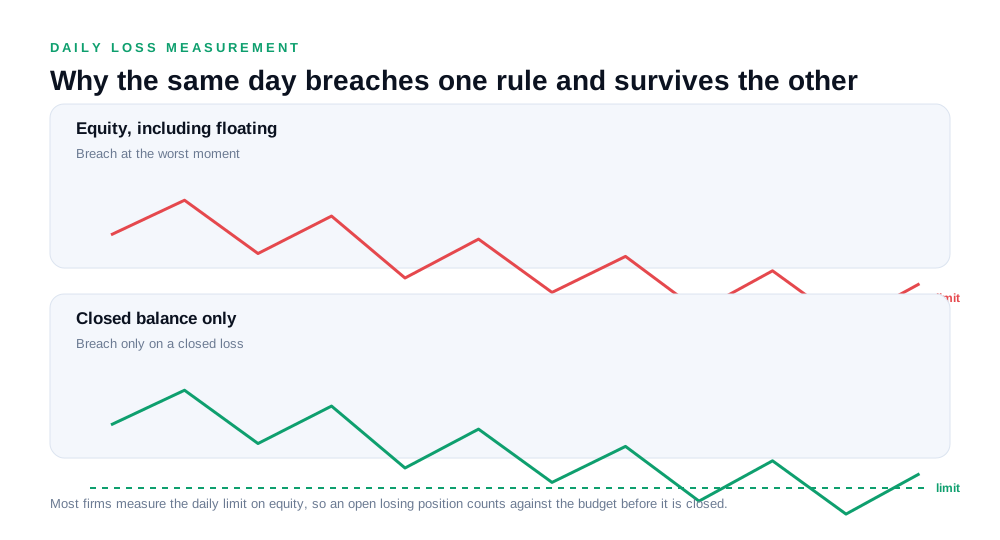
The first is that the rule is forgiving inside the day. Because the threshold is calculated end-of-day, an intraday excursion does not move it. A position that runs into profit and gives it back before the close has cost you money but not protection. On an intraday-trailing rulebook that same sequence would have raised the floor and compressed your buffer permanently mid-session. If your method tends to give back open profit, BluSky's evaluation is structurally gentler than a firm that trails tick by tick.
The second is that the rule is punishing at the close. A session that finishes at a new high hands you a higher floor for the rest of the attempt, and the compression is permanent. The account that could absorb a $2,000 drawdown on day one can absorb the same $2,000 on day twenty while sitting only a few hundred dollars above the level it started at. Nothing about your trading changed; the account changed underneath it.
The practical remedy is not clever, it is mechanical: risk is set from the distance between the current balance and the current floor at the start of each session, not from the original trail. On day one that distance and the trail are the same number. By the final week they are different numbers, sometimes by a factor of three, and a plan that uses the day-one unit in the final week is risking three times its own tolerance.
The static plans invert all of this. A 150K Propel Static holds a fixed $1,000 floor at $149,000 and it never moves, so a profitable attempt does not eat its own buffer. That sounds strictly better until you do the ratio: $1,000 of room against a $3,000 target is a 3:1 target-to-risk ratio, where the 100K trailing account offers $2,500 of room against $6,000. The static floor is easier to understand and harder to trade, and the plan that fits one is not the plan that fits the other.
The mistake this rule punishes most: banking a large week and then trading the next week at the size that produced it. On a trailing floor a good week raises the floor, so the same unit is now a larger share of the room. Size down after a strong close, not up.
The consistency cap, measured against the target
Most firms measure consistency as a share of total profit at the payout. BluSky does something different and stricter: your highest profit day becomes a percentage of your new target. The rule is published as a consistency rule with a stated cap, and the practical effect is that a single outsized day can push the target further away instead of finishing it.
The caps are 34% on Propel Premium and Static, 21% on the 300K plan, 50% on Launch evaluations, and none at all on Orbit. BluSky publishes the dollar figure beside each one, which removes the guesswork: $510 on the 25K, $1,020 on the 50K, $2,040 on the 100K, $4,200 on the 300K. Those are the largest single days those accounts can produce while the rule still clears.
| Plan and size | Target | Cap | Largest single day allowed | Minimum profitable days |
|---|---|---|---|---|
| Propel 25K | $1,500 | 34% | $510 | 3 |
| Propel 50K | $3,000 | 34% | $1,020 | 3 |
| Propel 100K | $6,000 | 34% | $2,040 | 3 |
| Propel 300K | $20,000 | 21% | $4,200 | 5 |
| Launch 50K | $3,000 | 50% | $1,500 | 2 |
| Launch 100K | $6,000 | 50% | $3,000 | 2 |
The final column is the one nobody quotes and the one that sets your calendar. BluSky states it plainly: because the biggest day cannot exceed 34% of your profitable days, the target cannot be reached in fewer than three profitable days. On the 300K at 21% it cannot be reached in fewer than five. A Launch account at 50% needs two. Those are floors, not averages — an attempt that produces a $2,040 day on a 100K Propel still needs two more profitable days before the target is met.
This changes the shape of a good plan in a way that is easy to get backwards. Traders normally try to make the target in as few sessions as possible and then worry about the payout rules. Here the payout-style rule is active during the evaluation, so the plan's job is to spread profit across at least three sessions rather than to maximise any single one. A method whose edge arrives in one large day per week is being taxed twice: once by the cap, and once by the extra days the cap forces.
The monitoring is straightforward because BluSky's dashboard calculates the metric and shows the profit of your best day. Check it after every session rather than at the end. If the best day is approaching the cap, the correct response is to reduce the per-session target and add sessions — not to press for a larger win and not to stop trading, because stopping does not lower the best day, it only delays the target.
One consequence is worth stating for anyone comparing plans on price: the 300K floor plan at 21% is not simply a bigger 100K. It needs five profitable days rather than three, with a $4,200 daily ceiling, and the distribution work that implies is the real cost of the larger target complete with its larger payout ceiling.
No daily loss limit — and why that is not easier
BluSky's evaluation accounts carry no daily loss limit. The firm says there is only one way to fail, and it is the minimum balance. News trading, holding a larger position than the terms allow, and trading outside the recommended hours are not fail conditions either — the firm states it will liquidate or restart rather than fail the account. Hedging is the exception and is prohibited, with reward denial or closure as the consequence.
On paper that removes the single most common cause of failure at other firms. In practice it moves the risk somewhere less visible, and a plan has to put it back deliberately.
Without a daily stop, a session's damage is bounded only by the trailing floor. That means the natural behaviour — hold a losing position and wait for it to come back — is not punished until it is catastrophic. At a firm with a 3% daily limit the punishment arrives early and cheaply. Here it arrives once, at the floor, and it ends the attempt. The absence of a rule makes the account more dependent on a self-imposed one.
So the plan imposes a session budget that BluSky does not: a fixed dollar loss per day, set as a fraction of the room to the floor, and a hard stop when it is spent. On a 50K Propel with $2,000 of room, a $250 unit allows eight losses; on the 150K Static with $1,000 of room and a $3,000 target, the same logic produces a much smaller unit because the room is smaller. The number is not chosen from the target. It is chosen from the floor.
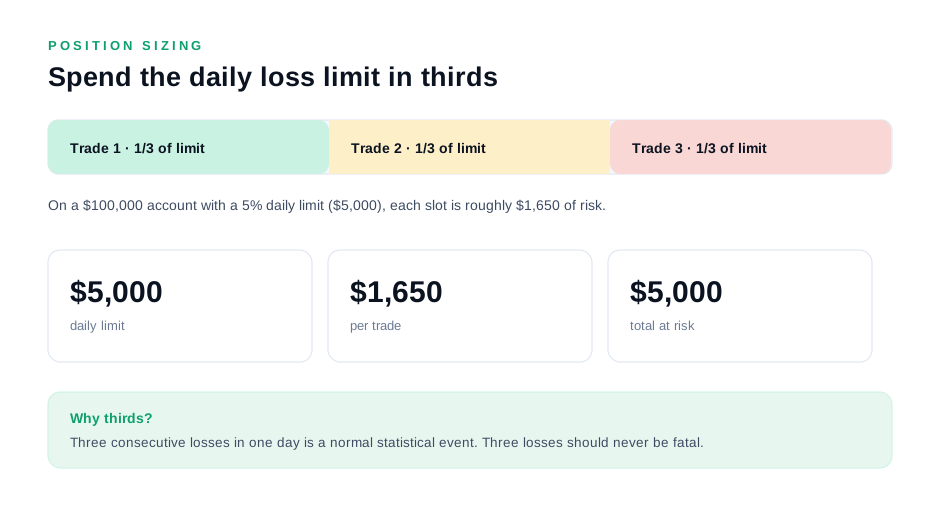
There is a second effect, and it is the one that catches disciplined traders. Because there is no daily limit, there is no automatic brake on a bad day, and bad days cluster. Three consecutive losses inside one session is not unusual for any method; at a firm with a daily stop it ends the day, and here it does not. The session budget exists to convert that cluster into a stop rather than into a fourth, larger position.
The static plans are the exception worth remembering. A 300K Static Growth carries a $2,500 daily loss limit alongside its fixed $5,000 floor and 21% consistency rule, and the smaller Static Growth accounts carry no daily limit but a 30% consistency cap. If you are choosing between BluSky products, the presence of the daily limit on the largest static plan is a real difference in the product rather than a rounding detail.
Sizing contracts from tick value
BluSky is a futures firm, and futures sizing is arithmetic, not judgement. A stop is a distance in ticks, a tick has a dollar value per contract, and the contract count is the quotient. Getting that order right is most of the risk control on this rulebook, because there is no daily limit to catch a mistake.
| Instrument | Tick value | 15-tick stop | Contracts at $300 risk | Contracts at $150 risk |
|---|---|---|---|---|
| MNQ (Micro Nasdaq) | $2.00 | $30 | 10 | 5 |
| MES (Micro S&P) | $1.25 | $18.75 | 16 | 8 |
| MYM (Micro Dow) | $0.50 | $7.50 | 40 | 20 |
| ES (E-mini S&P) | $12.50 | $187.50 | 1 | 0 — below one contract |
The last row is the useful one. On a $3,000 target with a $2,000 trail, a single ES contract with a 15-tick stop already risks 9% of the room. There is no sizing that makes a full-size contract conservative at this account size, which is why every worked example on this page uses micros. The contract sizing guide covers the arithmetic in more detail, including how to allow for slippage and commission before the contract count is fixed.
Two adjustments belong in the model before the first trade. Slippage: a stop becomes a market order when triggered, and in a fast tape the fill lands beyond the level, so a 15-tick stop on MNQ can cost closer to 18 ticks. Commission: charged per contract per side, so ten contracts is twenty units on a round turn, and on a small account that is a visible fraction of the target. Neither is large enough to change the plan, and together they are large enough to make the difference between eight losses of tolerance and six.
BluSky also states that it can automatically limit your maximum size if you are trading a single product. That is a safety net, not a strategy: relying on a cap you did not set means your size is decided by the firm's setting rather than by the room to your floor, and the two are not the same number.
One more sizing consequence comes from the trail itself. Because the floor rises with each new end-of-day high, the room shrinks in the profitable phase of the attempt — exactly when most traders feel most confident. Recalculate the unit each morning from the distance between balance and floor. On a Propel account that has climbed $1,500 above its start, the effective room is $500 plus whatever the floor has not yet absorbed, and a unit calibrated on day one is by then risking three or four times the tolerance the plan intended.
The plan a BluSky pass runs on
Six constraints write the plan, and none of them is a market view.
The trailing floor sets the dollar unit. Risk per trade is a fixed fraction of the room between balance and floor, recalculated at the start of every session. On a $2,000 trail that is $250 for eight losses. The unit never increases during an attempt.
The consistency cap sets the daily profit ceiling. With a 34% cap, no session is allowed to produce more than the published dollar figure: $1,020 on a 50K, $2,040 on a 100K. The cap is treated as a hard ceiling from the first session, not as a ratio checked at the end, so the rule is satisfied by construction and can never be the reason an attempt fails.
The minimum profitable days set the calendar. Three on Propel, two on Launch, five on the 300K. The target is divided across at least that many sessions, which means the pace per session is lower than the target implies and the schedule is longer than a one-phase evaluation suggests.
The absence of a daily limit sets a budget anyway. A session closes at a fixed dollar loss or at the daily profit ceiling, whichever arrives first. This is the constraint the firm does not impose and the plan must.
The conduct rules set the clock and the instruments. Permitted products, hedging prohibition and any holding restriction are treated as fixed walls. A hedging breach can lead to reward denial or closure, so the plan never opens opposing positions in correlated products, even to "lock" a gain.
The terms check gates everything. Nothing is traded until the third-party clause is confirmed in writing, and the check is free.
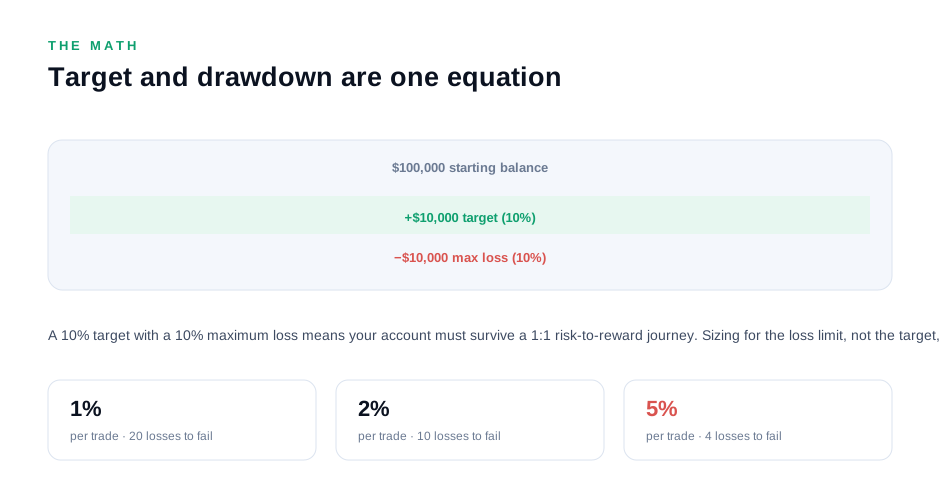
The order matters. A plan written from the target produces a unit that is too large for the floor; a plan written from the floor produces a calendar that respects both the cap and the missing daily limit. The second is slower and it is the only one that survives the final week, when the trail has eaten the room.
Failure handling is part of the plan rather than an afterthought. If an attempt is lost, the client is told the same day, the failure is classified as a floor breach or a conduct breach, and the retry runs at no additional service fee while the evaluation is open. The classification matters because the two failures have different causes: a floor breach is usually a sizing error in the profitable phase, while a conduct breach — a hedge, a restricted product — repeats on the next attempt unless the process changes.
The terms check, before anything is bought
Before payment we read BluSky's current terms for the specific product and confirm in writing whether the evaluation may be traded by a third party. This is the step that decides whether a pass produces a funded account or a voided one, and it costs nothing.
- Third-party trading on the evaluation. If the terms prohibit it, the job does not start. Accepting quietly would put the client's account at risk to protect a fee.
- Third-party trading after the pass. Some firms permit the evaluation to be traded externally and restrict the funded account. Since the funded account is the asset, the distinction changes the answer.
- Product and plan identity. Propel, Launch, Orbit, Static Growth and the two Instant Funding lines have different rules and different fees. The check is run on the exact plan and size, because a $1,000 static floor and a $2,000 trailing floor are not the same product.
- Conduct rules. Hedging, permitted instruments, maximum contracts and any holding restriction determine which sessions are usable and therefore how many weeks the attempt needs.
- Ownership. The evaluation is bought in the client's name with the client's payment details and identity verification. A provider holding the account is running a managed account, which most firms prohibit.
The check returns permitted, prohibited or silent, and silent is treated as prohibited unless the firm confirms in writing — because a firm that has not addressed the question can address it at the payout. Send the plan name, the account size and any support reply you already have, and the answer comes back before you spend anything.
How long a BluSky pass takes
BluSky does not impose a long minimum day count, so the calendar is set by the consistency cap and the target rather than by the firm. That makes a BluSky attempt faster than a staged two-phase evaluation and less forgiving of a week that produces nothing.
The consistency cap is the binding constraint. A Propel target cannot be completed in fewer than three profitable days whatever the pace, and the 300K needs five. Add flat sessions, small losses and the days the market offers no setup, and a realistic Propel attempt runs three to six weeks depending on the size.
The unit limits the pace. With risk at one-eighth of the room and a daily profit ceiling, a good week is a fraction of the target. Sizing up to shorten the calendar raises variance at exactly the point where the trail has reduced the room, which is why the plan extends the schedule instead.
Monthly billing makes the calendar a cost. Propel and Orbit bill monthly and the subscription ends when the evaluation is passed, so every extra week is a week of fees. Launch inverts that: nothing is charged until you pass, then a one-time Launch fee becomes due within 14 days, and missing the deadline loses the passed evaluation with no reinstatement. The fee timing changes which pace is rational, not just what the attempt costs.
Reporting is weekly at minimum. Progress is reported at agreed checkpoints and any failed attempt the day it happens. Silence during an evaluation is indistinguishable from a failure.
What the flat $220 covers
The fee is $220 for any BluSky evaluation and any account size. The scope is stated in full because a vague scope is the usual source of dispute.
| Item | Covered | Notes |
|---|---|---|
| The evaluation attempt | Yes | Traded to the target inside BluSky's rules |
| Retries while the evaluation runs | Yes | No additional service fee |
| Terms check before payment | Yes | Confirmed in writing, free |
| BluSky's own fee or subscription | No | Paid by the client directly to the firm |
| The Launch fee after passing | No | Due to BluSky within 14 days of the pass |
| The funded account after handover | No | Traded by the client under the firm's terms |
| Identity verification | No | Completed personally, as the account holder |
| Profit split | None taken | Payouts belong to the client |
The comparison that matters is against doing it yourself, and it cuts both ways. On a first-attempt pass the service costs $220 more than trading the evaluation alone, and you give up the experience. From the second attempt the arithmetic reverses, because the service absorbs the retries while a self-traded retry means another subscription or another Launch fee — and a trailing-floor rulebook produces second attempts at a higher rate than a staged one, for the simple reason that a profitable account can still breach.
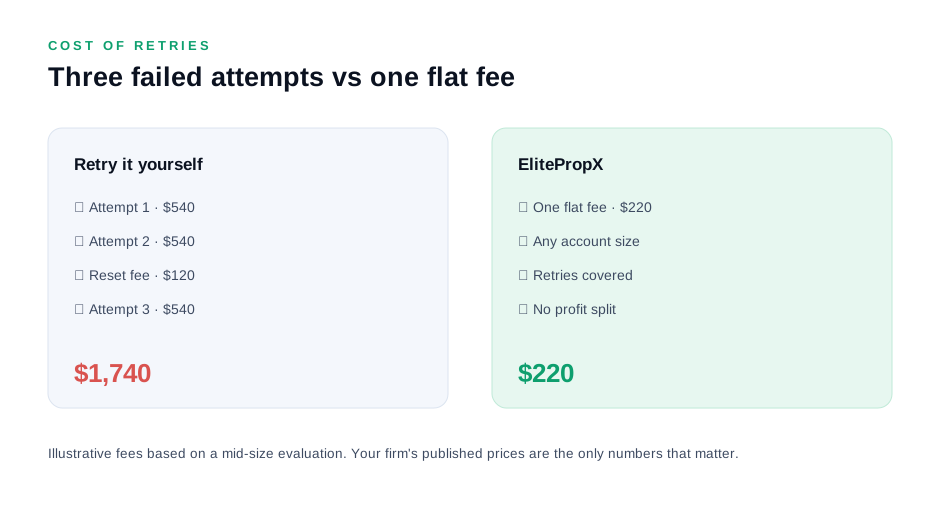
Three costs the fee does not remove are worth naming. BluSky's subscription continues while a Propel or Orbit account is open. The Launch fee falls due after a pass. And the calendar is not shortened, because the consistency cap applies to a service pass exactly as it applies to anyone else.
A worked BluSky pass, week by week
An illustration on a 50K Propel: $3,000 target, $2,000 trailing floor starting at $48,000, a 34% cap worth $1,020 for the largest day, no daily loss limit, and a $250 opening unit. The unit is recalculated every Monday from the distance between balance and floor.
Week one — the floor is wide. Five sessions at $250 risk on MNQ with a 15-tick stop, a self-imposed session budget of $500 and a profit ceiling of $1,020. Two green days at $600 and $450, two small red days, one flat. The balance closes the week near $51,300 and the floor lifts to $49,300. Room to fail is still $2,000; room above the start is $1,300, and the target is $1,700 away.
Week two — the cap starts to matter. The best day so far is $600, which is 20% of the target and safely inside the 34% cap. Two more green sessions at $500 and $400 take the balance to about $52,200 and the floor to $50,200. The floor is now above the starting balance, so a losing week hands back profit rather than the firm's money.
Week three — the compression week. With $1,800 of room to the floor but only $200 of it above the start, the unit drops to $200 and the weekly target is halved. Three green sessions of $350, $300 and $250 finish the target at roughly $53,100. The largest day across the attempt is $600, which is 20% of the target — inside the 34% cap without any late adjustment, which is the point of capping every day from the first session.
| Week | Balance at start | Floor | Unit | Work |
|---|---|---|---|---|
| One | $50,000 | $48,000 | $250 | Five sessions, two green, best day $600 |
| Two | $51,300 | $49,300 | $250 | Four sessions, floor passes the starting balance |
| Three | $52,200 | $50,200 | $200 | Compression week, unit cut, target finished |
The features worth noticing are the falling unit, the absence of any dominant day, and the deliberate refusal to compress the finish into one session. A trader who pressed for a $1,000 day in week three would have been inside the cap and still in more danger: the trail moves with the highest close, so the same win that finishes the target also lifts the floor under it. The BluSky challenge guide works the floor arithmetic in more detail, and the consistency guide covers the payout-side ratio.
Six ways a BluSky attempt ends
Holding the opening size into the final week. The commonest failure and the most avoidable. The unit is right on day one and wrong by week three, because the trail has taken the room the unit was calibrated against.
A daytime that turns into a day. With no daily loss limit there is no brake on a losing session. Three losses inside one morning is ordinary; a fourth, larger position to recover them is how an account built over three weeks ends in an hour.
One oversized day breaching consistency. A $1,500 day on a 50K Propel is inside the target and outside the $1,020 cap. The target is then recalculated against the best day, and the attempt extends by at least a session it did not need.
Hedging across correlated products. Locking one position with another is prohibited at BluSky and can lead to reward denial or account closure, which is a worse outcome than a failed attempt because it puts the funded account in question too.
Missing the Launch fee deadline. On a Launch plan the pass is not the end of the process: the fee falls due within 14 days and a missed payment expires the account with no reinstatement.
Nothing — the pace is slow. A target not reached inside the subscription period costs the calendar and the monthly fee, and no breach. It is the cheapest way to not pass, and the plan prefers it to a breach.
After the pass: Buffer Zone and payouts
BluSky's pass does not hand you a live account with no target. It hands you a Buffer Zone, which the firm describes as deliberately gentler than the evaluation: a smaller target, the same or a similar drawdown, no daily loss limit, and the 34% consistency cap continuing. On Propel the Buffer targets are $1,500 on the 25K, $3,000 on the 50K, $3,500 on the 100K, $2,000 on the 150K, $3,000 on the 200K and $3,500 on the 300K. On Launch the 50K Buffer is $3,000 against a $2,000 trailing floor with a $1,020 best-day cap, the 100K is $3,500 against $2,500, and the 200K is $3,000 against a static $2,000.
Two things follow. First, the evaluation is not the last target — the buffer is a second, smaller one, and a plan that arrives at the buffer with the trail already tight enters it with the least room it will ever have. Second, the consistency cap survives the handover, so the discipline that got you through the evaluation is the discipline the payout depends on.
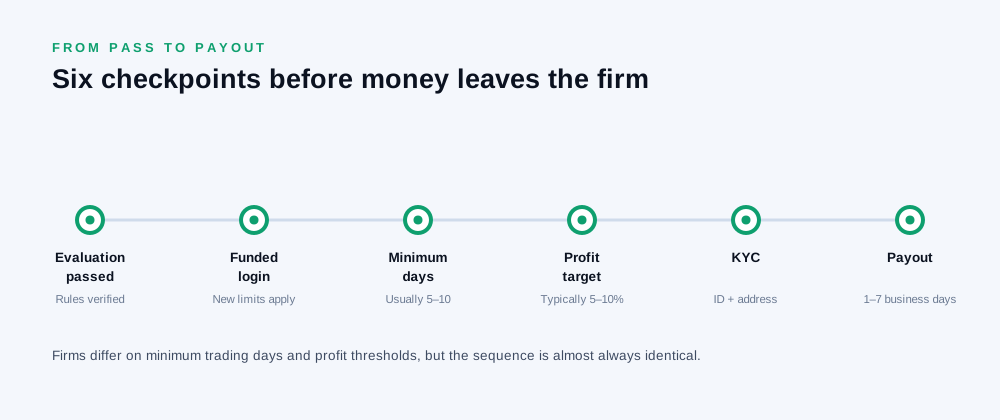
Once funded, BluSky advertises a 90/10 split with payouts Monday to Friday, subject to an eligible balance, completed identity and payment verification, and the account's consistency rules. Confirm the cycle in dollars rather than percentages: a 90% split is only better than an 80% split if the payout actually clears on the advertised rhythm, and the time from request to cleared funds is usually longer than either the split page or the fee page implies.
Four things to do in the first week after handover, in order. Change the password regardless of how access was provided. Confirm the account is in your name with your payment details and verification complete. Read the Buffer Zone and funded terms yourself rather than a summary. And write the funded plan — unit, session budget, daily profit ceiling, payout target — before the first trade rather than after the first loss. The payout process guide covers the withdrawal sequence and the delays that block first requests.
What this service will not do
It will not pass an account BluSky's terms prohibit someone else from trading. If the clause says no, the answer is no, and it is given before payment rather than after a funded account is questioned.
It will not remove the consistency cap, the trailing floor, or the minimum profitable days. Those are the firm's rules and they bind a service pass exactly as they bind anyone else. What the fee buys is the work of producing a completed evaluation inside them, not an exemption from them.
It will not promise a payout. The Buffer Zone has its own target and the funded stage has its own conditions; a pass is the end of one test and the start of another. Anyone selling a funded outcome is selling something the firm controls.
It will not trade an Instant Funding line as though it were an evaluation. Direct to Funded and Instant Sim Funded have daily loss limits, negative-day rules and no resets, and they are not passable products in the sense this page describes.
Frequently asked about the BluSky evaluation
Does the $220 fee change with the plan or account size?
No. It is flat for any BluSky evaluation at any size, because the work is the same process applied to different numbers. Size changes the payout ceiling and BluSky's own fee, not ours.
Is BluSky's drawdown intraday or end-of-day?
End-of-day on Propel Premium, Launch and Orbit, calculated at 6PM from the starting balance and lifted by each new highest close. The 150K and 200K Propel sizes, the 200K Launch and Static Growth use static floors instead. Intraday swings do not move an EOD floor; a strong close does, permanently.
Does BluSky have a daily loss limit?
No on Propel, Launch and Orbit evaluations — BluSky states the only way to fail is falling below the minimum balance. The 300K Static Growth plan carries a $2,500 daily limit, and both Instant Funding lines carry daily limits. The plan imposes its own session budget regardless.
What is the BluSky consistency rule?
34% on Propel Premium and Static, 21% on the 300K, 50% on Launch, and none on Orbit. The highest profit day is measured against the new target rather than against total profit, so the dollar ceilings are $510 on a 25K, $1,020 on a 50K, $2,040 on a 100K and $4,200 on a 300K.
Why can a BluSky pass not be finished in two days?
Because the best day cannot exceed 34% of the target on Propel, the target needs at least three profitable days; the 300K at 21% needs five. Launch at 50% can be done in two. Those are firm-published floors, not estimates.
Do you check the terms before I pay?
Yes, and it is free. Send the plan name, account size and any support reply you already have, and we confirm in writing whether third-party trading is permitted on the evaluation and after the pass. Silent terms are treated as prohibited unless the firm confirms otherwise in writing.
Who owns the account and the payouts?
The client. The evaluation is bought in the client's name with the client's payment method, identity verification is completed personally, and the funded account and its payouts belong to the client. No profit share is taken.
What happens if the evaluation fails?
You are told the day it happens, the failure is classified as a floor breach or a conduct breach, and the attempt is retried at no additional service fee while the evaluation is open. BluSky's own subscription, reset or new-account charge remains your cost.
Which BluSky plan should I buy?
The plan whose binding constraint matches your method. If your edge arrives in a few large sessions, Orbit has no consistency rule and Static Growth has a fixed floor. If it arrives steadily, a trailing Propel size gives you the most room per dollar of target. This is decided in the terms check, before any fee.
Can you pass an Orbit evaluation?
Orbit carries no consistency rule and bills monthly like Propel, which makes it the most forgiving of the evaluation products for a method with uneven daily results. Whether it is available depends on the terms check, which is run on the exact plan and size.
What do you need from me to start?
The plan name and account size for the terms check. If it clears, you buy the evaluation in your own name, we agree the scope of access in writing, and the plan starts on the next session. Identity verification stays with you throughout.
Check your BluSky terms first
Send the plan and account size and we confirm in writing whether third-party trading is permitted — before you pay anything. If it is not, we say so in writing.
Related reading
- Passing a BluSky Trading challenge: the rulebook
- Goat Funded Trader (GFT) evaluation
- Lucid Trading evaluation
- Tradeify evaluation
- Topstep Combine
- How the flat-fee model works
- The consistency rule guide
- Daily drawdown explained
- Challenge calculator: target, risk and pace
- Recently passed evaluations
BluSky Trading is named for identification only. ElitePropX is an independent evaluation service and is not affiliated with, endorsed by or sponsored by BluSky Trading or any other proprietary trading firm. The service is offered only where a firm's terms permit third-party trading. Rules, fees and payout terms change; verify every figure against the firm's own documents before purchasing an evaluation. A funded account is not a guarantee of income, and trading involves substantial risk of loss.