Micro Futures: A Complete Guide
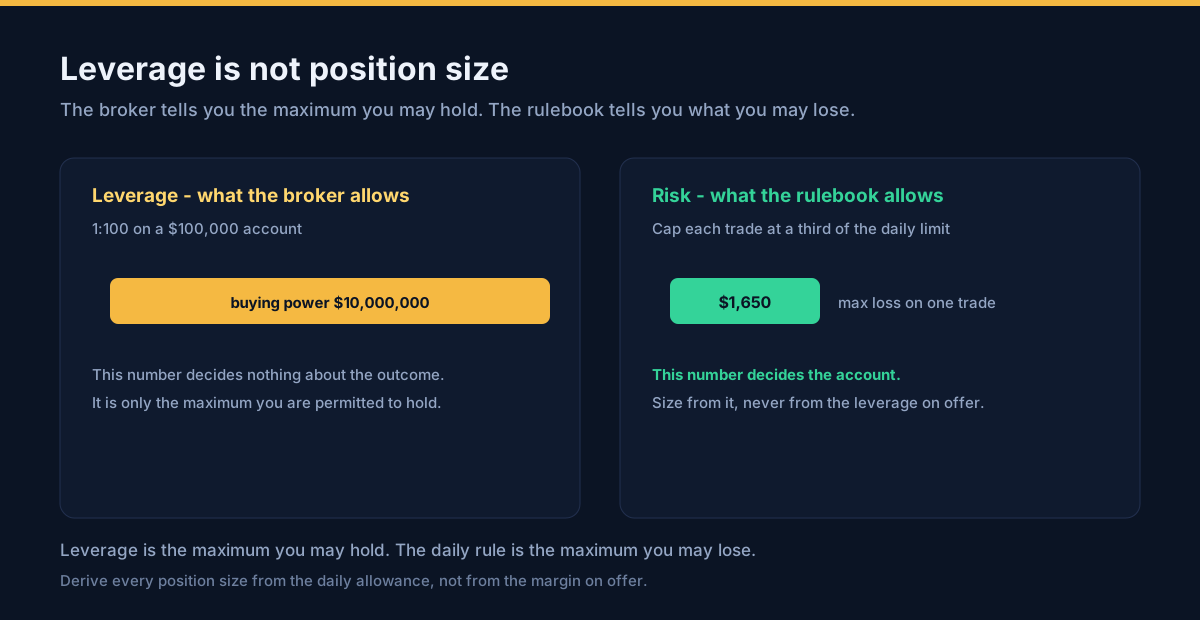
Micro futures are the instrument most funded futures accounts are actually traded in, and most explanations of them stop at the contract list. This guide covers what they are, how the point values work, why the small size matters more on an evaluation than on a personal account, and the sizing arithmetic that a fixed drawdown forces you to do every time you enter.
What micros are
Micro futures are exchange-traded contracts on the main US equity indices, sized at one tenth of the standard E-mini contract. They trade the same underlying index, over the same session, with the same mechanics. The only difference is scale.
| Micro | Index | Point value | Full contract |
|---|---|---|---|
| MES | S&P 500 | $5 | ES ($50) |
| MNQ | Nasdaq-100 | $2 | NQ ($20) |
| MYM | Dow | $0.50 | YM ($5) |
| M2K | Russell 2000 | $5 | RTY ($50) |
Every ratio is ten to one, so one full contract equals ten micros of the same index in exposure terms. Contract specifications are set by the exchange and brokers publish the current values; confirm before trading a live account rather than sizing from a remembered figure.
The point value is the whole mechanism
A stop loss is a distance on a chart. The point value is what turns that distance into money. Everything about sizing follows from it:
A loss per contract = stop distance in points × point value.
So a 20-point stop costs $100 on MES, $40 on MNQ and $10 on MYM. The same chart, the same 20-point stop, three very different risks — and a trader who moves between instruments without re-running the arithmetic will find their position size wrong by a factor of ten. The MNQ calculation is worked through here.
Session hours
The index futures trade nearly continuously on trading days, with a daily maintenance break, rather than only during the US cash session. That has two consequences worth knowing:
- Your strategy has a time of day attached to it. Liquidity concentrates around the US cash open and thins substantially overnight. A setup that works at the open may behave differently at 3am, because the participants are different.
- Overnight holds are possible on the instrument, but a prop firm's own rules may restrict holding through certain periods regardless of what the contract allows. Weekend and holding rules are separate from contract hours.
Why micros matter on a funded account specifically
On a personal margin account, the reason to trade micros is that you cannot afford the full contract. On a funded account the reason is different and more interesting: precision.
The granularity argument, again
A drawdown rule is a hard number. If one contract risks more than your per-trade budget, the contract is unusable. If it risks much less, you can take several and land close to the budget. Micros make the second case available at almost any account size, which is why the same account can be traded to its rules rather than around them.
Work an example on a $50,000 account with a $1,000 daily loss limit, risking a third of the daily limit per trade — about $333 — with a 40-point stop:
| Instrument | Risk per contract | Contracts within budget |
|---|---|---|
| ES (full) | $2,000 | None — the single contract exceeds the budget |
| MES | $200 | 1 (a second would breach it) |
| NQ (full) | $800 | None |
| MNQ | $80 | 4 |
The full-size contracts are simply unavailable at this risk budget. The micros are available at a precise count. That is the case for micros on an evaluation, and it holds at almost any account size a firm issues.
A sizing routine that works every time
Write down the daily loss limit
From your own dashboard, not from memory or from an article. This is the number that ends accounts.
Decide the per-trade fraction
A third of the daily limit means three ordinary consecutive losers still leave you inside it. Half means two.
Place the stop where the idea is wrong
Structure, not a round number of points. The stop is a decision about the trade, not a sizing input you choose to make the maths tidy.
Convert with the point value
Stop × point value gives the per-contract risk. Divide the budget by it for the contract count.
Round down, never up
A contract count that leaves part of the budget unused is correct. Rounding up to consume the full allowance is how a position becomes larger than the plan that justified it.
Reduce when volatility rises
Wider structural stops follow wider ranges, so the same risk budget produces fewer contracts automatically — provided you re-run the arithmetic rather than keeping a fixed count.
What to check before you rely on any figure
- Point and tick values — set by the exchange, published by your broker.
- Margin requirements — the exchange requirement and the broker's intraday figure are different numbers, and both are revised. Covered here.
- The firm's exposure limits — some evaluations cap contracts or lots regardless of margin.
- Commission per contract — charged per contract, so ten micros usually cost more than one full contract for the same exposure. On a small account this is trivial against the value of precise sizing.
Frequently asked questions
The FAQ block covers what micro futures are, which contracts exist, how they differ from E-minis, why prop traders use them, trading hours, capital requirements and whether they suit a challenge. Related: micro E-mini versus E-mini, margin requirements and the best futures prop firms.
What are micro futures?
Which micro futures contracts exist?
How do micro futures differ from the E-minis?
Why are micro futures popular with prop firm traders?
What hours do micro futures trade?
Do I need a lot of capital to trade micros?
Are micro futures good for a prop firm challenge?
Have a question before you commit?
Ask us anything about your firm, your account size or whether a passing service suits you. Two ways to reach us, both answered by a person: Telegram @voraspas, or email support@elitepropx.com. No forms, no queues.
Ready to pass your prop firm challenge?
Flat $220 per evaluation — we trade it for you and hand over a funded account. No hidden cuts, no monthly fees. Send your firm and account size on Telegram or by email and we will confirm availability, the current rules and the timeline.