
Evaluation service · rules checked 7 November 2026
We pass your Goat Funded Trader evaluation for a flat $220
Goat Funded Trader — GFT — is one of the few firms that sells six different evaluation models under one dashboard, and the differences between them are not cosmetic. A 1-Step account runs a 3% daily limit against a 6% total; the 2-Step Standard runs 5% against 10%; the GOAT Blitz runs a 3% target against a trailing 5% floor and a 2% floating-loss cap. The wrong model choice costs more than a bad trade does. This page covers the service for GFT specifically: which model to buy, how a pass is planned around a daily rule that resets at 5 PM EST, what the funded stage's payout gate actually requires, and what the handover looks like. Flat $220, any GFT account size, retries covered while the evaluation is open, no share of your payout.
Key takeaways
- GFT sells six models — 1-Step, 2-Step Standard, 2-Step GOAT, 2-Step PRO, 3-Step and GOAT Blitz — with profit targets from 3% to 10% and daily limits from 3% to 5%. The model, not the account size, sets the plan.
- Every model carries a static maximum loss except GOAT Blitz, whose 5% floor trails. The static ones are easier to defend; the trailing one needs an exit rule, not just a stop.
- The daily drawdown is calculated at 5 PM EST on balance or equity, so the trading day does not end when New York closes — it ends when GFT's clock does.
- The 2-Step GOAT model adds a 1% floating loss limit and Blitz a 2% one: open, unrealised losses count as a breach, which changes how many positions can be held at once.
- Funded accounts carry a $3,000 daily profit cap on most models and a payout gate of three profitable days — four on accounts bought after late July 2026, each day needing at least 0.5%.
- Flat $220 at any size, terms confirmed in writing before payment, retries at no extra fee, and the funded account handed back in your name.
Contents
- Six models, and why the choice decides the pass
- What a GFT evaluation is, model by model
- The 4% daily rule and the 5 PM EST reset
- The floating-loss clause most traders miss
- Sizing a position from a percentage budget
- The GFT terms check, before anything is bought
- The numbers the plan is written from
- Days, resets and the funded payout gate
- What the flat $220 covers at GFT
- Choosing a GFT account size and scaling
- The funded account after the handover
- A worked GFT pass, week by week
- Five ways a GFT attempt ends
- What this service will not do
- Frequently asked questions
Six models, and why the choice decides the pass
Most prop firms sell one evaluation shape with a choice of account size. GFT sells a product line, and the models are aimed at different traders rather than different budgets. That is convenient for a trader who knows what they want and dangerous for one who buys whichever tile is highlighted, because two models with the same account size and a similar price can require completely different trading.
The clearest way to see it is to compare the ratio inside each model: the daily limit against the total loss limit. On the 1-Step account that ratio is 3% to 6% — half the total budget is available in a single day, so a single bad session can consume a large share of the entire cushion. On the 2-Step Standard it is 5% to 10%, the same proportion but twice the absolute room. On the 2-Step PRO it is 4% against 8%, which is the same maths again with less room but a smaller second-phase target. Traders read the target and ignore the ratio, and the ratio is what actually ends accounts.
The second decision is whether the floor is static or trailing. Five of the six models use a static maximum loss: the failure line is fixed at the opening balance minus the stated percentage and does not move, whatever the account earns. GOAT Blitz uses a 5% trailing floor, which means profit lifts the failure line behind it. A static account can be traded with a simple rule — never lose more than X. A trailing account needs a second rule about when to bank a winner, because an open gain that retraces has already tightened the account whether or not it is closed.
The third decision is time. GFT markets no time limits on its evaluations, which is a genuine advantage over firms that cap an account at 30 days, but it changes the psychology of a pass: a plan with no deadline drifts, and drift is expensive when the daily limit is the binding constraint. The service still writes a target date into the plan, because a date is what turns a target into a schedule.
Where a client has no strong preference, the recommendation is the 2-Step PRO model: an 8% first phase and 4% second against a 4% daily and an 8% static total gives the widest useful cushion relative to the target, and the smaller second phase means the account is not asked to repeat the first one. The 1-Step account is the alternative when speed matters more than cushion — 10% in one phase with no second stage, at the cost of a 6% total loss limit that a single 3% day eats half of. Both are defensible; buying the cheaper tile without reading which constraint binds is not.
What a GFT evaluation is, model by model
The figures below are taken from GFT's own help centre, read on 7 November 2026. Two caveats belong in the same paragraph as the table. GFT updates its models — several rows carry an amendment date in late July, August or November 2026 — and the dashboard shown at checkout is the version that governs your purchase, not a page on this site or a screenshot in a forum. Where a figure here disagrees with your checkout screen, the checkout screen wins and the plan is rewritten around it before the first trade.
| Model | Profit target | Daily drawdown | Maximum loss | What it changes |
|---|---|---|---|---|
| 1-Step | 10% (one phase) | 3%, or 2% if chosen at checkout | 6% static | Fastest route; the tightest total cushion of the six |
| 2-Step Standard | 10% then 5% | 5% | 10% static | The widest daily room; the most forgiving model to size into |
| 2-Step GOAT | 8% then 6% | 4% | 10% static | Adds a 1% floating loss limit on open trades |
| 2-Step PRO | 8% then 4% | 4% | 8% static | Smaller second phase, smaller total; the balanced choice |
| 3-Step | 6% ×3 | 4% | 8% static | Three smaller attempts at the same idea |
| GOAT Blitz | 3% (one phase) | 3% | 5% trailing | Smallest target, trailing floor, 2% floating cap, 5 qualifying days |
Two structural details sit underneath that table and matter more than any single percentage. The first is that all models except Blitz require three profitable days before a phase counts, and GFT defines a profitable day precisely: at least one position closed and a day's profit of 0.5% or more of the initial balance, net of fees and commissions. A 0.4% day is not a qualifying day, however many trades produced it. That definition turns "three days" into a real constraint for a trader whose plan expects small, frequent gains, and it is the single most common reason a target is reached but the evaluation is not.
The second is the funded-stage amendment. For accounts purchased after 25 or 27 July 2026 — the date differs by model — the payout gate requires four qualifying days rather than three, and the requirement resets after every payout. A trader who passes on a pre-July account and a trader who passes in November are therefore holding different products at the payout stage, and the plan has to be written for the version actually owned. This is exactly the kind of detail a screenshot-based comparison misses, and it is why the terms check happens before payment rather than after.
The 4% daily rule and the 5 PM EST reset
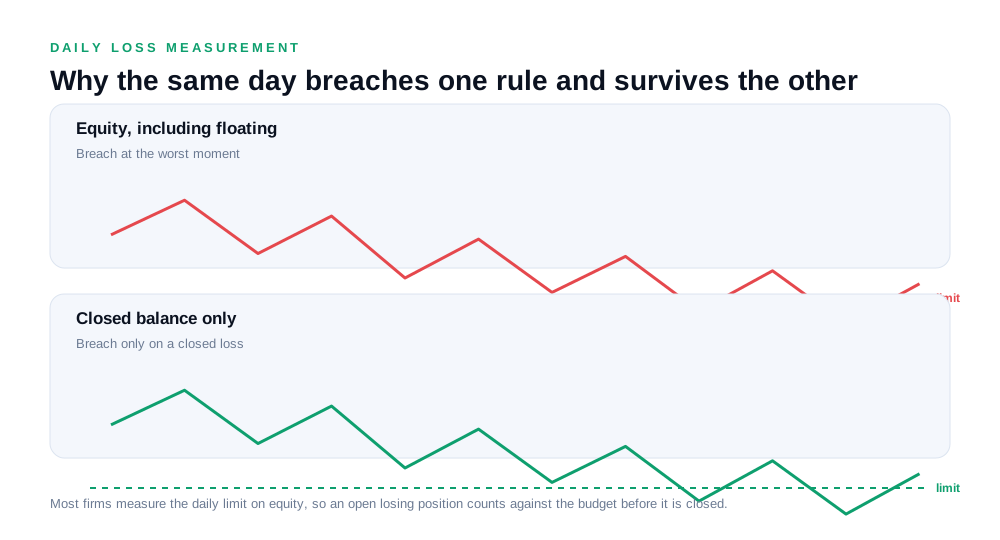
The daily drawdown is the constraint a GFT attempt touches first, and it has a definition that catches people who assume a trading day ends when the New York session does. GFT calculates the daily limit at 5 PM EST, based on account balance or equity. That means the boundary is a firm-clock event, not a market event: a position opened at 4:58 PM and held through the roll sits inside the new day's budget from 5:00 PM whether or not a single new trade is placed.
The practical consequence is that the daily budget has to be measured from the equity at the reset, not from the day's opening balance as the trader remembers it. If the account is 1.2% down when the clock turns, the next day's 4% limit is measured from that lower figure, so the room is smaller than the headline percentage suggests. Traders who keep a spreadsheet from the previous morning and stop trading at "4% below yesterday's open" are running a larger risk than they think.
There is a second consequence that matters more for a service pass. Because the limit is on equity, an open position that is 3.5% underwater at 4:55 PM is 3.5% of the next day's budget spent before the day begins, and if it moves further after the reset the daily breach can happen without a new order being placed. The plan therefore treats the reset as a decision point: positions are reduced or closed into 5 PM EST unless there is a written reason to carry them, and the reason has to be about the trade, not about wanting to be right.
On the funded account the same clock governs a different rule. Most GFT models impose a $3,000 daily profit cap once the account is funded, so a single enormous session does not count in full. That is not a pass condition and it is easy to ignore until a withdrawal is reviewed, which is why the plan keeps any single session's result modest relative to the total from the first week of the evaluation onwards. A record built in one heroic day is a record that has to be rebuilt later, on an account with its own limits.
The floating-loss clause most traders miss
Two GFT models restrict open, unrealised loss in addition to the daily and total figures: the 2-Step GOAT model carries a 1% floating loss limit, and GOAT Blitz carries a 2% one across all open trades combined. This is a different kind of rule from a stop-out level, and it changes position management rather than position size.
Under a floating limit, the breach happens while trades are open, not when they are closed. Two positions each 0.6% underwater are a 1.2% floating loss, which on the GOAT model is already past the limit even though neither has hit a stop and neither would have been closed by a discretionary trader waiting for a bounce. The rule effectively caps concurrent exposure, and it makes correlated positions dangerous in a way that a percentage daily limit does not: two long positions in EURUSD and GBPUSD are one bet on dollar weakness, and the floating figure reads them together.
For a pass this produces a concrete planning rule. On a model with a 1% floating cap, the sum of the stop distances on all open positions must stay under that cap at all times, which usually means one position at a time, or several very small ones. The temptation — open three small trades because the total risk "adds up the same" — is exactly what the clause is written to prevent. On Blitz the 2% cap is more permissive but pairs with a trailing 5% floor, so the two constraints interact: an open loss near the cap is also eating floor that has already moved up with profit.
How the plan handles it. On floating-cap models, exposure is treated as a single number that includes open loss: new entries are refused while the floating figure is above 0.6% on GOAT or 1.2% on Blitz, and hedged pairs are not used to "cancel" the number, because a hedge is two positions with two spreads and a firm that sums absolute exposure will read it as one.
This is also where a service decision has to be honest with the client. A floating rule makes a fast, aggressive pass harder to produce, so on those models the expected timeline is longer than on the 2-Step Standard at the same account size. Quoting a single timeline across all six models would be a sales answer, not a factual one.
Sizing a position from a percentage budget
GFT's limits are percentages, which makes the sizing arithmetic continuous rather than quantised: any lot size is possible, so the risk per trade is a decision rather than a rounding. That sounds easier than a futures rulebook and is in practice harder, because there is no natural unit that stops a trader from oversizing "just slightly". The plan fixes the unit before the first trade.
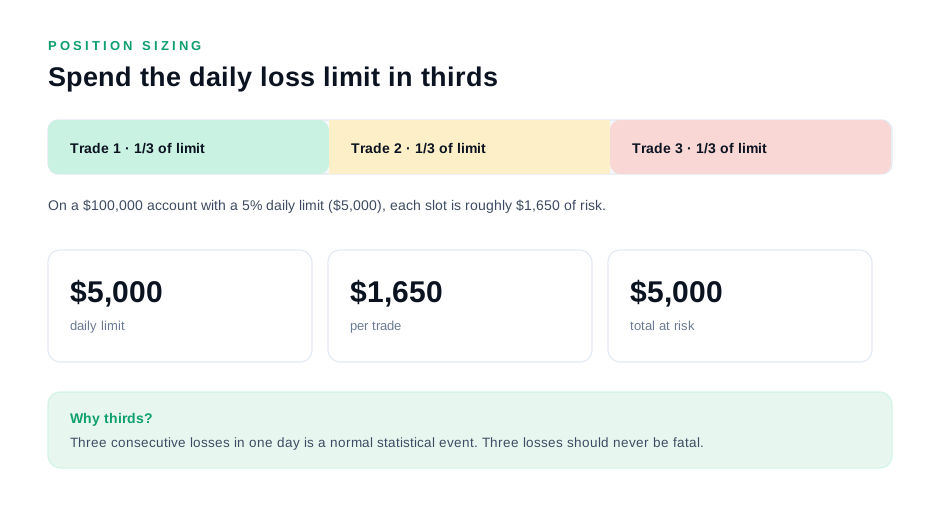
The sequence is short and every step is derived. Take the binding limit — on most GFT models that is the daily drawdown, not the total loss — and convert it into money: 4% of a $100,000 account is $4,000. Divide by the number of losses the day is allowed to contain: at four losses that is $1,000 of risk per trade. Convert that into lot size from the stop distance in pips and the pair's pip value, and round down. The answer is the maximum size for the day, and it is not adjusted upward because a setup looks unusually good.
The number that follows from the same maths is the one worth writing on the plan: how many consecutive losses the total-loss floor allows. On a 2-Step PRO account with an 8% static floor and risk at 1% of balance, that is eight losses with no recovery in between; at 1.5% it is five; at 2.5% it is three, and three is not a cushion, it is a coin toss with paperwork. If the answer is under six, the risk is too high for the account regardless of how the model's target reads.
One GFT-specific wrinkle: because the daily limit resets on equity at 5 PM EST, a plan that carries positions overnight is effectively borrowing from tomorrow's budget. The service prices that in by halving the permitted risk on positions held through the reset, which is a crude rule but an honest one — it makes the cost of holding visible at the moment of the decision instead of at the moment of the breach.
The GFT terms check, before anything is bought
No payment happens until three questions are answered in writing from GFT's own documents, and the answers are given even when they end the conversation. This is the part of the service that costs the most work and produces the least marketing, and it is the part that decides whether a pass is worth anything at all.
Is the evaluation permitted to be traded by someone else? Prop firm terms differ on this and the differences are decisive: a firm that permits assistance during the evaluation and prohibits it on the funded account produces the worst outcome available — a paid pass that is voided at the first withdrawal. GFT's terms are read directly, and where a clause is silent the working assumption is that it is not permitted, because a silent clause is one the firm can interpret later. The account-sharing rules across firms sets out why silence is not permission.
Does the permission, if it exists, extend past the pass? The funded stage is checked separately from the evaluation, every time, because the two documents are not always consistent and the payout is decided under the second one.
What does ownership require? The account is bought in the client's name, paid for with the client's method, and identity verification is completed by the client. GFT's promotional codes — the firm runs frequent 40% and 50% promotions — make buying several accounts tempting, and the temptation is worth resisting for a reason unrelated to cost: multiple accounts opened from one identity and traded in the same direction are one position with several invoices, and firms that aggregate exposure can treat that as a breach of the same clause that covers duplicate accounts.
Two conduct details are read at the same time, because they decide which sessions exist rather than how big a position may be. GFT allows news trading and weekend holding on its standard models, which is a real advantage over firms that black out releases — but the allowance is per model and per account vintage, not universal, and a plan that assumes it without checking is a plan built on a forum post. Position limits, if any, are read at the size being bought for the same reason.
The numbers the plan is written from
The trading itself is unremarkable, which is the point of a plan. Six numbers are fixed before the first session and checked at the end of every week, and every one of them is derived from the model's own document rather than from a market view.
- Risk per trade as a fraction of the daily budget, sized so that two consecutive losses leave the day's room intact. On a 3% daily model that is a tighter constraint than the same trader would face on the 2-Step Standard, and the size follows automatically.
- A session stop at the point where the day's loss has consumed the planned budget — self-imposed on every model, because a firm's daily limit is a breach threshold, not a risk management tool.
- A per-session profit ceiling as a share of the remaining target, which is what keeps the funded-stage $3,000 daily cap from becoming a problem later and keeps the qualifying-day count honest.
- A qualifying-day plan: the calendar is built around days that clear 0.5% net, because three of them — four on newer accounts — are required before a phase counts, whatever the profit target says.
- A reset discipline around 5 PM EST: reduce or close into the clock unless there is a written reason to carry, and never size a new position as if the previous day's loss had not happened.
- A weekly circuit breaker — two losing sessions end the week. The cost is a few days of calendar; the alternative is the sequence that ends evaluations, which is a loss, a size increase to recover it, and a second loss into a limit that has already been touched.
Why the qualifying-day rule changes the target maths. A 6% target on a 3-Step model looks like two good weeks. If the plan averages 0.4% a day, the target arrives while the qualifying days do not, and the account sits at target waiting for sessions that clear 0.5%. The plan therefore sets a floor as well as a ceiling: a session either clears 0.5% net or is not counted as progress.
Reporting runs weekly at minimum, with same-day notification if an attempt is lost. What the client receives at the end is GFT's own confirmation of the pass in the dashboard, not a summary written by the service — a distinction worth insisting on, because a screenshot of someone else's equity curve is not evidence of anything.
Days, resets and the funded payout gate
A GFT pass is measured in weeks, and the drivers are worth naming precisely rather than quoting one flattering number for every model.
The qualifying-day requirement sets the floor. Three profitable days per phase on most models means a phase cannot be completed in a weekend of lucky sessions even if the target is met on the first one. On Blitz the requirement is five days, and paired with a 3% target it makes that model a patience test rather than a speed test despite the name.
The model sets the ceiling. A 10% target on a 3% daily budget is not three days of work; a plan that risks a full 3% per day to reach it is one that breaches on the first bad session. The realistic arithmetic on the 1-Step model is four to six weeks at a risk level that survives a losing streak, and the same trader on the 3-Step model is looking at a similar calendar for a smaller target across three phases. Where a client wants a shorter timeline, the honest answer is a smaller account size on a two-phase model, not more risk on the cheap one.
A losing week is budgeted, not unexpected. Two losing sessions trigger the pause, and the pause costs four or five sessions of the calendar. That is the trade being made deliberately: a longer project in exchange for an account that survives to use its own no-time-limit advantage. GFT's evaluations do not expire, which means the pause is affordable — on a firm with a 30-day window the same pause would be the whole evaluation.
Resets are a cost, not a strategy. GFT sells resets at both the evaluation and funded stages, and a trader who plans to use them has stopped managing risk and started paying to repeat a mistake. The service treats a reset as evidence that the plan is wrong, and the plan is rewritten before the replacement account is traded. The failure recovery process is the same one used across firms.
What the flat $220 covers at GFT
The fee is $220, once, per evaluation, at any GFT account size from $1,000 to $400,000. It does not change with the model, and it does not change with the firm's own fee — which is a separate cost paid to GFT and varies by model, size and whatever promotion is running that week. Both numbers belong in the conversation before payment, and the firm's fee is the client's to pay directly, not something the service absorbs or marks up.
| What the $220 pays for | What it does not |
|---|---|
| The rule audit of your model, phase structure and account vintage | The evaluation fee GFT charges for the account |
| The written plan: risk, session stop, qualifying-day schedule, reset discipline | A guarantee that the evaluation is passed |
| The trading of the evaluation to the target, within the rules | Any share of your funded profit — there is no profit split |
| Retries at no extra fee while the evaluation is open | Resets charged by the firm, which are paid to the firm |
| Weekly reporting and the handover of the funded account in your name | Advice on what to trade after the handover |
That structure is deliberately unglamorous, because the alternative pricing models in this market are worse for the client. A percentage-of-payout arrangement aligns provider and client on the surface and in practice encourages a pass that maximises the first withdrawal rather than one that survives a consistency test. A large upfront fee with no retries turns a losing attempt into a lost purchase. A flat fee with covered retries makes the provider's incentive simple: get the account to the target without touching a limit, because a second attempt is unpaid work. The fee comparison works through the arithmetic on a real GFT purchase.
One point about the firm's own pricing that is worth stating plainly, because it is where clients get surprised. GFT's promotions are aggressive and frequent — 40% and 50% codes are advertised on its own homepage — and a discounted fee is still a fee that is not refunded if the evaluation is lost. Buying a cheaper account because it is discounted, rather than because its limit structure fits the plan, is the most expensive mistake in this market.
Choosing a GFT account size and scaling
Account size decides the payout ceiling, not the difficulty. Because GFT's targets and limits are percentages, a $100,000 account and a $10,000 account require the same percentage move; what changes is the money attached to each percentage point, and therefore the money at risk per trade in absolute terms. A trader who is comfortable losing $300 in a session is not made more capable by buying a $200,000 account, only more exposed.
The usable question is what a realistic payout looks like at each size. GFT's funded accounts run an 80% split on several models and advertise up to 100% on demand on others, with a $30 million total paid out across the firm's history according to its own homepage — a marketing figure this page repeats as the firm's claim, not as an independent finding. At an 80% split, a 4% month on a $100,000 account is $3,200 to the trader before any cap or consistency consideration. That is the number worth comparing against the evaluation fee, and against the $220, before choosing a size.
GFT also runs a scaling path toward $2 million of simulated capital and sells accounts up to $400,000. Scaling is worth reading before purchase rather than after, because the conditions are usually a run of profitable months rather than a single good one, and because a scaled account carries the same daily profit cap as the original — a $600,000 account with a $3,000 daily cap is a different product from the one the plan was written for. The scaling plan guide covers how those ladders usually work.
The funded account after the handover
The handover is where the service stops and the client's own trading begins. What is handed back is the GFT funded account in the client's name, with the firm's confirmation of the pass, and a written note of the funded-stage rules that now apply. It is not a promise of a payout, and this page will not pretend otherwise: the funded account keeps every limit the evaluation had, plus a few that only exist after funding.

Three funded-stage rules shape what happens next. The $3,000 daily profit cap on most models means a single large session does not translate into a single large payout. The qualifying-day requirement — three days, or four on accounts bought after late July 2026, each at least 0.5% net — resets after each payout, so the payout cycle is a repeating test rather than a one-off. And the firm's payout cycle decides when a request can be made at all, with on-demand and fast-payout options varying by model. The payout process guide covers the mechanics across firms, and the denied payout cases show what a failed gate looks like.
The service's position on what follows is deliberately narrow. It does not trade the funded account unless the client buys a separate arrangement, it does not promise a payout, and it does not present a passed evaluation as a business result. A pass is the removal of one obstacle — the fee and the calendar — not a guarantee that the account behind it will be profitable.
A worked GFT pass, week by week
The example below is a $100,000 2-Step PRO account — 8% then 4%, 4% daily, 8% static total — and every figure is derived from those numbers rather than chosen for the narrative. The aim is to show what an honest schedule looks like, including the weeks where nothing much happens.
Week one — plan and calibration. Risk is set at $800 per trade, which is 0.8% of balance and one fifth of the daily budget. Four losses in a session would use 3.2% of the 4% limit, so a fifth entry is refused by rule. Target for the week: 2%, ideally spread across three qualifying days. Outcome in a normal week: two qualifying days, one flat day, one small loss, ending around 1.4%. Nothing dramatic, and the 8% total floor has barely been approached.
Week two — the first test of discipline. A 1.9% loss day arrives early. The session stop triggers at $4,000 of loss on the day and closes the platform; the weekly circuit breaker is not reached because the next session is flat. What matters is what does not happen: no size increase on the following day, and no doubling of the previous plan's risk to recover the week. The account sits at roughly 0.5% down on the month, with 7.5% of static room intact.
Week three — the target approaches. Two good sessions put the account 5.6% up. Risk tapers from $800 to $500 for the final third of the phase, because at 5.6% the remaining distance to 8% is small and the cost of a 1% drawdown near the finish is disproportionate. The phase completes at 8.2% on the eleventh qualifying day, with a best day of 1.3% — a distribution that will not create a payout problem later.
Week four — phase two. A 4% target with the same daily limit and the same floor, now measured from the higher balance. Two sessions at 1.1% and 1.2%, a flat week, then a third session at 1.8% completes it. Total calendar: under five weeks, which is a good outcome rather than a typical one. A more honest median for this model is six to eight weeks, and the plan says so before the client pays anything.
Two things about the example are worth stating explicitly because they are the parts a marketing page would cut. The distribution is deliberately flat — the best day is 1.3% — because the funded stage's daily cap and qualifying-day rules punish a lumpy record. And the losing week is not treated as a deviation to be recovered; it is treated as the week the plan was written for. The GFT rulebook guide walks through the firm's model structure in more depth, and the consistency rule guide covers why flat distributions matter at payout.
Five ways a GFT attempt ends
These are not hypothetical. They are the patterns that show up across firms with percentage-based limits, and GFT's model set makes each of them slightly more likely for a specific reason.
Buying the cheapest tile instead of the right model. The 1-Step account is frequently the cheapest per dollar of target and the hardest to survive, because a 6% total floor with a 3% daily limit halves the cushion in one session. Traders choose it for the price and then trade it like a 2-Step Standard account.
Missing the qualifying-day rule. The target is reached in five strong sessions and the phase does not complete, because two of them were under 0.5% net. The trader then overtrades to manufacture qualifying days and breaches a limit instead. The plan builds the day count in from the first week for exactly this reason.
Treating the 5 PM EST reset as a market close. Positions are carried through the reset without the budget being recalculated, and the next day's limit is measured from an equity figure the trader never looked at. The breach looks sudden from the platform and obvious from the rulebook.
Ignoring the floating-loss cap on GOAT and Blitz. Two correlated positions, each comfortably inside its own stop, add up to a floating loss above 1% and the account closes while both trades are still open. No stop was hit; the sum was.
Buying several accounts after a promotion. Four discounted $100,000 accounts traded the same way are one position with four invoices. Firms that aggregate exposure can read that as a breach of the duplicate-account clause, and a discounted account is not a cheaper way to buy four attempts — it is a faster way to lose the permission to use any of them.
What this service will not do
The limits are stated in the same place as the offer, because a service page that only lists what it will do is a sales page.
It will not trade an account whose terms prohibit third-party trading, and it will say so in writing before any fee is discussed. It will not trade a funded account as part of the $220. It will not guarantee a pass, a payout, or a timeline shorter than the model's own qualifying-day rules allow. It will not use a strategy that requires breaching a rule to work — no news blackout violation, no duplicate-account arrangement, no hedge pair designed to hide exposure from a floating-loss cap. It will not take a share of profit, which means it also will not take a share of risk beyond the flat fee.
And it will not pretend that a $220 fee plus a firm's evaluation fee is a small amount of money. On a $100,000 GFT account the firm's own fee is several hundred dollars even after a 50% promotion, and a lost evaluation costs that fee again. The free demo test on the demo page exists for exactly this reason: watch the process on a broker demo for a week before spending anything on either side of the transaction.
Frequently asked questions
Which GFT model should I buy?
The 2-Step PRO model for most traders: an 8% then 4% target against a 4% daily limit and an 8% static total gives the most usable cushion relative to the target. Choose the 1-Step only if speed matters more than cushion, and treat GOAT Blitz as a patience test despite its name — a 3% target with a 5% trailing floor, a 2% floating cap and five qualifying days is not the easy option.
What is the daily drawdown at GFT and when does it reset?
It varies by model: 3% on the 1-Step (2% if chosen at checkout) and on GOAT Blitz, 4% on 2-Step GOAT, 2-Step PRO and the 3-Step, and 5% on the 2-Step Standard. It is calculated at 5 PM EST on balance or equity, so the trading day ends on the firm's clock rather than at the New York close. Positions held through the reset sit inside the new day's budget from that moment.
What counts as a qualifying trading day?
At least one position closed and a day's profit of 0.5% or more of the initial balance, net of fees and commissions. Most models require three qualifying days per phase; accounts bought after late July 2026 require four before a payout on the funded stage, and the requirement resets after every payout.
Is the maximum loss static or trailing?
Static on the 1-Step (6%), 2-Step Standard (10%), 2-Step GOAT (10%), 2-Step PRO (8%) and 3-Step (8%) models. Trailing on GOAT Blitz, which uses a 5% floor that follows peak equity. On the static models the failure line never moves, whatever the account earns; on Blitz, profit lifts it.
What is the floating loss limit on the 2-Step GOAT model?
1% across all open trades combined, and GOAT Blitz uses 2%. It is a breach while positions are open, not a stop level: two positions each 0.6% underwater are a 1.2% floating loss, which is already past the limit on the GOAT model even though neither stop was hit.
Does GFT allow news trading and weekend holding?
GFT advertises news trading and weekend holding as features on its standard models, and they are a genuine advantage over firms that black out releases. The allowance is per model and can change with account vintage, so it is confirmed on the account being bought rather than assumed from the homepage.
How long does a GFT evaluation take to pass?
Typically four to six weeks on a one-phase model at a risk level that survives a losing streak, and six to eight weeks on a two-phase model. The qualifying-day requirement, not the profit target, is usually the binding constraint. Anyone quoting two weeks is either risking a large share of the daily budget per trade or ignoring the day count.
What is the profit split and payout cycle on a GFT funded account?
80% on several models, with up to 100% advertised on demand on others, and the firm markets payouts within two days. A $3,000 daily profit cap applies on most funded models, so a single large session does not translate into a single large withdrawal. The split and cycle are confirmed per model before purchase.
Does the $220 include the evaluation fee GFT charges?
No. Two separate costs: the firm charges for the account, and the service charges a flat $220 for the pass. The firm's fee is paid directly by the client, varies by model, size and promotion, and is not refunded by GFT if the evaluation is lost. Both numbers are stated before anything is paid.
Is it permitted for someone else to trade my GFT evaluation?
That is the first thing checked, from GFT's own documents, and the answer is given in writing before any fee is discussed — including when the answer is no. Where a clause is silent, the working assumption is that it is not permitted, because a silent clause is one the firm can interpret at the payout stage.
What happens if the evaluation is lost?
The attempt is retried at no extra service fee while the evaluation is open, and the plan is rewritten before the replacement account is traded — a lost account is treated as evidence that the plan was wrong, not as bad luck. What is not recoverable is GFT's own evaluation fee, and the page says so rather than implying otherwise.
Start with the rulebook, not the fee
Send the model, the account size and the phase you are on, and the reply contains the fee, the calendar in trading days, and an honest note about whether GFT's terms make a paid pass a sensible idea on your account. If the answer is that it does not, that is the answer you get.