
Due diligence · reviewed October 2026
Prop firm scams to avoid
Most firms accused of being scams are not scams; they are strict. The genuine problems follow eight patterns, and every one of them is visible before a fee is paid — if you know which questions produce an answer that can be checked.
Key takeaways
- A strict rulebook is not a scam. A rule that changes after you paid is.
- The eight patterns that repeat are about disclosure, payout behaviour and enforcement timing, not difficulty.
- No prop firm holds client money in a segregated account, so the payout is a contractual payment rather than a withdrawal of assets you own.
- Every pattern below is testable before purchase with one email and a rulebook read.
Contents
Strict is not the same as fraudulent
The most common mistake in this conversation is conflating two different things. A firm with a 30% consistency rule, a trailing drawdown and a monthly payout window is strict — every one of those terms is disclosed, priced into the fee, and knowable before purchase. A firm that applies those terms only after you have paid, or that describes them in language designed to be misread, is doing something else.
When a trader says a firm "scammed" them, the honest answer is usually that a published rule was not read. That is not the firm's fault, and it is also not the end of the analysis: the firms worth avoiding are the ones that make the misreading likely, because the misreading is where their margin lives.
The three ways disclosure goes wrong
First, omission: the payout conditions are not on the pricing page, and the trader buys without seeing them. Second, contradiction: the marketing page says one thing and the terms say another, so which applies depends on who reads it first. Third, retroactive change: the rule is disclosed, understood and then altered mid-attempt.
Only the third is a genuine scam in the ordinary sense of the word, and it is the one that leaves a trader with no defence at all. The first two are choices about presentation, and both are defeatable by reading the objectives and payout pages before paying rather than after passing.
Why difficulty attracts accusations
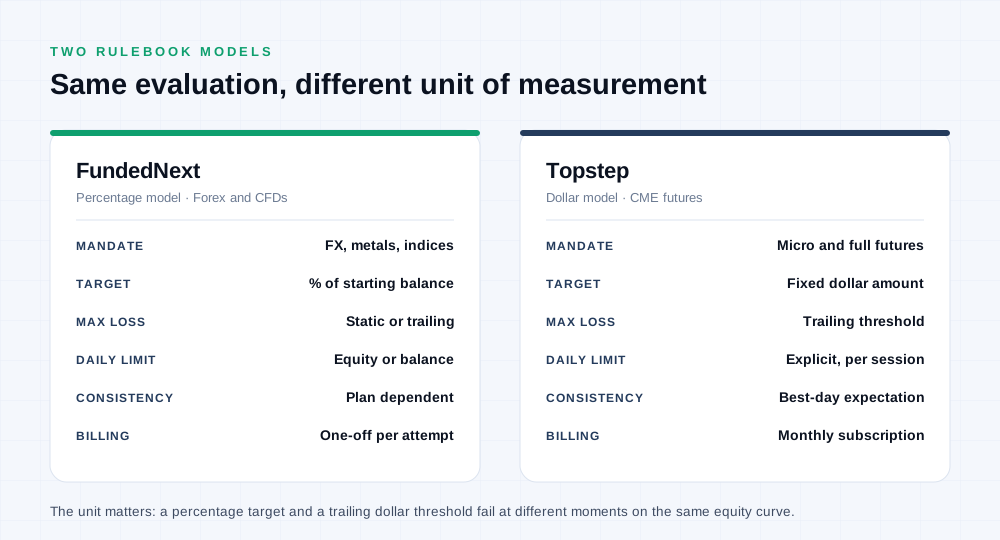
Futures firms with trailing drawdowns and consistency rules generate a disproportionate share of negative reviews for a structural reason: their mechanics convert profitable accounts into unpaid accounts. A trader who is 6% up with a single dominant session has done nothing wrong and cannot withdraw, and the experience of that is indistinguishable from being cheated.
The distinction that matters is whether the rule was in the terms when the account was bought. If it was, the firm sold you a product with an unattractive feature and disclosed it. If it was not, you have a complaint with evidence behind it.
The eight patterns that repeat
Each pattern below is stated as an observable behaviour rather than an accusation, because the behaviour is what a buyer can test.
Pattern one: payout terms that require a support request
Terms that are not published cannot be checked, and terms that change cannot be proven to have changed. Firms that publish payout conditions on a stable URL are not automatically better; firms that do not are impossible to hold to anything.
Pattern two: rules revised mid-attempt
A target that rises, a drawdown that becomes trailing, a payout window that extends — after an account is live. This is the clearest scam pattern and the hardest to litigate, which is why keeping a dated copy of the terms at purchase is the single most useful habit available.
Pattern three: prohibitions enforced only after funding
A firm lists a prohibition quietly, tolerates it through the evaluation, and invokes it when a payout is requested. The economic effect is to collect the evaluation fee and never pay. A trader who asks about enforcement timing in writing before purchase has a record.
Pattern four: payouts that are always one step away
Each request produces a new condition: verification, a document, a minimum balance that was not mentioned, or a rule cited for the first time. A single delay is administrative. A sequence of new conditions across successive requests is a payout policy.
Pattern five: affiliate-driven review sites
Rankings that change with commission rate, "best firm" pages that link exclusively through affiliate codes, and review scores that do not move when payout complaints accumulate. This is a scam on the information layer rather than the firm, and it is the most common form in the category.
Pattern six: funnel-based account sales
Discord and Telegram operations selling accounts through urgency — a bonus expiring tonight, a price that only applies to the first twenty buyers. Individually harmless, systemically corrosive: the pressure exists to prevent exactly the rulebook reading that would change the decision.
Pattern seven: passing services that hold the funded account
A provider that keeps the login, receives the payouts and pays the client a share has created a counterparty arrangement with no enforcement. The client's leverage is a chat message, and reviews of such arrangements tend to describe delays that are indistinguishable from refusal.
Pattern eight: no identifiable operator
No company name, no registered address, no terms of service, no named person. Not every anonymous operator is fraudulent, and every fraudulent operator is anonymous. Where no entity is identifiable, there is nobody to complain to and nobody to sue.
Testing a firm before you pay
Five tests, all free, all answerable before a fee is paid. Together they catch every pattern above except a retroactive rule change, which is caught by keeping a dated copy of the terms.
Test one: can you find the payout terms in under two minutes?
Not "does the site mention payouts" — can you find the profit threshold, the minimum trading days, any consistency ratio and the processing schedule. If any of the four is missing from the published terms, ask for it in writing. The reply becomes part of your record.
Test two: does the marketing page agree with the terms page?
Read both. Where the marketing says "10% drawdown" and the terms describe a trailing mechanic, the terms win and the marketing is a warning. One contradiction is carelessness; two in the same document set is a design choice.
Test three: what is the enforcement timing on prohibitions?
Ask directly: "if a prohibited position is opened during an evaluation, is the account closed at that point or at review after funding?" The answer matters more than the list, because enforcement after funding is the configuration that costs a client the whole account.
Test four: who is the legal entity?
Company name, jurisdiction, registered address, terms of service with a date. Every legitimate operator can be named. An operator who cannot be named has removed the only remedy a client would have.
Test five: what do the payout complaints look like?
Search for payout problems rather than for reviews. Read the responses: an operator who answers with a rule and a date has a policy; one who answers with reassurance about how much they value customers has a communication style.
The record you should keep
Save the objectives page and the payout page as they stood on the day of purchase, with the date, plus any written replies from support. It takes two minutes and it is the only thing that converts an argument about what the terms said into a question with an answer.
Scams on the service side
Passing services have a different failure mode from firms, because the product is a service rather than an account. Four patterns cover most of the problems.
Pattern one: the provider keeps the funded account
The client passes, the provider retains the login and receives the payouts, and the client is paid a share. The arrangement has no enforcement mechanism: the client's only leverage is a message, and the incentive structure rewards delay. Any arrangement where the funded account is not in the client's name should be treated as a red flag rather than a convenience.
Pattern two: the fee with no stated failure terms
A fee is paid, the evaluation fails, and the answer to "what happens now" is a conversation rather than a clause. Retry terms should be in writing before payment, and they should name the firm, the size and the trigger conditions.
Pattern three: promises of a guaranteed pass
Evaluations contain variance. Any provider offering certainty has either narrowed the definition of a pass, or intends to keep charging until one occurs, which is a different product from the one advertised.
Pattern four: work that never starts
The fee is collected and the evaluation is never traded, with the delay attributed to scheduling. A useful test is to ask for a start date before paying: a provider with capacity can give one, and one without cannot.
What a sound service looks like
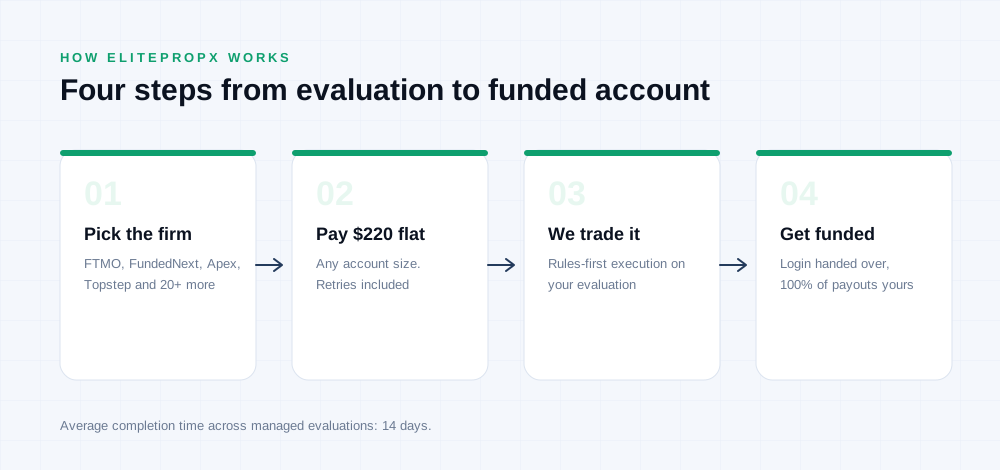
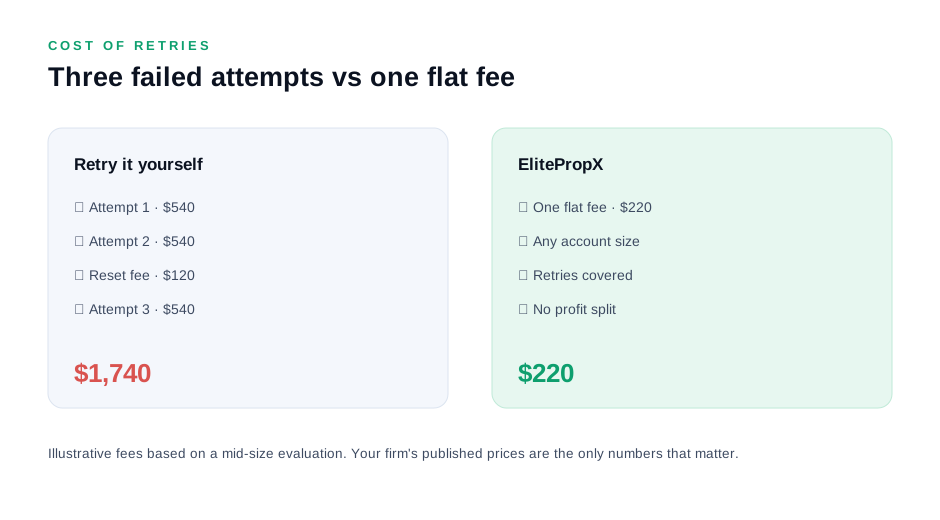
One flat fee for any firm and any account size, the funded account in the client's name with payouts paid directly, no profit split, retry terms in writing, a refusal list that includes firms whose terms make the arrangement unsafe, and evidence available before purchase rather than after. At ElitePropX that is the whole offer, at a flat $220.
What the legal position actually is
The legal reality of prop trading is unglamorous and worth understanding before it matters, because most of the anger in this market comes from a mismatch between what traders assume and what the agreements say.
Funded accounts are usually simulated
Most prop firms describe their funded accounts as simulated accounts with performance-based remuneration. There is no brokerage account, no client money held in segregation, and no investor protection scheme. The payout is a contractual payment from the firm to you under the terms you agreed, not a withdrawal of assets you own.
That distinction has three practical consequences. The balance shown is a licence to earn rather than savings. The firm can revoke it under the terms it published. And a dispute is a contract dispute in whatever jurisdiction the terms specify, which is frequently not the client's.
Why jurisdiction matters
Where the operating company sits determines what remedy exists. Firms registered in jurisdictions with a complaints process and a published address are meaningfully different from operators with no identifiable entity, even when the rulebooks look the same. A trader who has never checked the entity is relying on reputation alone, which is exactly what a fraudulent operator trades on.
What enforcement looks like in practice
Realistically, the remedies available to an individual are a chargeback on the fee where card payment was used, a complaint to the payment processor, and public pressure through reviews. None of them recovers an account, and all of them depend on a record of what was promised — which is why the dated copy of the terms is the single most valuable document a trader can keep.
If you have already been caught
Assuming a genuine problem rather than a misread rule, the sequence below is the one that recovers the most, in order.
Step one: write down what was promised and when
Dates, terms, screenshots of the pages as they were, email replies, payment receipts. The value of this is not emotional; almost every remedy depends on demonstrating what the terms said on the day money changed hands.
Step two: ask for the specific refusal in writing
Not "why was I not paid" but "which clause of the terms published on this date is being applied, and when did it take effect". A vague answer is itself useful evidence, and a specific answer tells you whether you have a case or a lesson.
Step three: use the payment route
Where the fee was paid by card, a chargeback for services not rendered is available within the card scheme's time limits. Where payment was made in crypto, this route does not exist, which is one reason crypto-only operators are worth treating with extra caution.
Step four: publish the specifics
A review naming the firm, the date, the account size and the clause relies on accuracy rather than volume. Specific, dated complaints are the only kind that influence a firm's behaviour, because they can be checked by the next reader.
Step five: check the passing service separately, if one was involved
Where a service traded the evaluation, ask what it knew about the firm's enforcement timing before accepting the assignment. A provider that checked and told you has done its job; one that did not has passed on a risk it should have priced, and the retry terms are the place where that shows up.
Reading a firm's terms like an auditor
The tests above are behavioural: they check what a firm does. This section is documentary: it checks what the terms actually commit the firm to, which is the only thing a complaint can rely on.
Look for the definition of a trading day
Minimum day counts are meaningless until you know what counts. Is a day with one trade a day? A day with a scratch? A day when a position was held but not opened? Where the definition is missing, the count is at the firm's discretion, and discretion is where disputes live.
Look for how the daily loss resets
Midnight server time, the broker's daily close, or a rolling twenty-four hours — three different rules with three different consequences for a trader active in more than one session. A terms page that does not say is a terms page that has not been finished.
Look for the trailing drawdown's update trigger
Peak equity, peak balance, end-of-day balance, or unrealised high-water mark. Each is stated in words that sound similar and behave differently, and the difference is worth several percent of room on a volatile instrument.
Look for what happens to an open position at the payout request
Some firms require a flat book; others allow a request with positions open. It is a small clause that becomes large at a month end when the processing window closes.
Look for the amendment clause
Almost every set of terms reserves the right to change. What matters is the notice commitment: whether changes apply to live accounts, whether clients are informed, and whether the version you bought is the version that governs your attempt. Where the answer is "we may change anything at any time", the terms are not an agreement so much as a licence.
Look for the dispute process
Named jurisdiction, stated process, defined response times. A terms page with no dispute clause assumes the question will never arise, which is a statement about the operator's confidence rather than its integrity.
Firms that look like scams but are not
An honest page on this subject has to list its own false positives, because most accusations in this market are aimed at firms doing something legitimate but unpopular.
Consistency rules
A 30% best-day rule delays payouts and looks arbitrary. It is disclosed, it is a filter for traders whose profit depends on rare days, and every trader buying the account can read it in advance. It is a feature of the product, not a fraud.
Trailing drawdowns
Stricter than static drawdowns, disclosed in the terms, and fatal to strategies that hold through pullbacks. The correct response is to choose a different firm, not to accuse this one of dishonesty.
Monthly payout windows
A firm that processes withdrawals monthly is slower, not fraudulent, provided the schedule is published. The variable worth caring about is whether the published schedule is met.
Tight prohibitions on strategies
Bans on latency arbitrage, copy trading between accounts and high-frequency exploitation are normal risk controls. Firms that enforce them are protecting the payout pool, which is in every other client's interest.
Firms that close accounts after review
The practice is legitimate where a rule was breached; it is objectionable where the rule is vague, unenforced during the evaluation and cited for the first time at payout. The distinction is enforcement timing, which is testable before purchase.
How this market is regulated in practice
Prop firms operate in a space that is lightly regulated compared with brokerages, and understanding the shape of that space explains why the advice on this page is procedural rather than protective.
Firms are not brokers
Because most evaluate and pay on simulated accounts rather than holding client funds, they sit outside the client-money protections that apply to a brokerage. There is no compensation scheme, no segregated account, and no regulator whose permission can be checked in the same way a broker's can.
That does not make the model fraudulent; it makes it contractual. A client's protection is the terms, the payment route and the reputation of the operator, in that order.
What consumer law can still do
Where the operator sells into a jurisdiction with consumer protection and takes card payments, the ordinary mechanisms apply: the sale must be as described, and a chargeback is available where it is not. That is why the dated copy of the terms matters. It converts "they changed the rules" into a document comparison.
Why the payment method is a protection decision
Card payments carry chargeback rights; crypto payments do not. A firm that accepts only crypto has removed a client's cheapest remedy, which may be an operational decision rather than a deliberate one and has the same effect either way. Where an operator offers both, using the card is rational even if the crypto route is faster.
Where the industry is heading
Disclosure is improving, driven mostly by competition and by the volume of public complaints. Firms that publish payout conditions and enforcement timing are now at an advantage with informed buyers, which over time pushes the market toward the standard a buyer should demand: terms that can be found, read and dated.
A one-page integrity checklist
- Named legal entity, jurisdiction and address published.
- Target, daily limit and its measurement point published together.
- Maximum loss mechanic stated, including whether it trails and when it updates.
- Minimum trading day count with a definition of a trading day.
- Payout conditions published: threshold, days, consistency, processing.
- Enforcement timing for prohibitions stated in writing.
- Amendment clause with a notice commitment.
- Dispute process with a named jurisdiction.
- Payment accepted by a route with a chargeback right.
- Payout complaints answered with a rule and a date.
Ten lines. A firm that satisfies eight is workable; a firm that satisfies four has told you what an attempt there is worth. None of the ten requires specialist knowledge, and all of them can be checked in the time it takes to read a pricing page twice.
Five scenarios, and what each teaches
These are composites of patterns that recur in public complaints, written to show how a check that takes two minutes changes the outcome.
Scenario one: the payout condition that appeared at payout
A trader passes a $50,000 futures evaluation in three weeks, requests a withdrawal, and is told a consistency rule applies. The rule is in the terms — page nine, under withdrawals. The evaluation was completed correctly and the payout is delayed until ordinary profit dilutes a single strong session from 55% of total profit to under 30%.
The lesson is not that the firm cheated. It is that "passed" and "paid" are two different events with two different conditions, and the second one was published and unread. The same trader, having read the payout section in week one, would have capped sessions at a fifth of the target and withdrawn on schedule.
Scenario two: the prohibition enforced after funding
A firm's terms list third-party trading as prohibited in a single line among eleven others. A passing service takes the assignment, the evaluation is completed, the funded account is issued, and three weeks later the account is closed at review and the balance forfeited.
Nothing in this sequence is illegal, and the entire loss sits with the client. The check that prevents it is one email to the firm asking about enforcement timing, sent before a fee is paid to anyone. A provider that puts the clause in writing lets the client decide rather than hiding the risk in a fee.
Scenario three: the account that was never traded
A service collects a fee, then reports delays: platform issues, scheduling, a rulebook query. Three weeks pass with no trades. The client asks for a start date, is given another estimate, and eventually stops asking.
The test is simple and costs nothing: ask for a start date before paying. A provider with capacity can name one. One that cannot is describing a pipeline rather than a plan, and the fee should stay unspent until a date exists.
Scenario four: the split arrangement with no enforcement
A provider offers to pass an evaluation free of charge and take 25% of payouts, with the funded account held in the provider's name. The pass happens, the first payout is delayed for a reason that sounds administrative, and the second request also slips. Over six months the client receives two-thirds of what was earned, and has no recourse, because the account was never theirs.
The lesson is that ownership is not a formality. An account in the client's name with payouts paid directly is the difference between a service and a counterparty arrangement, and it is the first thing to confirm before paying anyone.
Scenario five: the review site that ranked by commission
A trader researches for a fortnight using the top three search results, all of which are affiliate sites with "best firm" tables. The tables agree on the winner, because all three are paid by the same firm. The rulebook of the firm ranked fourth — which fits the trader's style far better — is never read.
The defence is to treat every ranking page as an advertisement, including this site's own comparison pages, and to work from the four mechanics instead: how the drawdown behaves, how the daily limit is measured, what the payout conditions require, and whether enforcement happens before or after funding. Those four questions do not have affiliates.
What the five scenarios have in common
None of them required technical knowledge to avoid, and all of them were preventable before money moved. In four of the five, the fix was a written question and a two-minute read; in the fifth it was refusing to let a ranking page stand in for a rulebook. That is an unusually favourable ratio for due diligence, and it is the reason this page is a checklist rather than a warning.
One habit ties the whole page together: keep a dated copy of the terms, the payout section and any written replies in a single folder, and add to it each time you buy an evaluation. It takes two minutes per purchase and it does two things at once — it makes the reading happen before payment rather than after a problem, and it turns every later disagreement into a question with evidence attached. Traders who do this rarely describe themselves as having been scammed, because they can see exactly which rule applied and when it was published.
The final point is about tone. Most firms in this market are ordinary businesses with strict products, and treating all of them as adversaries costs a trader the ability to use the ones that fit. The patterns on this page are specific for that reason: they describe behaviours worth refusing, not an industry worth avoiding. A trader who applies the ten-line checklist, keeps the dated record and asks about enforcement timing twice — once of the firm and once of any service — has removed almost all of the risk that is actually removable, and has left the rest where it belongs — with the market. That boundary is the whole skill: diligence is finite, the market is not, and a trader who knows which side of the line a question falls on stops spending evenings on questions no purchase can answer. Write the answers down, date them, and re-read them before the next purchase rather than after the next complaint, and the list will do the work that outrage cannot. Diligence is a habit, and habits are cheaper than disputes, and the ten-line checklist above is the whole habit in miniature, and it takes one afternoon to learn.
Frequently asked about prop firm scams
Are prop firms regulated?
Mostly not in the way a brokerage is. Because funded accounts are usually simulated and client money is not held, the client-money protections and compensation schemes that apply to brokers do not apply here. The protection is the contract, the payment route and the operator's reputation.
Is a tough rulebook a scam?
No. A trailing drawdown or a consistency rule disclosed before purchase is a strict product, not a fraudulent one. A scam is a rule applied or changed after the money is paid.
What is the clearest sign of a problem?
Rules revised mid-attempt, or prohibitions enforced for the first time at payout. Both mean the terms were not the agreement you thought you had, and both are why keeping a dated copy of the terms matters.
How can I protect myself before paying?
Read the objectives and payout pages, ask about enforcement timing in writing, check the legal entity, pay by a route with a chargeback right, and keep a dated copy of the terms you bought under.
Do passing services ever hold the funded account?
Some do, and it is the arrangement to avoid: it creates counterparty risk at the point where the client has the most to lose. The funded account should be in your name with payouts paid directly.
What does ElitePropX charge?
Will you take any firm?
Yes. What changes is the disclosure: before payment you are told in writing what the firm’s third-party trading clause says, whether enforcement is credible, and that the account holder carries that risk. A provider that will not put the clause in writing is the one to avoid.
What if a firm changes its rules mid-evaluation?
The plan is recalculated against the new terms, and where the target becomes unreachable within the original risk budget the choice is between a longer timeline at reduced size and abandoning the attempt. Continuing at the old size while assuming the old rules is the one option that does not work.