Smaller Prop Firms Compared (2026)
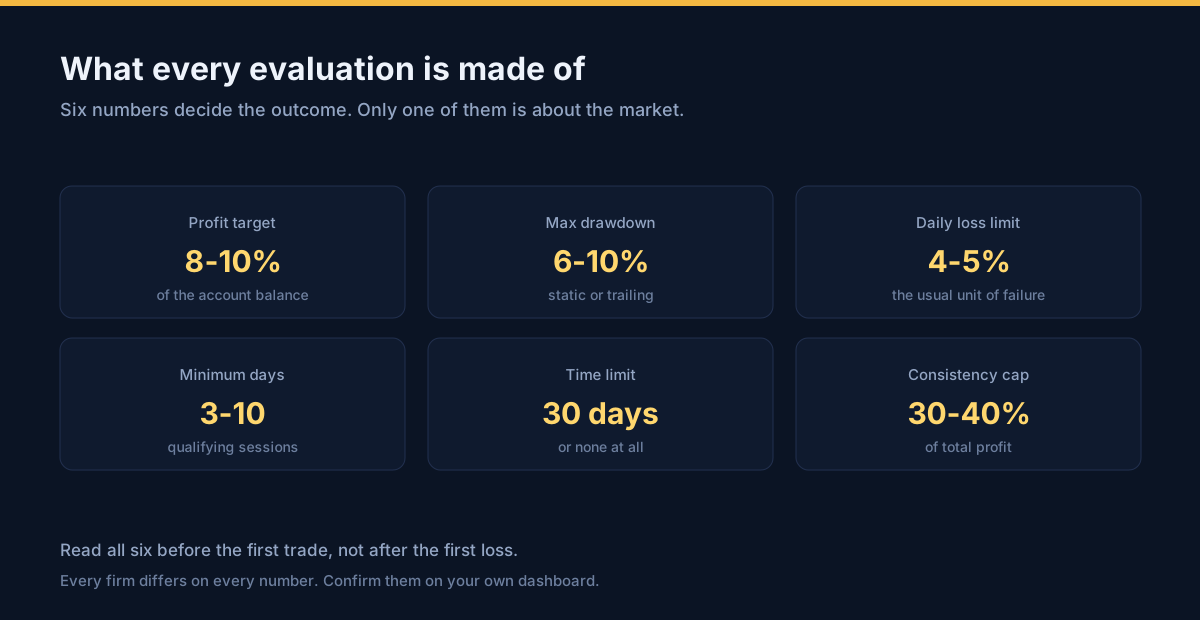
Nine firms, three markets and a lot of rules that look different and behave the same. This page replaces a set of individual firm guides with one comparison, because the honest finding from writing them was that the mechanics repeat — the same two rules decide nearly every evaluation. What genuinely varies is the drawdown model, whether a daily limit exists at all, and which market you are trading.
Confirm current parameters before trading
Prop firms adjust targets, drawdowns, splits and pricing regularly, and several on this list sell multiple products with different rule sets. The structural column below — static versus trailing — is what stays stable and what decides your failure mode. Treat every figure as something to verify on your own dashboard rather than a settled number.
The nine side by side
| Firm | Market | Maximum loss | Daily limit | What is distinctive |
|---|---|---|---|---|
| BrightFunded | Forex / CFD | Static | Yes | Built around a static drawdown, which removes the moving-floor failure mode entirely |
| Funded Trading Plus | Forex / CFD | Static (historically) | Yes | Static model with a profit split that has been competitive in the forex segment |
| Lux Trading Firm | Forex / CFD | Varies by product | Yes | Tiered products at different price points and rule profiles |
| ThinkCapital | Forex / CFD | Varies by product | Yes | Tiered products; a familiar one and two-step structure |
| FTUK | Forex / CFD | Varies by product | Yes | An unusually low profit target on an unlimited trading window |
| Elite Trader Funding | Futures | Several models offered | — | You choose between static, end-of-day trailing and real-time trailing |
| Earn2Trade | Futures | Trailing, with a lock point | — | A historically generous evaluation window with no deadline pressure |
| TradeDay | Futures | Trailing, calculated intraday | No (historically) | Intraday trailing, and no separate daily loss limit |
| Trade The Pool | US equities | Maximum loss limit | Depends on account | Funds stock traders rather than forex or futures |
In the daily limit column, a dash means the firm's model is built around a single drawdown rule rather than a separate daily stop — a meaningful structural difference, not a missing value.
The two rules that decide all nine
The daily loss limit
At the forex and CFD firms this is where almost every evaluation ends. It is a hard stop measured on equity including floating losses, it triggers the moment it is touched, and it removes your ability to recover a bad session with a larger position.
The pattern that ends accounts
A small morning loss, a larger recovery position at lunch, a second loss, then a doubled position into the close. That sequence consumes a daily allowance faster than most traders expect, and at a 5% limit it can end an evaluation inside a single session.
The survival arithmetic
Risk no more than a third of the daily allowance per position. At $100,000 with a 5% limit that is roughly $1,650 per trade, so three consecutive losers still leave you inside the limit. Traders rarely fail from taking too little risk.
The drawdown, and whether it moves
The second rule decides the futures firms and the static-drawdown forex firms alike. A static maximum loss is measured against your starting balance and never moves, so a growing account does not shrink its own buffer. A trailing floor follows your highest balance upward.
Why a trader can lose an account that never lost money
On a $2,500 trailing threshold, run a trade to $1,000 of unrealised profit and the floor rises by $1,000. You are still $2,500 from your peak but only $1,500 from your opening balance. Bring the trade back to break-even and you have closed flat with a permanently tighter buffer. Traders who believe they still have $3,500 of room lose the account discovering otherwise. The mechanism in full.
Three variations appear in the table above, and they are not equally difficult. Static is the most forgiving. End-of-day trailing recalculates only at the close, so an unrealised winner does not touch your floor until the session ends. Intraday trailing — TradeDay's model — moves the floor while the position is still open, which makes it the strictest of the three and changes how a winner must be managed.
The relief at every futures firm is the lock point: at a defined profit the threshold stops trailing and the floor becomes fixed. Reaching it converts a moving-target account into an ordinary one, and it should be your explicit first objective rather than a side effect of a good week.
Where they genuinely differ
- The market, which changes the session. Forex and CFD firms trade nearly around the clock; futures run extended sessions with a daily break; Trade The Pool is confined to US equity hours of roughly six and a half hours. A compressed session means fewer opportunities and a stronger temptation to force setups — which on a daily limit is expensive.
- Whether a daily limit exists at all. TradeDay has historically been structured around a single trailing rule. That removes the escalation failure mode entirely: you can still breach the floor, but only with a position you are holding, not through a run of intraday decisions. It is the one structural advantage on this list that removes a whole category of failure.
- How much choice you get. Elite Trader Funding offers several drawdown models, and Lux, ThinkCapital and FTUK all sell tiered products. At those firms the model you select determines your failure mode more than the account size does — and choosing casually can hand yourself the hardest version available.
- The target-to-drawdown ratio. FTUK's low target is a genuine attraction, but difficulty comes from the ratio of target to drawdown and then from whether that drawdown trails. A low target on a trailing model is easier to reach and harder to survive.
- Event risk in the underlying. Index futures concentrate risk in macro data and central banks. Individual stocks add earnings and company news that can gap a position outside market hours — a risk that does not exist in the same form in forex.
Payout reliability outranks every parameter here
This is the one judgement that applies to all nine and is worth making before any of the rules above. An evaluation you cannot withdraw from is worth nothing, at any price and on any structure.
- Compare splits on the account you would actually buy, not the headline maximum, which is usually attached to the largest tier.
- Read recent independent withdrawal reports rather than the firm's own marketing. FTUK's independent record, for instance, includes payout disputes and rule-change complaints alongside positive accounts — which is a reason to check, not a verdict.
- Weigh reliability above the percentage. A slightly lower split that pays on schedule beats a generous one that does not.
A plan that transfers across all nine
Identify your drawdown model before the first trade
Static, end-of-day trailing or intraday. Everything else about how you manage a position follows from this one fact, and it is the parameter firms change most often.
Size from the daily allowance, not the balance
A third of the daily limit per position where a daily limit exists. Where it does not, size from the trailing floor and treat the floor as the budget.
On futures, use micros until the lock
Not as a concession to inexperience: micros are what let a fixed risk budget be hit precisely. The sizing arithmetic is here.
Scale out into strength under intraday trailing
Holding for one ideal exit lets a floor that is moving in real time keep following you. Taking part of the position off stops the floor sooner.
Set your own deadline where the window is open-ended
A generous window removes deadline pressure and discipline at the same time. Decide the number of sessions you intend to take, and treat it as binding even though the firm does not.
Spread profit if consistency is assessed at payout
A pass built on one dominant day is not immediately withdrawable at most of these firms. Plan the distribution of profit from the first session rather than repairing it later. The consistency rule explained.
Frequently asked questions
The FAQ block covers whether these firms share rules, which drawdown model is easiest, the hardest rule across the set, whether a daily limit is worse than a drawdown, what to check before paying a fee and which firm funds stock traders. Related: daily drawdown explained, the best futures prop firms and which firms suit beginners.
Do these prop firms all use the same rules?
Which drawdown model is easiest to pass?
What is the hardest rule across these firms?
Is a daily loss limit worse than an overall drawdown?
What should I check before paying an evaluation fee?
Which of these firms funds stock traders?
Have a question before you commit?
Ask us anything about your firm, your account size or whether a passing service suits you. Two ways to reach us, both answered by a person: Telegram @voraspas, or email support@elitepropx.com. No forms, no queues.
Ready to pass your prop firm challenge?
Flat $220 per evaluation — we trade it for you and hand over a funded account. No hidden cuts, no monthly fees. Send your firm and account size on Telegram or by email and we will confirm availability, the current rules and the timeline.