Why Most Traders Fail Prop Firm Challenges
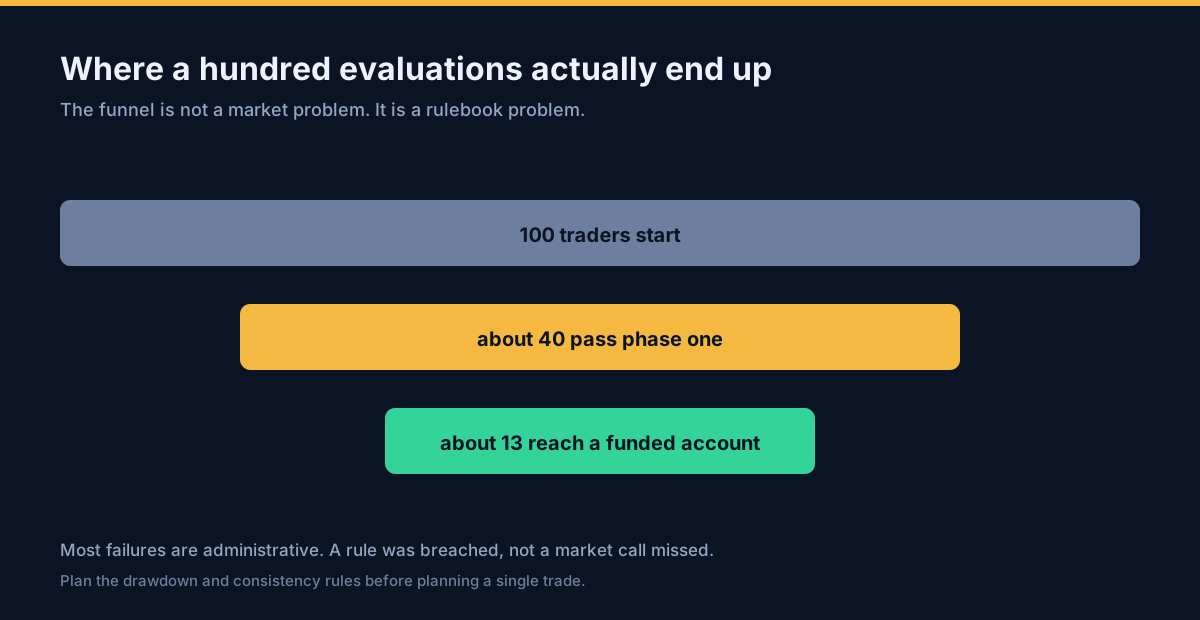
The statistics in prop trading are brutal and widely repeated: the overwhelming majority of evaluation attempts fail. What is discussed far less often is why, and the answer has almost nothing to do with market analysis. This is a breakdown of the failure pattern, the economics behind it, and the specific changes that move a trader out of the failing majority.
The failure statistics, honestly framed
Precise figures are hard to pin down because firms rarely publish them and definitions of "attempt" vary. What is consistent across published commentary and firm-adjacent data is that a large majority of attempts fail — commonly cited in the 80–95% range for stricter firms.
Two caveats matter before drawing conclusions. First, this is not the same as saying 80–95% of traders fail, because many traders buy several attempts before succeeding. Second, the rate differs enormously by rule structure: a firm with a static drawdown and a generous daily limit will have a materially higher pass rate than one with a trailing threshold and a tight daily stop. The rules, not the traders, are the primary variable.
The commercial context you should understand
Prop firms earn meaningful revenue from evaluation fees. A firm whose evaluations almost everyone passed would not be commercially viable at its price point. So the rules are calibrated to be genuinely hard — hard enough that the majority of attempts fail.
What this does and does not mean
It does not mean the firm is cheating you; the rules are published and applied consistently. It does mean you should assume the evaluation is deliberately stricter than the funded account that follows. That is the design, and planning around it is the rational response.
The failure pattern, in one sentence
Almost every failed attempt is a rule breach rather than a bad trade. When traders look honestly at why they lost their last challenge, the answer is nearly always one of the following.
| Cause | What actually happened | Preventable? |
|---|---|---|
| Daily loss limit | Lost more than the allowance in one session, usually after trying to recover an earlier loss | Yes — sizing and a hard stop |
| Trailing drawdown | Held a winner that reversed, having misread the floor as static | Yes — bank gains, understand the mechanic |
| Oversizing | Moved to full contracts before the threshold locked | Yes — micros until locked |
| Consistency rule | Reached the target with one dominant day and could not withdraw | Yes — distribute profit from day one |
| News or weekend gap | A gap jumped the stop and breached the limit instantly | Yes — flatten before events |
| Revenge trading | Compounded losses within a single session | Yes — pre-committed daily stop |
Not one of those rows requires a better indicator, a new system or improved market reading. Every single one is prevented by a process decision made before the session starts.
Why experienced traders are not immune
There is a counter-intuitive finding here: experienced discretionary traders often fail more than beginners on their first attempts, because the evaluation format inverts the incentives they have practiced.
- Letting winners run is correct on a personal account and expensive on a trailing-drawdown account.
- Recovering a losing day is rational when you have unlimited time and fatal when a daily limit exists.
- Sizing up with confidence is normal risk management with your own capital and a rule breach with someone else's limits.
- Trading your own hours works until a challenge requires minimum days and consistent activity.
In other words, the skills that made the trader profitable are precisely the habits the evaluation punishes. That is the structural mismatch which makes the format so hard, and it is why unlearning matters more than learning.
The true cost of failing
Most traders compare a service fee to a single evaluation fee and conclude the service is expensive. The correct comparison is against the expected number of attempts.
| Account fee | Pass rate | Expected attempts | Expected evaluation spend |
|---|---|---|---|
| $300 | 30% | 3.3 | ~$1,000 |
| $300 | 50% | 2.0 | ~$600 |
| $300 | 80% | 1.25 | ~$375 |
| $550 | 30% | 3.3 | ~$1,815 |
At a 30% pass rate on a $550 evaluation, the expected cost of self-passing is around $1,800 in fees alone — before accounting for weeks of screen time. Against that, a flat $220 service fee is not a luxury; it is a discount on a cost the trader is already incurring. Run your own figures on the profit calculator.
The three changes that actually move the pass rate
Cap risk at one third of the daily allowance
Three consecutive losses must still leave you inside the limit. This single rule prevents the majority of failures, because almost nobody fails from trading too small.
Set a daily profit ceiling and a hard daily stop
Most breaches happen in the minutes after a trader has already decided to stop. Make stopping mechanical rather than a decision made under pressure.
Pace the target from day one
An 8% target over four weeks is roughly 0.3% per day. Pacing removes urgency, and urgency is the parent of most rule breaches — and it makes the consistency rule a non-issue.
When the honest answer is a service
If you have implemented all three and still breach one specific rule — usually the daily limit — the decision becomes economic rather than educational. Continuing to buy attempts at a low pass rate costs more than a flat fee that covers the assignment including retries.
That is who our service is for: traders who understand the format, have a diagnosis for their failures, and would rather pay $220 once than $1,800 across three attempts. It is a flat fee with no profit split, and we cover retries on managed accounts. Read the honest category assessment in our service review before deciding — and if the three changes above solve it, you do not need us. If a failure has already happened, the mechanical next steps are in what happens after you fail a prop firm challenge.
Frequently asked questions
The FAQ block below covers the failure rate, the most common cause, whether firms want you to fail, whether failing means you are a bad trader, the cost of retries, how to raise your pass rate and when to consider a service. Related: trading psychology and challenge mistakes.
What percentage of traders fail prop firm challenges?
What is the most common reason for failing?
Do prop firms want traders to fail?
Is failing a challenge a sign you are a bad trader?
How much does repeatedly failing cost?
How do I raise my pass rate?
When should I consider a passing service?
Have a question before you commit?
Ask us anything about your firm, your account size or whether a passing service suits you. We answer directly on Telegram — no forms, no queues.
Ready to pass your prop firm challenge?
Flat $220 per evaluation — we trade it for you and hand over a funded account. No hidden cuts, no monthly fees. Message us on Telegram and we will answer in minutes.