Prop Firm Taxes Explained
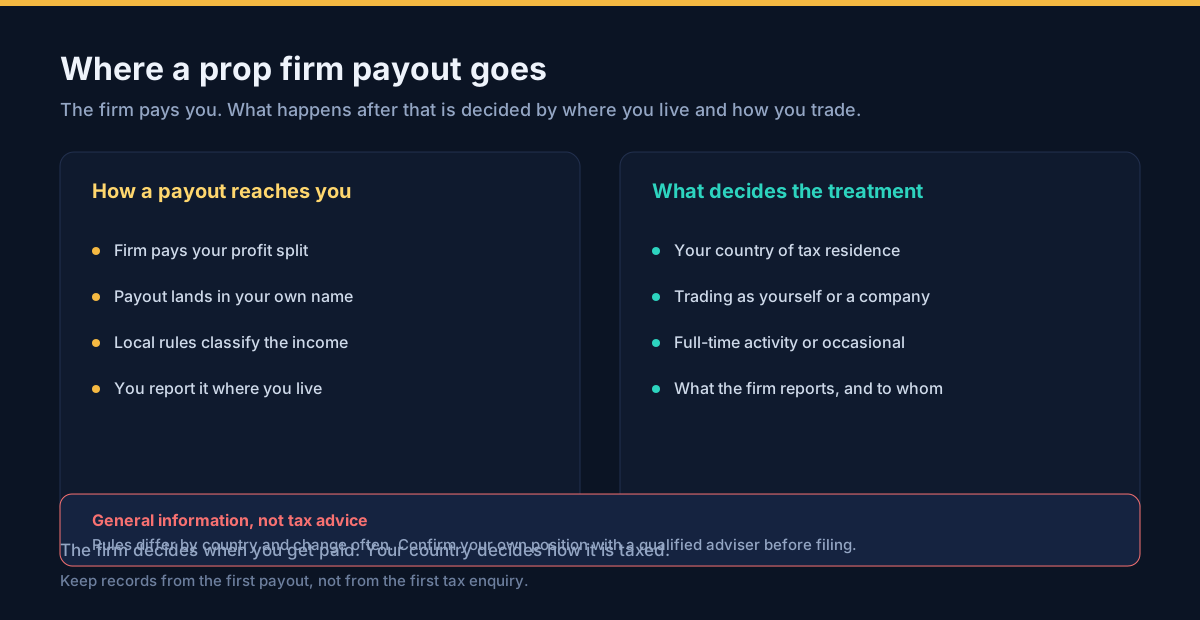
Getting funded is a trading problem. Being funded is not a trading problem — it is an administrative one, and tax is the largest part of it. Prop firm traders routinely know their drawdown rule to the dollar and cannot say how their last payout was classified. This guide explains what actually decides the treatment of prop firm income, why no article can give you your rate, and the records that make the whole question cheap to answer.
Read this first
This is general information, not tax advice, and it deliberately avoids country-specific rates. Tax rules differ by country, change frequently, and depend on facts only you and a qualified adviser know. Use this page to understand the mechanics and to ask your adviser better questions — not to file a return.
What people actually mean by "prop firm taxes"
The phrase is doing a lot of work. It usually hides four different questions:
- Is the money I withdraw from a funded account taxed at all?
- If it is, as what — a business profit, an investment gain, or something else?
- How much will be taken, and when?
- What do I have to file, and what happens if I do not?
Only the first and third have short answers, and neither is the one most traders assume. The starting point is to be clear about the relationship: a prop firm is not your employer.
A prop firm is not your employer
This is the single most important structural fact, and it is where most confusion starts. When you pass an evaluation and the firm pays you a profit split, it is paying you a share of trading profit under the terms you accepted. It is not paying you a salary.
| Employment | Prop firm payout |
|---|---|
| The employer withholds income tax before paying you | The firm pays you the figure and withholds nothing on your behalf |
| You receive a payslip or equivalent each period | You receive a payout record and a bank or wallet transfer |
| The employer reports your income to the tax authority | Reporting is your responsibility, in your own country |
| Tax code and contributions handled for you | Nothing is handled for you at all |
That is not a loophole and it is not a warning about the firms. It is simply what the arrangement is: a commercial profit-sharing agreement between you and a firm. The consequence is the same in every country — the compliance burden lands on you, which is also why payout speed is not the only thing worth optimising when you choose a firm.
The three questions that decide your answer
Once you accept that the payout is your income to report, the treatment stops being about the prop firm entirely. Three things decide it, and all three are about you.
1. Your country of tax residence
This is the dominant factor. Two traders on the same firm, in the same account size, trading the identical strategy, can face completely different outcomes because they live in different countries. Where the firm is registered, where its servers are, and which platform you trade on are usually irrelevant to where you owe tax. Residence is normally what matters, and moving country mid-year can split one year's income across two systems with different rules.
2. Whether you trade as an individual or through a company
Trading personally means the payout is income on your personal return. Trading through a company means the money may arrive into the company first, with a different set of rules, different filing obligations, and a second layer of consideration when you take money out. Neither structure is automatically better; the right one depends on your country, your other income, and how much you expect to earn.
3. Whether this is a business activity or something occasional
A trader who works at funded accounts full-time, day after day, looks very different to a tax authority from someone who passed one evaluation and withdrew a single payout. The first is usually assessed as carrying on a business; the second may not be. This distinction decides not only the rate, but whether you can deduct the costs of earning the money at all.
Why the firm's own paperwork will not answer it
Firms routinely describe payouts as profit splits, performance rewards, bonuses or distributions. Those words are chosen for clarity about the commercial deal, not for tax. Two reasons it would be a mistake to treat the label as decisive:
Your tax authority classifies the income, not the firm
Classification follows what you did and how you are structured — how you made the money — not the noun on an invoice. A firm calling a payment a "bonus" does not make it a bonus in the eyes of a tax authority, and calling it a "profit split" does not by itself make it a partnership distribution.
Firms are not positioned to advise you
A firm knows its own commercial model; it cannot know your residence, your other income or your entity. Most sensibly avoid the question, and that silence is easy to misread as "nothing to declare". It is not information at all.
How a payout is usually framed
The categories below are the common framings a professional will consider. Which one applies to you is exactly the question this article will not answer, because the answer is country-specific and fact-specific.
| Possible framing | What tends to point toward it | What you would typically need to confirm |
|---|---|---|
| Business or self-employment income | You trade systematically for profit as your main activity, repeatedly, across one or more firms | Whether your activity meets your country's test for carrying on a business, and which costs are deductible |
| Investment or trading gains | You trade your own capital occasionally, without the organisation of a business | Whether your country distinguishes trading from investing, and how it treats the difference |
| Other income | An isolated payout that does not fit a business or investment pattern | How your country sweeps up residual income, and whether any allowance applies |
Notice what the table does not contain: a rate. Anyone publishing a single percentage for "prop firm taxes" is describing one country, one structure and one set of facts, and presenting it as universal.
Why we do not publish country-by-country rates
Country-specific tax pages rank well, which is exactly why so many of them are wrong. The failure modes are consistent and worth knowing before you trust any of them:
- The rules change. Thresholds, allowances and classifications move most years, and an article written two years ago can be confidently incorrect today.
- The same country has many answers. Even inside one jurisdiction, the outcome turns on your other income, your entity, your filing status and how long you have traded — not just where you live.
- Prop firm income is young. Many tax authorities have not published guidance specific to profit-sharing prop arrangements, so the honest position is often "this is unsettled", which is not a satisfying headline and gets skipped by pages chasing traffic.
So the useful move is not to find the article that names your country. It is to arrive at your adviser with the facts already assembled — which is the next section.
Does a passing service change your tax position?
It can change the numbers, in your favour, and it is worth understanding why. If you use a service to pass an evaluation, the fee you pay is a cost incurred to produce the eventual payout rather than a personal expense. Where trading is treated as a business activity, costs of that kind are commonly deductible — which means the flat fee is not simply money gone.
Practically, that makes the fee a record-keeping obligation. You want the receipt, the date, the account it related to, and what it bought. Our own fees are a flat prop firm passing service cost per evaluation with retries covered on managed accounts, so each entry is easy to describe; the reasoning behind the fee structure is set out in what a passing service costs. Whether you can deduct any of it is a question for your adviser — but only if you kept the paperwork.
The five mistakes that cost the most
Assuming the firm handles it
The most expensive error, because it is silent. Nothing is withheld, nothing is reported for you, and the first signal is often a letter years later with interest attached. Assume the opposite until an adviser tells you otherwise.
Mixing payouts with personal money
Once a payout lands in the account you pay bills from, every figure has to be reconstructed from memory. A separate account or wallet, used only for trading income and related costs, turns an afternoon of archaeology into a five-minute download.
Trying to work out the rate from the firm's label
Treating a "performance reward" as a bonus, or a "profit split" as a partnership distribution, on the strength of the wording alone. The label is marketing, not classification.
Ignoring the costs
Evaluation fees, data subscriptions and passing-service fees are frequently the difference between a taxable figure and a much smaller one. Traders who only record income overpay; traders who only record costs get questioned.
Moving country mid-year and assuming yesterday's answer still holds
Residence changes can split income across two systems with different rules and different deadlines. Confirm the position before the move, not after the year ends.
The records to keep from your first payout
This is the part that is entirely within your control, and it is what makes the unanswerable parts cheap to answer later.
| Record | What to capture | Why it matters |
|---|---|---|
| Every payout | Date, amount, firm, account size, the split applied | Turns a vague total into a defensible figure |
| Every fee you paid | Date, amount, what it bought — evaluation, subscription, passing service | The difference between gross and taxable profit |
| Statements | Bank or wallet statements showing money in and out | Third-party evidence that matches your own record |
| Terms you accepted | The current rulebook and payout terms for each firm | Shows the arrangement you were actually operating under |
| Residence dates | When you were resident where, if you moved | Decides which system, and which year, each payout belongs to |
If you run several funded accounts, this multiplies — and running multiple accounts multiplies the income too. The mechanics of doing that are covered in how to get multiple funded accounts, and the realistic scale of the numbers in how much prop firm traders make. Both make the record-keeping point sharper: one account is a filing task, four accounts is a small bookkeeping job.
A routine that survives a review
None of the following requires an accountant, and all of it makes an accountant cheaper when you do need one.
- One folder per tax year. Digital is fine; searchable is better.
- Log the payout the day it lands. Date, amount, firm, account. Two minutes, versus an hour of reconstruction.
- Keep the cost side in the same place. Evaluation fees, subscriptions, service fees, platform costs.
- Do not let payouts sit in the trading wallet. Withdraw to a dedicated account so the record and the statement agree.
- Ask your adviser once, then write down the answer. One paragraph of guidance from someone qualified beats a fresh search every spring.
The wider point is that the tax position is downstream of everything else on this site. A consistent payout history makes the numbers simple; a chaotic one makes a routine filing into a negotiation. That is the same tension the consistency rule guide describes from the firm's side, and it is why the payout process is worth understanding end to end before the first withdrawal.
Frequently asked questions
The questions below cover who reports prop firm income, whether payouts are taxable at all, whether the firm's label decides the category, the company-versus-individual question, deducting challenge and service fees, the records worth keeping, and where you owe tax if you trade from somewhere you do not live. Related: the payout process and our FAQ.