Micro Futures Margin Requirements
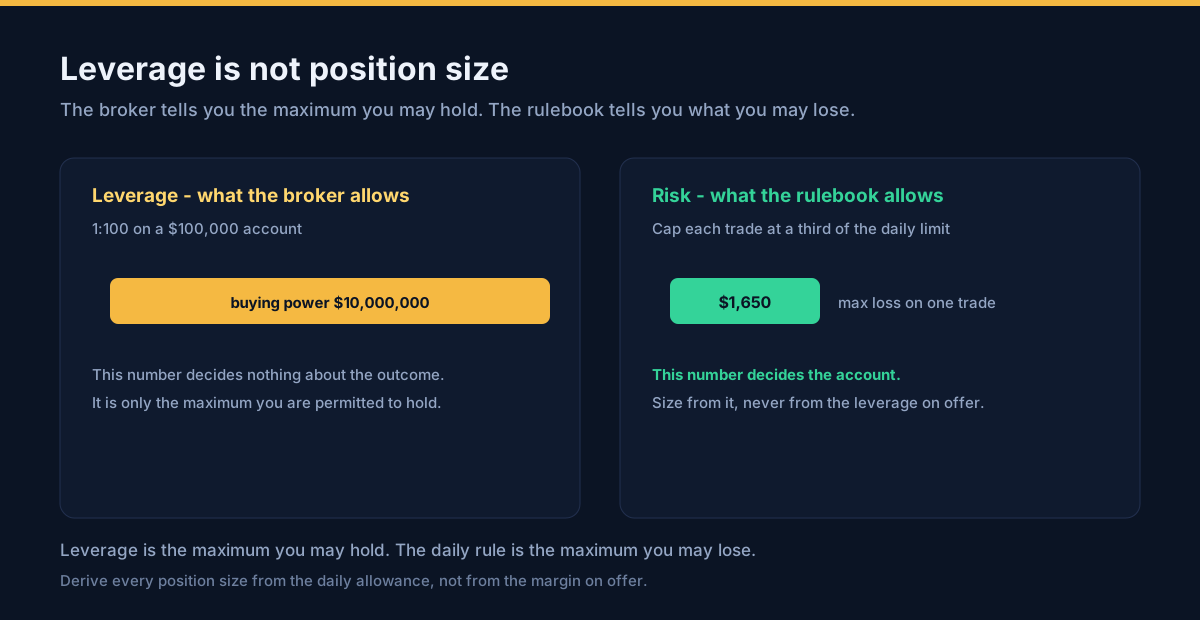
Micro futures margin confuses people for a specific reason: two very different numbers share the name. One is set by the exchange and is a genuine requirement to hold a position overnight. The other is set by your broker, applies only intraday, and is often an order of magnitude smaller. Knowing which one a given figure refers to is most of the skill, and knowing that neither is your risk budget is the rest.
The two numbers
| Exchange initial margin | Broker intraday margin | |
|---|---|---|
| Set by | The exchange | The broker |
| Applies to | Holding a position, particularly overnight | Day trades closed within the session |
| Typical relationship | The real requirement | Often a small fraction of it |
| Can change | Yes, periodically, by the exchange | Yes, at the broker's discretion, sometimes quickly |
| Revised ahead of volatility | Sometimes | Commonly |
Quoted margin figures differ between sources because they are often different figures. A number quoted from an exchange margin table and a number quoted from a broker's day-trade page are not in conflict; they are answers to different questions.
Verify current figures with your broker
Micro margin is small in absolute terms but it is not stable. Both the exchange requirement and the broker's intraday figure are revised, and brokers commonly adjust intraday margin around scheduled events. Check the current number for the contract you trade before sizing, rather than working from a figure remembered from an article or a video.
Margin scales with contract size
Because a micro contract is one tenth of the corresponding E-mini, its margin is roughly one tenth as well — on both the exchange and the intraday figure. That relationship holds across the four micros, which makes the practical comparison simple: the same account supports roughly ten times the position in micros as in full-size contracts for the same margin outlay.
The absolute numbers differ between the four because the underlying contracts do. A Dow micro and a Nasdaq micro are not the same instrument with a different label; their volatility and therefore their margin differ.
Margin is not your risk budget
This is the distinction that matters more than any figure on this page. Margin is the deposit required to hold a position. Your risk is what you lose if the trade reaches your stop. They are unrelated numbers, and margin requirements are almost always smaller.
The trap
A trader sees that one micro contract requires a few hundred dollars of intraday margin, has a few thousand available, and concludes there is room for ten contracts. The margin figure says nothing about what ten contracts would lose on a bad day. Size from the stop and the drawdown limit; use margin only to check that the position is permitted at all.
Worked through: if intraday margin on one contract is $200 and your stop is 40 MNQ points away, the risk on that contract is 40 × $2 = $80. Margin is not the binding constraint. If your per-trade budget is $300, you can hold three contracts on risk grounds while margin would have permitted far more. The limiting factor is the stop, which is the correct order of things.
Do you need margin on a prop firm account?
No — and this is one of the genuinely useful properties of the model. On an evaluation or a funded account the firm carries the instrument and you post no margin of your own. Your outlay is the evaluation fee. That removes the margin requirement as a constraint on position size.
It does not remove anything else. The firm's own exposure limits may still cap the number of contracts you can hold, and your own drawdown limit still caps the risk you may take. The difference is that the constraint has moved from "what deposit can I afford" to "what loss can this account survive", which is the more useful question and the one that decides outcomes.
Practical sizing order
Start from the drawdown, not the deposit
A fraction of the daily loss limit, expressed in currency. On a prop account this is the only number that can end your trading.
Measure the stop on the chart
Where the idea is wrong, in points or ticks.
Convert with the point or tick value
For MNQ that is $2 per point and $0.50 per tick. The full calculation is here.
Check margin last, as a permission rather than a limit
Confirm the broker would allow the position, then confirm the firm's own exposure rules allow it. Neither of these should be what sized the trade.
Reduce in advance of known volatility
Both broker margin and required stop distance expand around scheduled events. A position that was correctly sized last week is not necessarily correctly sized this week.
The broader question of how much money a micro futures trader actually needs — as opposed to what the margin page says — is covered in the sizing guide, and the contract comparison in micro E-mini versus E-mini.
Frequently asked questions
The FAQ block covers micro margin figures, why broker intraday margin differs from exchange margin, margin versus risk, whether margin applies on a prop account, whether brokers can change it and how much money is actually needed. Related: micro E-mini versus E-mini, MNQ point values and how much money micro futures need.
How much margin do micro futures require?
Why is broker day-trade margin so much lower than exchange margin?
Is margin the same as my risk on a trade?
Does margin matter on a prop firm account?
Can my broker raise margin without warning?
How much money do I need to trade one micro contract?
Have a question before you commit?
Ask us anything about your firm, your account size or whether a passing service suits you. Two ways to reach us, both answered by a person: Telegram @voraspas, or email support@elitepropx.com. No forms, no queues.
Ready to pass your prop firm challenge?
Flat $220 per evaluation — we trade it for you and hand over a funded account. No hidden cuts, no monthly fees. Send your firm and account size on Telegram or by email and we will confirm availability, the current rules and the timeline.