How Long Does It Take to Pass a Prop Firm Challenge?
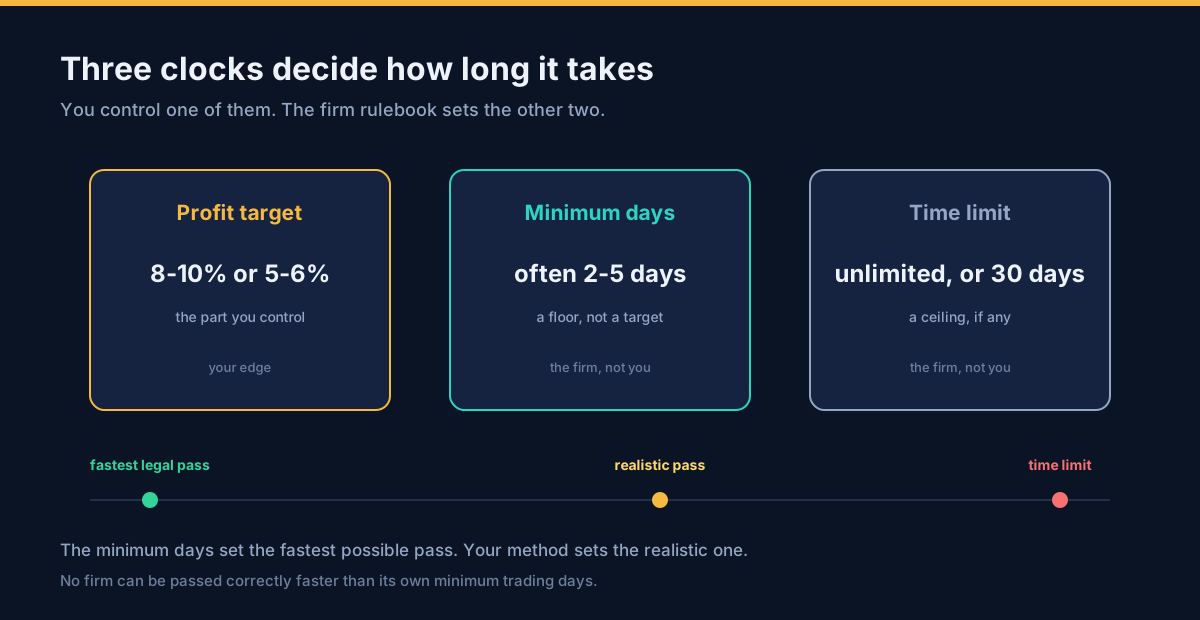
It is one of the first questions traders type, and almost every page that answers it does so with a single number. That number is usually wrong, because a prop firm challenge is not governed by one clock — it is governed by three, and you only control one of them. Here is how long passing actually takes, what sets the floor, and what makes it drag on for months.
The short answer, and why it depends
For a standard two-phase evaluation, traders who pass usually do it somewhere between two and eight weeks, counting both phases. A one-step challenge can complete faster because there is only one target to clear, but the drawdown is correspondingly less forgiving, so a faster rulebook is not automatically a faster pass.
Those ranges are wide on purpose. The honest answer is that your timeline is set by three separate clocks running at the same time, and the slowest one wins.
The three clocks
| Clock | What it does | Who sets it |
|---|---|---|
| Profit target | The percentage you must earn to clear the phase — commonly 8–10% on a first phase and 5–6% on verification | You, through how fast your method actually produces |
| Minimum trading days | A floor on the number of days you must trade before the phase can be considered passed — often 2–5 days per phase | The firm |
| Time limit | A ceiling on how long you have, where the firm imposes one — unlimited at many forex firms, commonly around 30 days at several futures firms | The firm |
The profit target is the clock everyone thinks about, and it is the only one you influence. The other two come from the rulebook, which means part of the answer to "how fast can I pass" is really "how fast does this firm allow".
Why the minimum trading days matter more than traders expect
The minimum trading days rule is widely misunderstood as a formality. It is actually the hard floor on your fastest possible pass.
Where a firm requires a minimum of three trading days per phase, a two-phase evaluation cannot be completed in fewer than six trading days, whatever your equity curve looks like. A trader who makes the full target on day one has not passed — they have hit the target and are now waiting for the rule to be satisfied. Understanding this changes the plan: there is no prize for finishing the target on day one, and there is real cost in trying to.
No firm can be passed faster than its own minimum
This is why any claim of a same-day or overnight guaranteed pass should be treated as a red flag. The rulebook does not have a fast lane. What a legitimate service removes is not the minimum days — it is the failed attempts, the restarts and the weeks lost rebuilding after a breach.
Fastest possible versus realistic
These are two different numbers and conflating them is what gets accounts breached.
| Fastest possible | Realistic | |
|---|---|---|
| What it is | The firm's minimum trading days, met exactly | The minimum days plus however long your method needs to reach the target |
| What it requires | Hitting the full target almost immediately | Consistent profit inside the daily and maximum drawdown |
| Main risk | Oversizing to force the target, and breaching the daily limit | None inherent — this is simply how the process works |
| Typical result | Rare, and often followed by a breach on the funded account | Two to eight weeks across both phases |
The fastest possible pass is the one that most often ends badly, because forcing a target in a handful of days means size that leaves no room for a normal losing run. The realistic pass is slower and survives the funded stage — which is the stage that actually pays.
One-step versus two-step timelines
The structure of the evaluation changes the arithmetic more than the target percentages suggest.
| 1-step | 2-step | |
|---|---|---|
| Targets | One larger target | Two smaller targets |
| Minimum days | Often lower per phase, since there is one phase | Applied per phase, so the floor is effectively doubled |
| Drawdown | Typically tighter relative to the target | Usually more room to absorb a normal losing day |
| Realistic timeline | Can be shorter if the target is met cleanly | Longer, but more failures are recoverable mid-challenge |
The trade-off is not "which is faster" but "which can I finish without breaching". A one-step with a tight drawdown often produces a slower real-world pass than a two-step with comfortable room, because the one-step fails and restarts.
What makes a pass take months instead of weeks
When traders report being stuck on a challenge for a long time, the cause is almost always one of these — and none of them is "the market was slow".
Restarting after a breach
Each failed attempt resets the clock to zero and adds a new fee. Three restarts turn a two-week job into a two-month one, and the rule that was breached is rarely the one the trader thinks it was.
Inconsistent sizing
If one oversized loss erases several days of progress, the account spends its time recovering rather than advancing. Flat, rule-based sizing is what makes a timeline predictable.
Overtrading to "make progress"
More trades does not mean a faster pass. It means more exposure to the daily loss limit, which is the rule most often breached on the way to a slower result.
Chasing an elevated target
Scaling up after a good week to shorten the timeline is the classic error. The daily loss limit does not scale with your confidence.
Ignoring the consistency rule
Where a firm caps how much of the profit may come from a single day, a fast start can block the pass entirely — the trade-off is covered in the consistency rule guide.
The wider point: speed is an output of a clean process. The traders who pass quickly are not the ones trying to pass quickly. If you want to understand the failure side of that in detail, why most traders fail sets out the mechanics.
The number that actually decides your timeline
Strip everything else away and the question reduces to one figure: how much profit your method reliably produces per week, at a size that never threatens the daily loss limit.
If a method produces a steady 2% a week on a well-sized book, a 10% target is around five weeks of normal trading, not five days of pushing. If it produces 1%, the same target is roughly ten weeks. Neither of those changes because you want it to — and a target reached faster than your own average usually means one outsized trade, which is exactly the pattern the consistency rule and the daily limit exist to catch.
This is also why "how long" has a different answer for every trader asking it, and why a single published number is a symptom of a page guessing. The rule side of all this is documented consistently across firms in our prop firm rules matrix.
What happens once you pass
Passing the evaluation is not the end of a clock — it starts the next one. After the final phase clears, the funded account is issued, the firm's payout cycle begins, and the first payout usually arrives on the firm's schedule rather than yours. That sequence is worth understanding before you start, and what happens after you pass a challenge walks through it end to end, with the withdrawal mechanics in the payout process.
The alternative: have the challenge passed for you
Everything above assumes you want to trade the evaluation yourself, on your own timeline. Some traders do not — they want the funded account and the payouts, not the weeks of phase management in between.
That is the entire job we do. ElitePropX trades your challenge to the profit target and hands you back a funded account: one flat fee per evaluation, retries covered on managed accounts, and no profit split taken from anything you withdraw. You never have to work out the minimum days, the drawdown maths or the consistency cap for your firm, because we are already trading every one of them daily.
And the thing that matters most when you are weighing timelines: the delays described in this article are almost all the product of failed attempts, restarts and rebuilds. Removing those is what makes a funded account arrive predictably, and everything you earn after that belongs entirely to you — see how much prop firm traders make for what a funded account is realistically worth once it is paying.
If the fee is the deciding factor rather than the timeline, the same comparison is set out in challenge fees versus a passing service. Otherwise, message us on Telegram with your firm and account size and we will tell you exactly what applies to your challenge.
Frequently asked questions
The questions below cover how long a challenge takes, the fastest possible pass, whether firms impose time limits and minimum trading days, whether a same-day pass is possible, why some traders take months instead of weeks, and whether a passing service changes the timeline. Related: the complete passing guide and recovering from a failed challenge.
How long does it take to pass a prop firm challenge?
What is the fastest possible way to pass?
Do prop firms have a time limit?
Is there a minimum trading days rule?
Can I pass a challenge in one day?
Why does it take some traders months?
Does a passing service finish it faster?
Will ElitePropX pass my challenge?
Have a question before you commit?
Ask us anything about your firm, your account size or whether a passing service suits you. Two ways to reach us, both answered by a person: Telegram @voraspas, or email support@elitepropx.com. No forms, no queues.
Ready to pass your prop firm challenge?
Flat $220 per evaluation — we trade it for you and hand over a funded account. No hidden cuts, no monthly fees. Send your firm and account size on Telegram or by email and we will confirm availability, the current rules and the timeline.