The Prop Firm Challenge Rules That Actually Matter
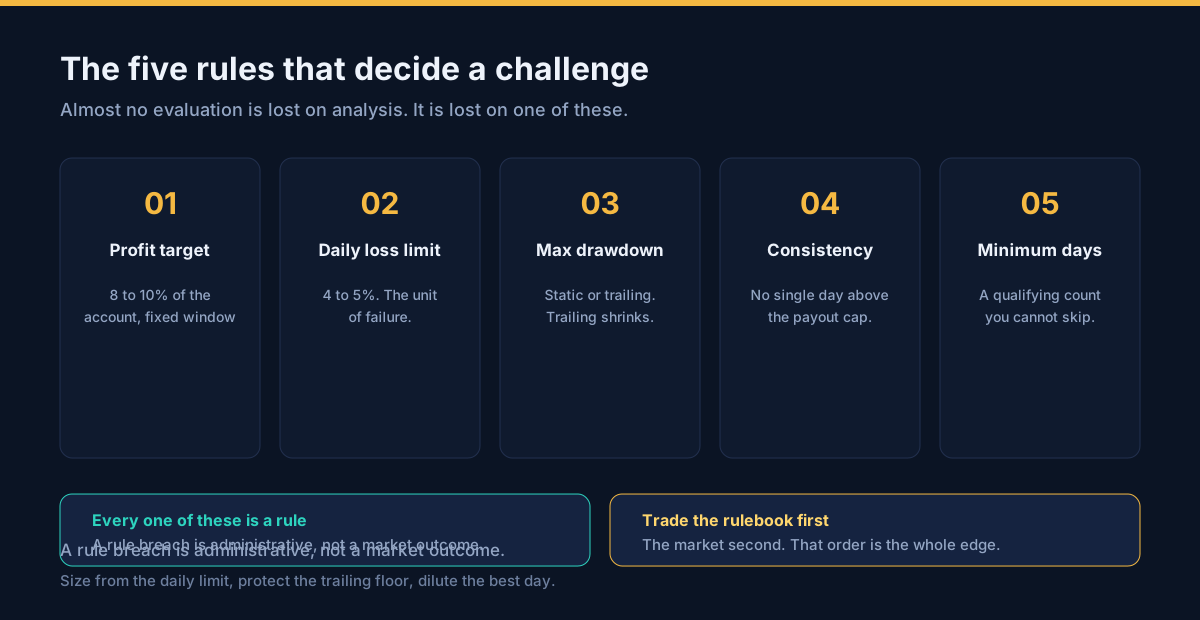
Every evaluation comes with a terms-of-service document of a dozen or more rules, and traders tend to treat them as equally important. They are not. A handful decide the overwhelming majority of outcomes; the rest are noise for most traders. This is the ranked list, with the reasoning for each position. To see how the individual firms currently set each of these rules — targets, drawdown type, minimum days and consistency — the prop firm rules matrix holds one sourced row per model.
Tier 1: The rules that end accounts
These are the rules that decide whether you pass. If you optimise for only these, your pass rate will rise substantially.
1. Maximum daily loss
The single most consequential rule in prop trading. It is a hard stop measured on equity — so floating losses count — and breaching it ends the evaluation instantly, regardless of how much overall drawdown remained.
Why it dominates: it eliminates the recovery behaviour that most discretionary traders rely on. Once you have lost the day's allowance, there is no "getting it back by the close". Combined with the fact that it is measured live, including on open positions, it fails more attempts than everything else combined.
Preparation: cap each trade at a third of the allowance, set a personal stop inside the official one, and stop for the day when it is hit. Non-negotiable.
2. Drawdown type — static versus trailing
The amount of drawdown matters less than its type. A 5% static drawdown and a 5% trailing drawdown are not remotely comparable in difficulty.
| Type | How it behaves | Effect on a winning account |
|---|---|---|
| Static | Fixed floor below the starting balance | Your buffer is unchanged as you profit |
| Trailing | Floor follows your peak upward | Your buffer shrinks as you profit, until the threshold locks |
On a trailing account, giving back a winner is doubly expensive because the floor rose while the position was open. This is why futures firms fail more traders than forex firms at equivalent nominal drawdowns.
Preparation: identify the type before your first trade, find the lock point on trailing accounts, and use micro-size until it locks.
3. Consistency rule
Strictly speaking this is a payout rule rather than a trading rule — but it belongs in tier 1 because it can leave an otherwise successful evaluation unpayable for weeks. No single day may exceed a defined share of your total profit, commonly 30–40%.
Why traders miss it
The rule does nothing during trading; it only bites when you request a withdrawal. A trader who reaches the target with one dominant day has, in effect, created a soft breach that costs them more screen time to fix. Full maths in the consistency rule guide.
Preparation: trade for comparable daily gains from day one, and check your best-day percentage before requesting a payout.
Tier 2: The rules that can end accounts in a single event
4. News and restricted-window policy
Two distinct risks hide here. The first is rule-based: some firms restrict opening or closing positions around specified releases. The second is mechanical: holding a large position into a release can gap straight through a stop, breaching the daily limit before the order executes. The second is far more common.
Preparation: check the calendar daily, reduce before high-impact releases, and know whether the policy differs on funded accounts.
5. Weekend holding policy
Holding over the weekend exposes you to gap risk that no stop order can control. On a trailing-drawdown account, an adverse gap can breach the floor outright.
Preparation: flatten or substantially reduce before the Friday close unless your edge specifically depends on weekend exposure. See the weekend rules guide.
6. Automation and EA restrictions
Rules on expert advisors range from permissive to outright prohibition, and violations are often assessed at payout review rather than immediately — meaning an account can run for weeks before a determination is made.
Preparation: confirm in writing whether your approach is permitted, and avoid anything that looks like latency arbitrage or coordinated cross-account activity.
Tier 3: The rules that shape strategy
7. Minimum trading days
Rarely a direct cause of failure, but decisive for approach: they make sprinting pointless and pacing sensible. Use the mandated sessions to distribute profit evenly — it costs nothing and protects your payout.
8. Profit target size
Notable mainly for what it is not. The target is often the least constraining number on the page. Traders obsess over reaching it quickly when the real constraint is the loss limit. A 10% target over four weeks is 0.35% per day — entirely achievable without ever approaching the daily limit.
9. Time limit
Rarely binding if you pace correctly, and dangerous only if you leave the work too late. Treat the deadline as a planning input, not a source of daily pressure.
Tier 4: The rules you can mostly ignore
- Instrument restrictions on products you never trade.
- Maximum position-count limits you are nowhere near approaching.
- Leverage limits that your position sizing never tests — remember that the drawdown limit binds long before margin does.
- Cosmetic clauses about platform usage or account naming that carry no practical consequence.
That is not a recommendation to ignore terms — it is a recommendation to rank them, so preparation effort goes where it changes outcomes.
The two-list system
The most practical way to use this ranking is to write two lists for your specific firm:
| List | Contents | Routine |
|---|---|---|
| Can end the account | Daily limit, overall drawdown, news policy, weekend policy, prohibited practices | Sizing rules, hard daily stop, calendar checks, flatten before events |
| Can block a payout | Consistency rule, minimum days, minimum profit, KYC | Even distribution, tracking days, profit buffer, documents submitted early |
Almost every avoidable failure and every avoidable payout delay sits in one of those two columns, and almost all of them are prevented by a routine rather than by analysis. Our guide to soft versus hard breaches explains how the two categories differ in practice.
Frequently asked questions
The FAQ block below covers which rule fails the most traders, drawdown amount versus type, minimum days, news policies, which rules to ignore and how to prepare for a new firm. Related: the daily drawdown explainer and challenge mistakes.
Which prop firm rule fails the most traders?
Is the drawdown amount or the drawdown type more important?
Do minimum trading days matter?
Can a news policy end an account?
What is the least important rule to worry about?
How should I prepare for a new firm's rules?
Have a question before you commit?
Ask us anything about your firm, your account size or whether a passing service suits you. We answer directly on Telegram — no forms, no queues.
Ready to pass your prop firm challenge?
Flat $220 per evaluation — we trade it for you and hand over a funded account. No hidden cuts, no monthly fees. Message us on Telegram and we will answer in minutes.