Prop Firm Copy Trading Rules
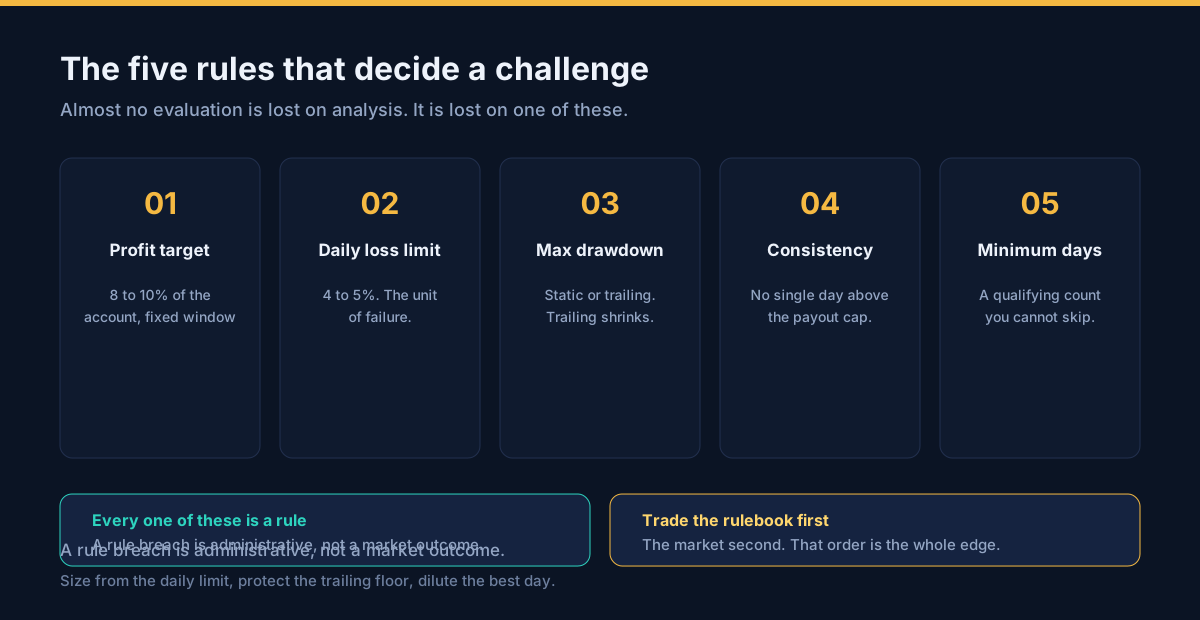
"Can I copy trades on a prop firm account?" sounds like one question and is really three, and firms answer them differently. Following someone else's strategy is one thing. Copying your own trades from one account to another is another. Running the same positions across two accounts you own is a third — and it is the one that ends accounts, because it is functionally the hedging clause wearing a different name.
Verify on your dashboard
Copy-trading clauses vary by firm and are revised. The descriptions below are how these rules are typically structured and what they are aimed at. Confirm your own firm's current wording before relying on any of it.
The three things people mean by copy trading
| What you are doing | How firms usually treat it |
|---|---|
| Following a third-party strategy through a copy service | Often tolerated. It is a form of automated execution, and some firms restrict it only where the provider's sizing would violate their rules. |
| Copying your own account to another account | Commonly restricted. Frequently requires the accounts to be with the same firm and owned by you, and sometimes must be declared. |
| Mirroring positions across two accounts in opposite directions | Almost always banned, and usually covered by the hedging or prohibited-strategies section. |
The reason the third is treated so harshly is not the technology. It is that a mirrored pair carries no market risk, while both accounts continue to look like active trading and keep satisfying minimum-day requirements. That is the same thing a hedge does, and it defeats the purpose of an evaluation.
Why a copy relationship is riskier than it looks
Copying bundles your accounts together whether you intended that or not:
- One rule breach can end several accounts. The same oversized position is placed everywhere it is copied to, so a daily-drawdown breach is not confined to the account where the mistake was made.
- Sizing does not transfer cleanly. A position that is 2% of one account's drawdown can be 8% of a smaller account's, and a copy service that scales by equity will happily do that.
- A stop in one place is an entry in another. If account A's exit logic is not mirrored, account B can be left holding a position with no exit — an unmanaged risk on a funded account.
- Correlated accounts share a failure. Two accounts running the same trades do not diversify; they are one exposure counted twice. On a payout schedule that measures consistency, that is a single anomalous day appearing on every account.
The version that catches people out
Copying a strategy that worked on a personal account, at a size that made sense there, onto an evaluation with a tighter drawdown. The trade logic is fine and the sizing is fatal. Copying does not scale risk management — it scales position size, and the rules do not come with it.
What is usually permitted
Where firms do allow copying, the permitted shape tends to be narrow and specific:
Accounts you own
The copy relationship is between accounts registered to the same person. Copying someone else's trades into your account is a different matter and often falls under account-sharing rules.
With the same firm
Copying across two different firms is the pattern most likely to be prohibited outright, because neither firm can see the other side of the position.
Declared where required
Some rulebooks ask you to tell them if you operate more than one account or use automation. Declaring it is cheap; being found not to have declared it is not.
Consistent with the sizing rules
A permitted copy arrangement does not exempt you from maximum position size, maximum lots or exposure limits.
How to find your firm's actual position
Search the rulebook for the right words
"Copy", "mirror", "duplicate", "hedge", "opposite", "third-party" and "prohibited strategies" are the terms that find the clause. It is often not under a heading that mentions copying at all.
Read the hedging and account-sharing sections too
These three clauses are written as a set and enforced together. A copying arrangement can breach any of them, so a clear answer in one section is not a clear answer overall.
Check whether it needs declaring
Look for language about operating multiple accounts or using automation. If declaring is required, do it before you trade, not after a query.
Ask support in writing if you depend on it
If your approach requires copying, get the answer as a message you can keep. It is also what you would rely on in a dispute.
The risk-free alternative
Most of what copying is used for can be achieved without the exposure. If the goal is to avoid repeating an entry across accounts, that is a discipline problem with several cheaper answers: place each trade deliberately, size each account to its own drawdown rather than to a shared default, and treat each account as an independent set of rules — because it is.
If the goal is to run a consistent process at size without violating a single-account exposure limit, the rulebook already tells you what is allowed, and it is usually to trade one account well rather than several identically. The related question of how many accounts you can hold at one firm is worth reading next.
Frequently asked questions
The FAQ block covers whether copying is allowed, the difference from mirror trading, copying between your own accounts, the overlap with account-sharing rules, the consequences of a breach, and which services connect technically. Related: do prop firms allow hedging?, account sharing and prop firm rules and the rules that actually decide outcomes.
Is copy trading allowed on prop firm accounts?
What is the difference between copy trading and mirror trading?
Can I copy my own trade from one prop firm account to another?
Does copy trading break the account-sharing rules?
What happens if a firm detects prohibited copying?
Which copy services work with prop firm accounts?
Have a question before you commit?
Ask us anything about your firm, your account size or whether a passing service suits you. Two ways to reach us, both answered by a person: Telegram @voraspas, or email support@elitepropx.com. No forms, no queues.
Ready to pass your prop firm challenge?
Flat $220 per evaluation — we trade it for you and hand over a funded account. No hidden cuts, no monthly fees. Send your firm and account size on Telegram or by email and we will confirm availability, the current rules and the timeline.