Multiple Accounts at One Prop Firm
Holding several accounts at one firm feels like diversification and behaves like concentration. Most firms permit it; almost all of them restrict what those accounts may do together, and the restrictions exist because the obvious reasons to run multiple accounts are the ones that remove market risk rather than spread it. This is what the rules usually say and why the arithmetic does not work out the way it looks.
Verify on your dashboard
Caps on the number of accounts, declaration requirements and the rules about operating them together differ by firm and are revised. What follows is how these clauses are typically structured. Confirm your own firm's current terms before buying a second evaluation.
What firms usually allow, and what they restrict
| Activity | Typical treatment |
|---|---|
| Owning more than one account | Often allowed, sometimes capped |
| Paying a fee for each | Always — the fee is per evaluation |
| Trading each account independently | Usually fine |
| Copying the same trades across accounts | Commonly restricted, sometimes banned |
| Deliberately opposing positions across two accounts | Almost always banned |
| Failing to declare accounts where required | A breach in itself |
The distinction is between owning accounts and operating them in concert. Firms are largely indifferent to the first and specifically hostile to the second, because a pair of accounts running complementary positions is a way of removing risk while still satisfying activity requirements.
Why running them identically is not diversification
Diversification means that a loss in one place is offset or limited by a position that behaves differently. Two accounts running the same trades do the opposite:
- One decision, several consequences. The same oversized position is placed everywhere, so the same mistake breaches every account at the same moment.
- One bad day is a bad day on all of them. Daily drawdown limits are per account, but they are breached by the same session.
- Correlated failure is the point of the arrangement, not a side effect. If the accounts are genuinely identical, they succeed and fail together, which means the second account added nothing except a second fee.
The concentration arithmetic
Three accounts running the same strategy is not one-third the risk each. It is the same single exposure, entered three times, at three times the fee, with three drawdown limits breached by one decision. The only thing that has multiplied is the cost.
Where the fees actually land
Multi-account trading is often presented as a way to scale, and it is worth pricing it as a straightforward multiplication:
| Accounts | Fees paid | Distinct exposures |
|---|---|---|
| 1 | 1 × fee | 1 |
| 2, traded identically | 2 × fee | 1 (duplicated) |
| 3, traded identically | 3 × fee | 1 (duplicated) |
| 2, traded independently | 2 × fee | 2 |
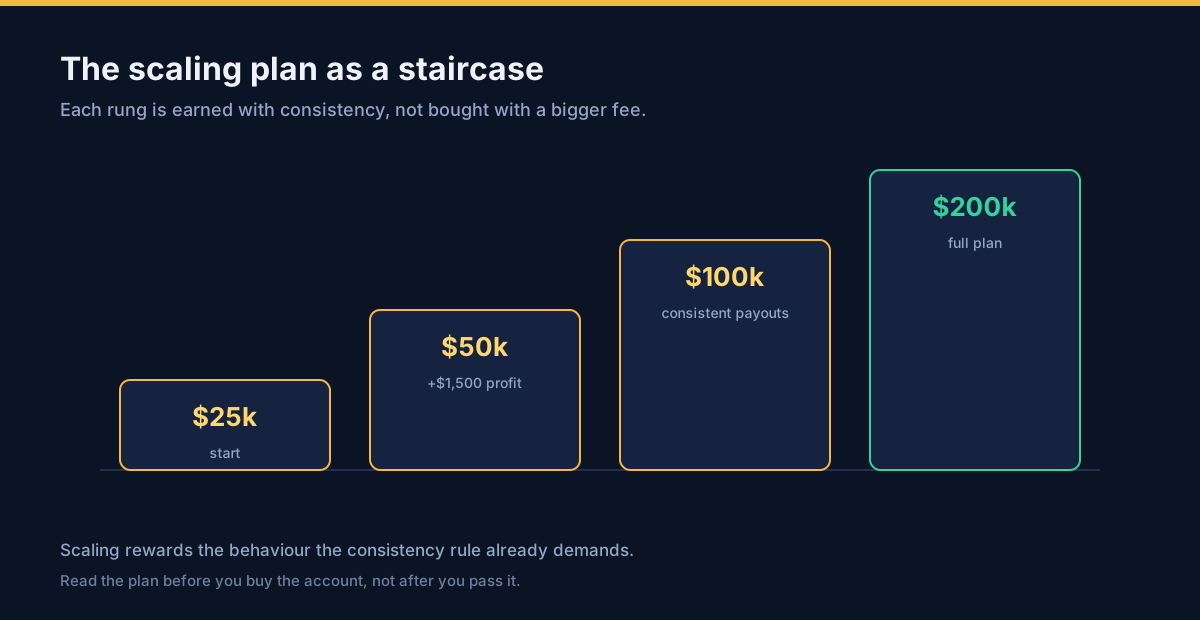
Only the last row adds a second exposure, and it costs a second fee and a second full-time job to run. That is the trade-off to weigh before buying a second evaluation — as opposed to using the firm's scaling plan, which increases the size of the account you already passed without multiplying either the fees or the exposure.
How to check your firm's position
Find the cap, if there is one
Search the rulebook for "number of accounts", "maximum accounts" or "per trader". Some firms cap it outright.
Read the copy-trading and hedging clauses
These are what actually govern how accounts may be operated together, and they are usually where the restriction lives. Copying rules are here and hedging rules are here.
Look for an aggregate exposure rule
Some firms cap total exposure across everything you hold, which limits the benefit of opening more accounts even where multiple accounts are allowed.
Check declaration requirements
If the rulebook asks you to declare additional accounts, do it at the point you open them.
Check whether the firm offers scaling
If the objective is more size, the scaling plan is usually the intended route and avoids the whole question.
When a second account is defensible
It is not automatically wrong. A second account makes sense when it carries a genuinely different process rather than the same trades — a different strategy, a different instrument, or a different session — so that the failure conditions are not identical. It also makes sense as a deliberate second attempt after a first has been failed, which is simply buying another evaluation rather than running two at once.
What it does not do is spread risk. Two accounts running one strategy are one strategy, and the second fee buys nothing except a duplicate of the first account's destiny. For the firms' view of this, the related guide to holding multiple funded accounts covers the funded-account side of the same question.
Frequently asked questions
The FAQ block covers whether multiple accounts are allowed, fees per account, running the same strategy across accounts, hedging between accounts, declaration requirements, how many is too many and scaling instead. Related: copy trading rules, hedging rules and multiple funded accounts.
Can you have multiple accounts at one prop firm?
Do you pay the challenge fee for each account?
Can you trade the same strategy on several accounts at once?
Is it against the rules to hedge between two accounts?
Do I have to declare multiple accounts?
How many accounts is too many?
Can I scale an account instead of opening several?
Have a question before you commit?
Ask us anything about your firm, your account size or whether a passing service suits you. Two ways to reach us, both answered by a person: Telegram @voraspas, or email support@elitepropx.com. No forms, no queues.
Ready to pass your prop firm challenge?
Flat $220 per evaluation — we trade it for you and hand over a funded account. No hidden cuts, no monthly fees. Send your firm and account size on Telegram or by email and we will confirm availability, the current rules and the timeline.