Is It Hard to Pass a Prop Firm Challenge?
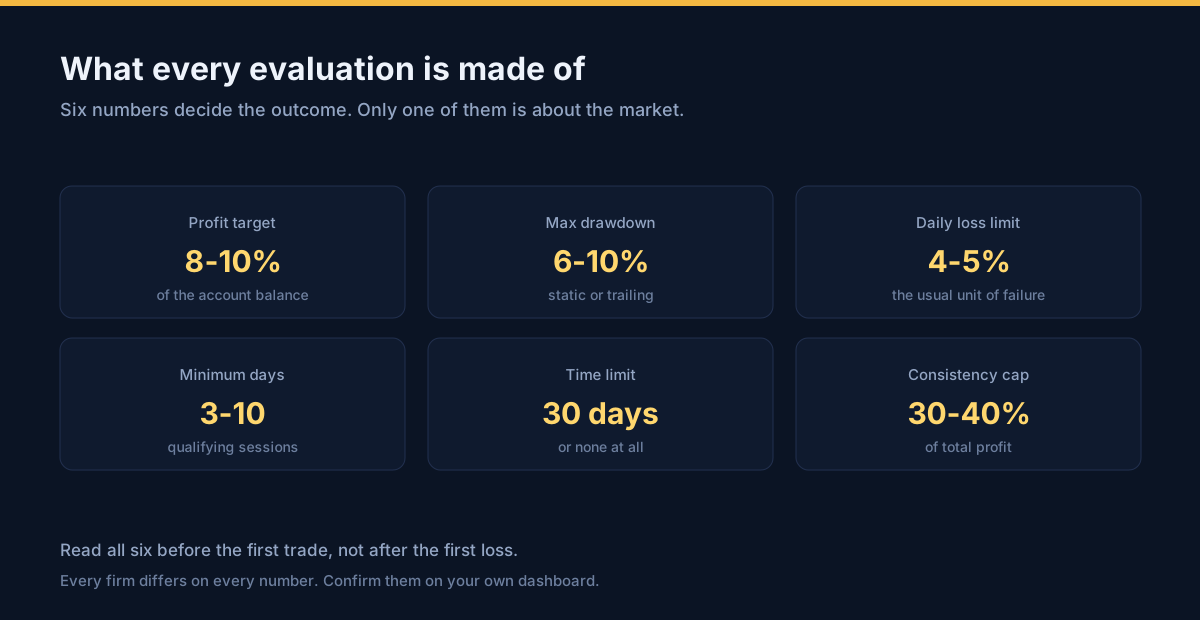
The honest answer is that the challenge is not hard in the way it looks hard. The profit target is usually modest, the rules are published in advance, and nothing about the market conditions is hidden. What makes it hard is that it tests a specific thing — whether you can trade inside a hard loss limit — and most people approach it with habits built on accounts where that limit did not exist.
Why it looks harder than it is
Take the components separately. Reaching a profit target of a few percent is not an unusual achievement. Reading a rulebook is not difficult. Sizing a position is arithmetic. None of these is the barrier.
The barrier is that an evaluation converts three things from preferences into absolute constraints:
| On your own account | On an evaluation |
|---|---|
| You decide how much to risk | The maximum loss is fixed by the firm |
| Drawdown is a number you can trade through | Crossing it ends the account permanently |
| Position size is limited by your capital | Position size is limited by a loss budget |
| A bad month is a set | A bad day can be the end |
A trader whose history includes periods of oversized positions, adding to losers, or holding through a drawdown has a habit that was survivable when the capital was theirs. On an evaluation, the same habit is terminal.
What actually ends accounts
The failures are not exotic, and they cluster into a short list:
The daily limit, breached on an ordinary day
Not a crash — a position sized too large for the daily allowance, so three normal losers exceed it. This is the most common single cause.
Revenge trading after a loss
Immediate re-entry at larger size to recover. The size is the problem and the speed is what makes it worse. Covered here.
Increasing size after losses
Martingale in practice, whether or not it is named that. On a fixed loss limit the arithmetic fails fast. The maths is here.
A trailing drawdown and a winner given back
The floor rises with the balance. A profitable position that retraces leaves the account closer to failure than when it started, with nothing visible on the equity curve.
Rule breaches that were never read
News windows, hedging, copying, martingale clauses — an account can be closed for a rule the trader did not know existed.
Overtrading to force a target
More trades to reach a number, at sizes that erode the buffer. Frequency is a risk multiplier, not a strategy.
The distinction that matters
Almost everything in that list is a sizing or discipline failure rather than a market-call failure. That is the useful conclusion: you do not have to be better at predicting price than most people to pass. You have to be better at not breaching a number.
A different skill from trading profitably
A trader can be genuinely profitable over a year and fail evaluations repeatedly, because the two activities optimise for different things. Profitability on your own capital rewards taking risk when you believe it is worth it. Passing an evaluation rewards never taking a risk whose loss the account cannot absorb. Those are compatible, but not automatically.
What makes it substantially easier
- Size from the daily limit, not the balance. A third of the daily allowance per trade means three ordinary losers fit. Size from the balance and the first bad session can end it. The mechanics are here.
- Know the drawdown type before the first trade. Static and trailing are different accounts. Trading a trailing floor as though it were static is a common and avoidable failure.
- Pace the target. Weekly objectives rather than daily ones, which reduces the pressure that produces overtrading.
- Read the rulebook properly, once. An hour spent finding the news window, the consistency rule and the prohibited strategies removes a whole category of failure.
- Take the smallest size that still teaches you something. The fee is the cost of iteration, so iterate cheaply.
- If it fails, record why. The useful signal is whether the reason changed between attempts. Repeating the same breach at the same size is not iteration.
When it is genuinely the wrong route
For some traders the honest conclusion is that the evaluation format does not suit them — not because they cannot trade, but because a hard loss limit is incompatible with how they express conviction. Recognising that is not a failure. There are two legitimate responses: trade the format properly by rebuilding the sizing habits from the drawdown outwards, or accept that the funded-account structure is a poor fit and trade your own capital instead.
What is not a legitimate conclusion is that the challenge is unfair. The rules are published before you pay, they are the same for everyone, and the profit target is modest. What is being tested is stated clearly in advance — the loss limit — which makes the challenge hard in a way that is knowable, and therefore fixable.
Frequently asked questions
The FAQ block covers whether it is hard, published pass rates, the most common failure, whether profitable traders still fail, typical attempt counts and using a service instead. Related: daily drawdown explained, avoiding revenge trading and the complete guide to passing a challenge.
Is it hard to pass a prop firm challenge?
What percentage of people pass a prop firm challenge?
What is the most common reason a challenge fails?
Can a profitable trader still fail a challenge?
How many attempts does it usually take?
Is it easier to have someone pass it for you?
Have a question before you commit?
Ask us anything about your firm, your account size or whether a passing service suits you. Two ways to reach us, both answered by a person: Telegram @voraspas, or email support@elitepropx.com. No forms, no queues.
Ready to pass your prop firm challenge?
Flat $220 per evaluation — we trade it for you and hand over a funded account. No hidden cuts, no monthly fees. Send your firm and account size on Telegram or by email and we will confirm availability, the current rules and the timeline.