Two traders with identical strategies and identical skill can have wildly different pass rates — and the difference is often not what they trade but when they trade it. The clock on your chart is not neutral: liquidity, volatility, spreads, and stop reliability all change dramatically through the day, and every one of those variables interacts with the drawdown limits that decide whether your challenge survives.
Trading a prop firm challenge at the wrong time is like taking a test with the wrong rules — the material is the same, but the conditions punish you. Trading at the right time is a passive edge: better fills, cleaner moves, fewer surprise spikes, and a much smaller chance of the one bad candle that ends an account. This guide breaks down the best times to trade prop firm challenges by market and session, the windows to avoid, and the daily rhythm that successful challenge traders actually run.
The Session Map: What Happens When
Before choosing a trading time, know what each session offers. The two markets most challenge traders use — futures and forex — have different session structures:
Futures Sessions (Apex, TopStep, and the futures firms)
- Overnight/Asian session (6 PM - 9:30 AM ET): thin liquidity, wide spreads, and choppy price action. A few firms' accounts allow overnight trading; most day-trading accounts require flat positions at the close, so overnight sessions matter mostly for news gaps and stop-outs.
- Pre-market (7-9:30 AM ET): liquidity builds ahead of the open, but the behavior is often erratic and news-driven. Good for preparation, risky for execution.
- RTH open (9:30-11:30 AM ET): the highest-liquidity, highest-quality window of the day. The ES and NQ get their cleanest ranges, tightest spreads, and most reliable fills. This is where most successful futures challenge traders make their money.
- Midday lull (12-2 PM ET): volumes dry up, ranges compress, and the market chops sideways. Tradable for scalpers with patience, dangerous for traders who chase the lack of movement.
- Afternoon (2-4 PM ET): a second, smaller move window into the close, with position-flattening pressure before the session ends.
Forex Sessions (FTMO, FundedNext, Funding Pips, The5ers)
- Sydney/Tokyo (7 PM - 3 AM ET): thin and range-bound. Fine for scalpers who know the pairs, poor for trend strategies.
- London open (3-5 AM ET): the first big liquidity wave of the day; EUR/USD and GBP/USD get their momentum. Strong window for European-session traders.
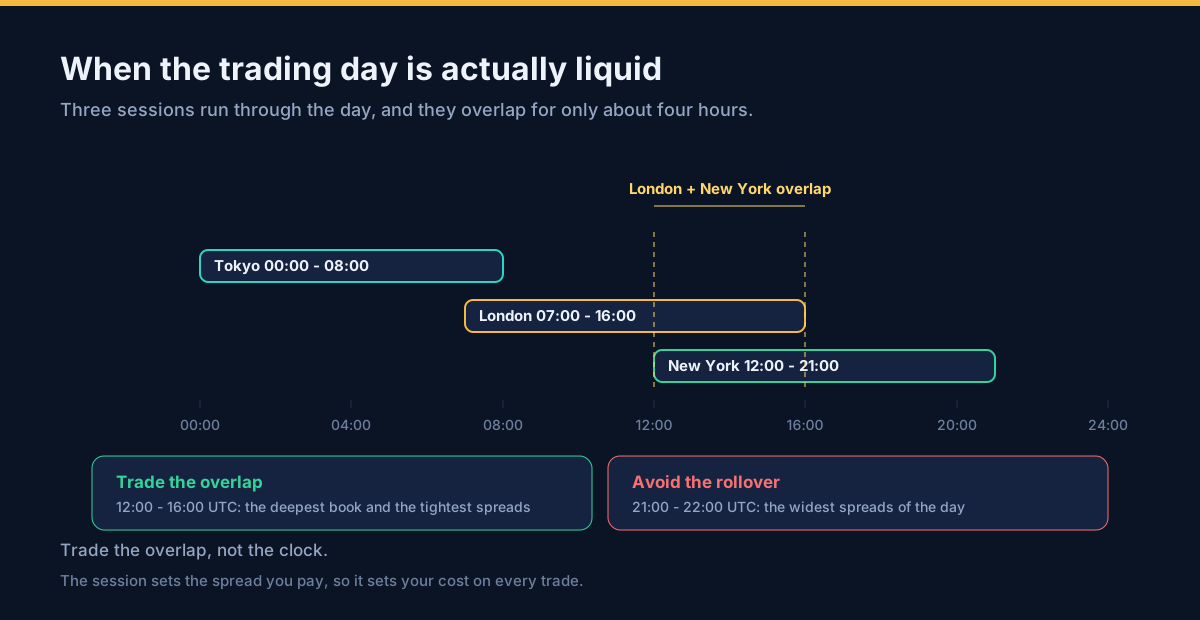
- London/NY overlap (8 AM - 12 PM ET): the highest-volume window in forex, with the best ranges and the most reliable moves. This is the forex equivalent of the futures RTH open — the quality window.
- NY afternoon (12-5 PM ET): liquidity thins after the overlap; ranges compress until the close.
The pattern across both markets is identical: there is one high-quality window per day (the overlap), and everything else is a compromise. The traders with the best pass rates concentrate their trading in that window and stay out of the compromise hours.
Why Session Quality Matters More on a Challenge
On a personal account, trading in thin liquidity costs you a few dollars in slippage. On a challenge account, the same thin liquidity interacts with rules that turn small disadvantages into account-ending events:
- Wide spreads eat your edge. A 1.5-pip spread on a pair that normally trades at 0.5 pips silently reduces your expected profit per trade. On a challenge with a fixed profit target, that is direct difficulty added to your test.
- Thin liquidity produces gaps. In low-volume windows, price can jump past your stop level, filling you far worse than planned — or not filling at all until the drawdown has already breached.
- Choppy ranges trigger overtrading. In the midday lull, price moves nowhere while your brain demands activity. Traders start "fishing" for trades, and fishing in a lull is how daily loss limits get hit.
- News spikes are deadlier in thin markets. A release that moves the market 10 points in the RTH overlap might move it 20 in the overnight session, where liquidity cannot absorb the flow. The same news, far worse odds.
Every one of these factors is a small percentage — but challenges are decided by percentages. A session-quality edge of 5-10% compounds across the weeks of an evaluation into a meaningfully higher survival probability.
The Best Times to Trade, By Firm Type
Futures firms (Apex, TopStep): 9:30-11:30 AM ET
Trade the first two hours of the RTH session. The open establishes the day's direction, volume is at its peak, and the ES/NQ produce their most tradeable ranges. Enter during the initial move or the first pullback, target the midday exhaustion, and be flat or small by lunch. The traders who pass futures challenges fastest are almost all morning traders.
Forex firms (FTMO, FundedNext, Funding Pips): 8 AM - 12 PM ET
Trade the London/NY overlap. This is when EUR/USD, GBP/USD, and the majors have their highest volume and clearest trends. London-only traders get a second option (3-6 AM ET) if the overlap conflicts with their schedule, but the overlap is the quality window. European and Asian timezone traders should map the overlap to their local clock and protect it as their trading hour.
Swing/position traders: the exceptions
Swing traders on firms that allow holds (The5ers, some FTMO accounts) care less about the intraday window and more about the weekly rhythm: entries after Monday's opening volatility, exits before Friday's close, and avoiding the hour around central bank announcements. For these traders, the "best time" is the day of the week and the phase of the trend, not the clock.
When NOT to Trade
Knowing when to stay out is worth as much as knowing when to trade. The windows to avoid on a challenge:
- The 5-10 minutes after major releases. The initial spike is where stops get gapped and drawdowns get hit. Unless news is your edge, wait for the dust to settle.
- The first 15 minutes of your chosen session. Let the open establish; the first candles are often the most volatile and the least predictable. (This applies to both the US futures open and the London open.)
- The last hour before the close. On day-trading accounts, the flattening pressure and end-of-session whipsaws punish late entries. If you are not already in a position, do not start one at 3:30 PM ET.
- Any window where you are tired. The best time to trade is when you are alert. A 2 AM session traded from memory of a good strategy is a bad trade regardless of the clock.
- Days when your plan is not there. No rule says you must trade every day. If the market is a choppy mess and your setup is absent, the best trade is the one you do not take.
The Daily Rhythm That Maximizes Pass Rates
Here is the actual daily structure successful challenge traders run — the rhythm, not just the clock:
- Prepare before the session (15-30 minutes). Review the overnight action, the economic calendar, your levels, and your risk plan. Decide the setups you will take before the market opens.
- Trade the quality window only (2-4 hours). Execute your plan during the overlap. Front-load your planned trades while you are fresh.
- Stop by lunch. Most challenge traders finish by noon ET. The rest of the day is for monitoring, not trading.
- Log and review after the session. Journal every trade, the session conditions, and your emotional state. This is the compounding feedback loop.
- Respect the daily kill-switch. Whatever the window, a -1% day ends your trading day. The account that lives to trade tomorrow beats the account that "recovers" today.
Notice what this rhythm does: it concentrates your risk exposure into the hours where it is cheapest, and it removes you from the hours where small disadvantages become account-ending events. It is not a strategy — it is the container that makes any strategy more likely to survive.
Session Timing by Strategy Type
The "best time" is also a function of your strategy, not just your market. Different edges need different windows:
- Scalpers: need the highest liquidity and tightest spreads, so the first two hours of the overlap are non-negotiable. Scalping the midday lull means fighting wider spreads and thinner volume for smaller moves — the worst of both worlds.
- Day traders (momentum/breakout): the open-to-midday window is where daily ranges establish. Enter on the initial move or the first retest, and expect the edge to fade by early afternoon.
- Swing traders: the intraday clock matters less than the weekly rhythm. Enter after Monday's opening volatility settles, manage through the week, and exit before Friday's close or the weekend gap.
- News traders: their clock is the economic calendar, not the session clock — trade the releases their strategy is built for, and sit out everything else, including the sessions between.
The rule that connects all four: match the window to the strategy's dependency. If your edge needs tight spreads, trade when spreads are tight. If your edge needs time, trade the calendar that gives you time. Forcing a strategy into the wrong window is how good plans produce bad results.
The Week as a Whole: Days That Matter
The best time to trade is not just about hours — it is about days. The weekly rhythm is nearly as predictable as the daily one:
- Monday: the market digests the weekend; opens are often gappy and ranges establish late. Many professionals trade light on Monday and wait for Tuesday's clarity.
- Tuesday-Thursday: the highest-quality trading days of the week, with full liquidity, established trends, and the week's key data releases. This is where challenge targets are won.
- Friday: position-flattening pressure builds toward the close, and afternoon liquidity thins. Trade the morning, and be flat well before the weekend — especially on firms with strict weekend holding rules.
The practical pattern: front-load your week. The traders who pass challenges fastest bank most of their target Tuesday through Thursday, protect it over the weekend, and never treat Friday afternoon as a trading opportunity. The week is a delivery schedule, and the quality days are the delivery windows.
Common Time-Related Mistakes
- Trading all day "to use the time." The challenge does not reward hours logged; it rewards survival. Overtrading hours is how drawdowns get breached at 3 PM on a day that was green at noon.
- Chasing the overnight gap. Gaps are dangerous for the same reason they are exciting — nobody controls the fill. Let the gap form, then trade the reaction in the quality window.
- Ignoring the firm's session clock. If your firm defines the trading day in US Central Time but you think in your local time, your "daily loss limit" resets at a moment you do not expect. Know the firm's clock.
- Trading through lunch out of boredom. The midday lull produces the worst fills and the worst decisions. If nothing is happening, nothing should be traded.
- Assuming "more liquidity" means "easier." The RTH open is liquid but also the most volatile window. Enter with the plan, not with the noise.
Session Overlap Analysis by Market
The overlap logic changes depending on which market you trade. Here is how the classic sessions stack up for each of the main prop firm markets:
- Forex (FX): the forex market runs 24 hours a day from Sydney's open to New York's close, five days a week. The most liquid windows are the London–New York overlap (12:00–16:00 GMT in summer, 13:00–17:00 GMT in winter) and the Sydney–Tokyo overlap during Asian hours. European pairs like EUR/USD and GBP/USD move most during London, while JPY crosses see their clearest action during Tokyo and the London open.
- Indices (US): the cash session is 09:30–16:00 New York time, with the opening and closing 30 minutes generating the bulk of the day's volume. For prop traders, the 09:30–11:00 window is where the cleanest directional moves form, and the final 30 minutes often sees a wave of position-squaring that produces sharp reversals.
- Commodities: crude oil and gold follow the COMEX and NYMEX sessions, which effectively track US market hours, with the most volatility during the New York morning. European traders get meaningful commodity movement from roughly 08:00 New York time when US data and option expiries kick in.
- Crypto: crypto never closes, which sounds like an advantage but usually is not — 24/7 markets simply spread the same volume across more hours. The clearest crypto moves happen during US trading hours when institutional flows are active, and the overnight hours are often dead, low-liquidity chop that produces fake breakouts.
The practical takeaway: your best trading window is the overlap where your market's biggest players are active. For most prop traders that is a two-to-four-hour window per day, not eight hours of screen time.
Weekly Rhythms: The Best Days of the Week
The day of the week matters almost as much as the hour. Prop firm challenges are won and lost on weekly rhythms, and the smart traders plan around them:
- Monday: ranges often set early and the market can be directionless while participants digest the weekend. Monday is a good day for range-bound strategies and a poor day for breakout hunting.
- Tuesday and Wednesday: the most reliable trend days of the week. Liquidity is fully restored, economic calendars are full, and trends that start mid-week tend to have follow-through. If you have a strategy that works, Tuesday and Wednesday are its best environment.
- Thursday: still good, but watch for the early release of key data (jobless claims, central bank decisions) that can cause whipsaw. Thursday trends are common but more volatile.
- Friday: the classic trap day. Positions get squared ahead of the weekend, and trends that look strong in the morning often reverse violently in the afternoon. A Friday loss is the most common way traders give back a week of progress.
This pattern is why so many successful prop traders front-load their week — they aim to hit the profit target by Thursday and protect what they have earned on Friday.
Building a Personal Session Schedule
Rather than copying someone else's session times, build a schedule that fits your strategy and your life. Here is the process:
- Identify your strategy's peak: backtest or journal your strategy by hour of day for a few weeks. If your strategy produces its best results between 09:30 and 11:00 New York time, that is your session — regardless of what the "best time to trade" articles say.
- Match your energy: a trader who is sharp at 6 a.m. but exhausted at 6 p.m. should trade the morning session, even if the evening session is statistically busier. Your execution quality matters more than market conditions.
- Fix your hours: decide your session window in advance and trade only within it. Prop firm challenges reward consistency, and a trader who trades the same two hours every day builds a repeatable record that firms trust.
- Build in a review block: reserve 15 minutes after your session to journal your trades. This closes the loop and compounds your edge session after session.
The best session time is the one you can execute consistently — not the one with the most volume. Consistency is what passes challenges, and volume is only useful if you are in front of the screen to catch it.
Q: What is the best time to trade a prop firm challenge?
A: The session overlap: 9:30-11:30 AM ET for futures (Apex, TopStep) and 8 AM-12 PM ET for forex (FTMO, FundedNext). These windows have the best liquidity, cleanest ranges, and most reliable fills.
Q: How many hours a day should I trade a challenge?
A: Two to four focused hours in the quality window. More hours correlate with more trades, and more trades correlate with drawdown breaches. Quality of hours, not quantity.
Q: Should I trade the news?
A: Only if it is your proven edge and your account allows it. For everyone else, the minutes around major releases are where daily loss limits get hit. Trade around the calendar, not through it.
Q: Is it better to trade in the morning or evening?
A: Morning (US sessions) for most traders — highest liquidity, widest ranges, freshest mind. Evening/Asian sessions are thinner and choppier, a poor trade on any drawdown-limited account.
Q: Does the trading day reset at a specific time?
A: Yes — each firm defines its trading day (US Central Time for Apex and TopStep, server time for others). Your daily loss limit and session rules reset at that boundary. Know it exactly.
Q: Can I pass a challenge trading only weekends or nights?
A: Only if your firm allows it (most don't for day-trading accounts) and the liquidity supports your style. For the vast majority of traders, the answer is: trade the quality windows during the week, and use off-hours for preparation and review.
Don't Let the Clock Decide Your Funding
Session timing is a real edge — but passing a challenge is a full-time discipline. We pass prop firm challenges for traders at a flat rate for any account size, with a free test available. You keep your edge; we handle the evaluation.
News Days: When the Best Time to Trade Becomes the Worst
Economic news releases override every session rule in this article, and they deserve their own section because they are where challenges get blown up:
- High-impact releases (NFP, CPI, central bank decisions): in the minutes around these releases, spreads widen, slippage spikes, and price can gap through your stop-loss without ever trading at your level. Even in markets that allow news trading, the execution quality is the worst of the month.
- Firm-specific news restrictions: many firms restrict or prohibit trading in the minutes around high-impact news, or require you to hold positions for a minimum time. Violating a news rule is a fast path to termination, so check your firm's news policy before the release — not during it.
- The post-news window: the 30–60 minutes after a major release often produces the cleanest trend of the day once the initial spike settles. For traders who understand the release, this window is frequently the best time to trade all week — but only if your firm allows it and you have a plan.
The rule of thumb: know what is on the economic calendar every single day you trade. A red-folder release at 08:30 New York time changes the character of the entire session, and the traders who get caught are the ones who did not check.
Putting It All Together: A Sample Winning Week
To make this concrete, here is what a week looks like for a trader using everything in this guide — a swing trader with a 2-hour daily session targeting 2% a week:
- Monday: no new trades. Review charts from Friday, update levels for the week, and check the economic calendar for the next five days. Maybe a small range play if a clean level shows up — nothing more.
- Tuesday: primary trading day. Trade the London–New York overlap window with full attention. The goal is to bank the week's first 1% with one or two high-quality setups.
- Wednesday: secondary trading day. Look for continuation setups in the same overlap window. If Tuesday worked, Wednesday is for adding without overextending.
- Thursday: trade only if a clear setup appears. Protect the week's gains — a Thursday that ends flat is a successful Thursday.
- Friday: no new positions. Square anything still open before the weekend, journal the week, and plan next week's levels. Friday's job is preservation, not profit.
Notice what this plan does: it concentrates risk into the days and hours where the market is most cooperative, it protects profits on the dangerous days, and it builds a consistent, low-variance record — exactly the record prop firms reward with payouts and scaling. The best time to trade is not a single hour; it is a rhythm, and this is what a winning rhythm looks like on paper.
The Bottom Line
The best time to trade a prop firm challenge is the session overlap — 9:30-11:30 AM ET for futures, 8 AM-12 PM ET for forex — when liquidity is deepest, spreads are tightest, and fills are most reliable. Every other hour is a compromise where the small disadvantages (spreads, gaps, chop, tiredness) compound into the large failure modes (drawdown breaches) that end evaluations.
Trade the quality window, stop by lunch, respect the daily kill-switch, and know your firm's session clock. The clock is not the strategy — but trading the right hours is the cheapest edge available, and the traders who use it consistently outsurvive the ones who trade around the clock.