
Payout mechanics · reviewed October 2026
The funded account payout process, step by step
Passing an evaluation produces a funded account. Getting money out of it is a separate sequence of conditions — minimum trading days, a profit threshold, a consistency check, identity verification and the withdrawal itself. This guide covers each one and the errors that delay them.
Key takeaways
- Five conditions usually sit between a pass and a first withdrawal, and they are checked independently.
- Completed KYC before the profit threshold is reached removes the most common avoidable delay.
- A consistency rule at payout is the most frequent reason a profitable account cannot withdraw.
- Withdrawal methods and processing windows matter more than a few points of profit split.
Contents
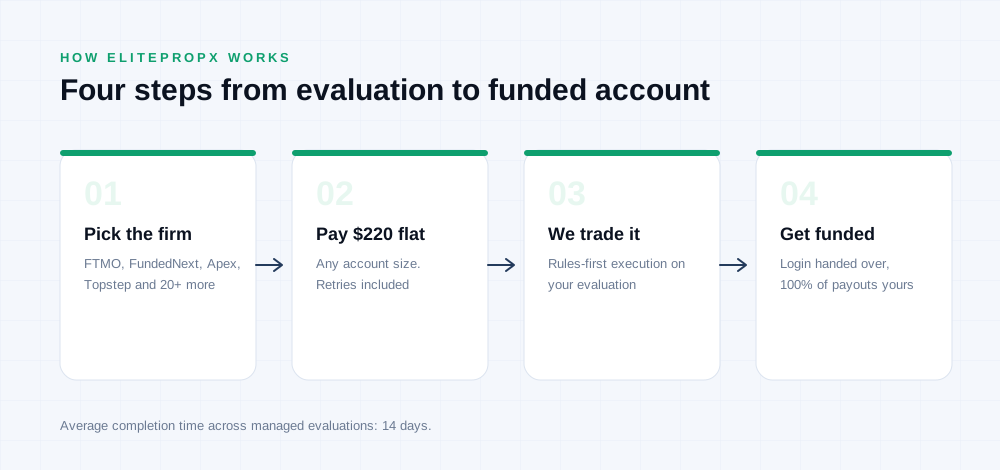
The payout sequence in one page
A funded account is not a bank account. Withdrawals are governed by conditions that differ from firm to firm but follow the same order almost everywhere.

- Funded credentials issued. The evaluation is verified and the live account is opened in your name.
- Minimum trading days completed. Usually five to ten days of qualifying activity.
- Profit threshold met. Often 5–10% on forex accounts, or a dollar figure on futures accounts.
- Consistency satisfied. No single day should dominate total profit — commonly a 30% best-day cap.
- KYC completed. Identity and address documents matched to the account holder.
- Withdrawal processed. Typically one to seven business days after approval, depending on the method.
Two properties of this sequence cause most of the frustration traders experience. First, the conditions are cumulative but independent: satisfying four of the five produces nothing. Second, the threshold usually resets after each withdrawal, so the sequence repeats for every payout rather than being a one-time gate.
Step 1: minimum trading days
Firms require a minimum number of qualifying days before a payout can be requested, and the definition of a qualifying day varies in ways that matter.
- A closed trade. The most common definition: at least one position opened and closed on the day.
- A day meeting a minimum activity level. A few firms require a minimum number of trades or a minimum holding period.
- A calendar day with platform activity. Rare, but occasionally used for accounts that must show continuous engagement.
The practical implication is that day count cannot be accelerated. A trader who reaches the profit threshold in three sessions still waits for the remaining days, and during that wait the account must stay profitable — which is why reaching the threshold early is not an advantage. The efficient approach is to pace the profit to arrive on or just after the minimum day, so there is no idle period at target.
Our own recorded pass timelines cluster around fourteen trading days for two-phase forex evaluations, which comfortably exceeds most minimum-day requirements — the pacing arithmetic naturally produces enough sessions without any deliberate pad.
Step 2: the profit threshold
After funding, most firms require a fresh profit threshold before the first withdrawal. On forex accounts this is commonly 5–10% of the account; on futures accounts it is usually stated in dollars.
Three details are worth confirming in the firm's terms rather than assuming.
Whether the threshold resets after each payout. Many firms apply the same threshold to every withdrawal, which means the sequence repeats monthly or bi-weekly for as long as the account is traded.
Whether floating profit counts. Almost universally, the threshold is measured on closed profit. A trader sitting on a large unrealised gain has not met it.
Whether the threshold scales with the account. On firms with scaling plans, the threshold may rise as the account grows, which changes the arithmetic for subsequent payouts.
Step 3: the consistency check
This is the gate that blocks the most withdrawals, and it is entirely an arithmetic problem.
A consistency rule at payout limits how much of total profit may come from one day. The common shape is 30%, which means total profit must reach at least 3.33× the best day. A trader with a $6,000 best day needs $20,000 in total before the withdrawal is approved, regardless of the firm's profit threshold being met.
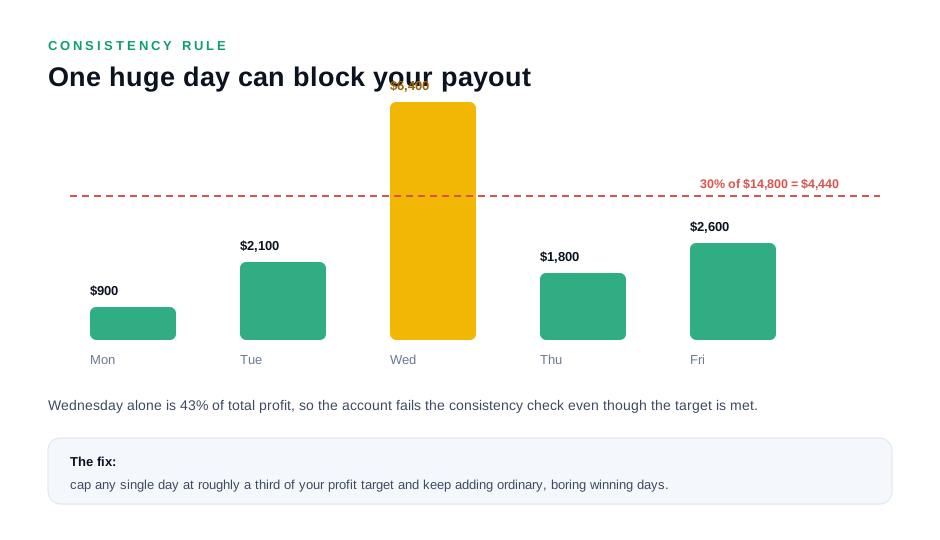
The remedy is additive rather than surgical: more ordinary winning days, with each of them small. A trader with a dominant day who repairs the ratio with a second large day has simply raised the bar, because the required total scales with the new best day. The full arithmetic, including worked examples at 30%, 40% and 50%, is in the consistency rule guide.
Step 4: KYC
Identity verification is handled by the firm, not by any passing service, and it is the most common source of avoidable delay in a first withdrawal.
What firms typically require: a government-issued photo identity document, a proof of address dated within the last three months, and in some cases a payment method in the same name as the account. Requirements differ by jurisdiction and by firm, and a document accepted by one firm can be rejected by another for reasons such as a name mismatch, an expired date or an address that does not match the account details exactly.
Three practical rules reduce the friction to nearly nothing.
- Complete KYC before reaching the profit threshold. Verification queues are not instant, and a trader who reaches the threshold first waits at the gate rather than at the desk. Doing it in the first week of the funded phase converts a delay into a formality.
- Use the same name, spelling and address everywhere. Account registration, identity document, address document and payment method should match character for character. Most KYC rejections are clerical rather than substantive.
- Photograph documents properly. Glare, crop, angle and file size cause a surprising share of rejections. A flat, well-lit phone photo with all four corners visible is usually sufficient.
One clarification that matters for anyone using a third-party service during the evaluation: KYC is tied to the account holder, and it should be. The account is registered in your name, funded in your name and paid out to you. No passing service should ever request your identity documents, and any that does should be avoided.
Step 5: the withdrawal itself
With the conditions met, the withdrawal request enters the firm's processing queue. Three variables determine how long it takes and how much arrives.
Processing windows. Some firms process payout requests on a fixed schedule — weekly, bi-weekly or monthly — rather than on demand. A request submitted the day after a processing run waits for the next one, which can add three weeks to a withdrawal that appeared to take two days.
Method. Bank transfer, cryptocurrency and e-wallet transfers have different speeds and different fee structures. Firms differ on which are available and whether the method must match the payment method used to purchase the evaluation.
Split and fees. The firm pays your share of the profit — typically 80–90% — and may deduct transfer fees. On a $10,000 payout at an 85% split, the arriving amount is $8,500 before any transfer costs, and the split percentage is worth less attention than the processing window.
A useful comparison habit: an 85% split paid weekly delivers cash more often than a 92% split paid monthly, and for a trader withdrawing regularly the difference over a year is larger than the headline percentage suggests. Where a firm's split is unusually generous and its payout cycle unusually slow, that combination is usually deliberate.
Payouts on forex accounts versus futures accounts
The sequence is the same for both, but the practical experience differs in four ways that matter to how you plan the funded phase.
| Dimension | Forex and CFD firms | Futures firms |
|---|---|---|
| Threshold basis | Percentage of account balance | Fixed dollar figure |
| Typical first-payout delay | Two to four weeks after funding | Often a minimum of ten trading days |
| Consistency at payout | Applied by some firms | Applied by nearly all |
| Scaling structure | Common, usually tied to payout milestones | Common, often plan-based rather than profit-based |
The consequence of the second row is underrated. On a futures account with a ten-day minimum, the funded phase is effectively an extension of the evaluation, and the rules that got you through the evaluation are the rules that get you through the waiting period. Traders who treat funding as permission to change their approach tend to lose the account during the wait, before the first payout is ever requested.
A second difference is how the threshold interacts with consistency on futures accounts. Because the threshold is a dollar figure and consistency is a ratio, a trader can meet the threshold and fail the ratio simultaneously — for example, reaching a $6,000 threshold with a $5,000 best day, which requires $16,667 of total profit under a 30% rule. Reaching the threshold in that situation is not progress; it is a request that will be refused.
What a payout history does for scaling
First payouts are usually about clearing the gate rather than maximizing income, and the reason is that most firms tie account growth to a demonstrated payout record.
Scaling plans generally work in one of two ways. The first increases the profit split as payout milestones are met — 80% rising to 85% or 90% after a defined number of withdrawals. The second increases the account size, either by allocating additional accounts or by raising the balance on the existing one, sometimes conditioned on consistent monthly payouts rather than on a single large one.
Both structures reward regularity over size. A trader who withdraws a moderate amount every month for six months accumulates a stronger record than one who withdraws a large amount once and then breaches a rule. That is not a moral point; it is how the plans are written, and it means the payout discipline described in this guide — small, evenly distributed daily profit, repeated — compounds into a larger funded account.
A practical sequencing note for traders intending to scale: pass one account, take one or two payouts on it, then add a second account rather than running two evaluations simultaneously. Two funded accounts at once split attention, create correlated-position risks that firms treat as a single exposure, and delay the point at which either account produces income.
Six reasons a first payout is delayed
These are the causes we see most often, in roughly the order they occur.
1. An incomplete consistency ratio
One dominant day, total profit below the required multiple, withdrawal refused until the distribution changes. This is arithmetic rather than discretion, and no negotiation alters it.
2. KYC not started
The threshold is met, the request is submitted, and verification is requested for the first time. Add several days to a week depending on the firm's queue.
3. Profit counted as floating rather than closed
An unrealised gain does not satisfy a threshold measured on closed profit. Traders watching an open position that would push them over the line have not yet met the condition.
4. A misunderstanding of the processing schedule
Monthly payout windows are common and often buried in the terms. A firm advertising "fast payouts" may mean fast processing inside a fixed window rather than on-demand payment.
5. Minimum day count measured differently than assumed
A day with no closed trade may not count, which quietly extends the requirement beyond what the trader expected. The fix is to close at least one small position on each intended day rather than holding positions open across sessions.
6. A rule interaction with the funded account's own limits
Funded accounts have their own daily limits and drawdown conditions. A trader who spends the wait to the payout threshold trading aggressively can breach one of them, which ends the account and the pending withdrawal with it. The waiting period is the worst possible time to increase size, and it is exactly when many traders do.
The one-line summary: treat the funded phase as a second evaluation with different rules, complete KYC early, keep daily profit small and evenly distributed, and the first payout becomes a formality rather than a negotiation.
A worked first payout, day by day
The sequence is easier to plan with dates attached. Here is a realistic first payout on a $100,000 funded forex account with a 5% payout threshold, a ten-day minimum and a 30% consistency rule.
Day 1 — funded credentials received. KYC is submitted the same day rather than at the payout request. The funded-phase rules are read: threshold, minimum days, consistency, payout window.
Days 1–4 — small, capped sessions. Daily profit is deliberately limited to roughly 0.4% of balance, which paces the 5% threshold across ten sessions and keeps every day comfortably under the consistency ratio. Nothing dramatic; the objective during this phase is a clean record rather than a fast finish.
Days 5–8 — KYC clears, progress continues. Verification completes in the background while trading continues. By day 8 the account is at 3.1% of the threshold, with a best day of 0.6% — about 19% of total profit, well inside a 30% rule.
Day 10 — minimum days satisfied. The threshold is reached on the same day the day count completes, which is the ideal outcome and the reason the pace was planned backwards from the minimum-day requirement rather than forwards from ambition.
Day 11 — payout requested. The request is submitted with the day count complete, the threshold met on closed profit, the consistency ratio at 19% and KYC already approved. No gate is left open.
Days 12–14 — processing. The withdrawal clears inside the firm's processing window and the trader's share of $5,000 arrives after the split is applied. On an 85% split that is $4,250 before transfer costs.
Afterwards — the cycle repeats. The threshold resets, so the same disciplined pace is required for the next withdrawal. Traders who maintain it find the second payout easier, because both the ratio history and the KYC requirement are already established.
What made that sequence smooth: KYC before the threshold, pacing planned backwards from the minimum-day requirement, daily profit capped well inside the consistency rule, and no attempt to accelerate once the finish was in sight. Each of those is a scheduling decision made before the funded phase began.
Funded-account rules that differ from the evaluation
Traders often assume the funded account is the evaluation with a bigger target. It is a different rulebook, and knowing which conditions change prevents the most common funded-phase losses.
| Rule | During the evaluation | On the funded account |
|---|---|---|
| Profit target | One-time target to pass | Recurring threshold before each payout |
| Daily loss limit | Usually 5%, enforced strictly | Often relaxed, sometimes removed |
| Maximum loss | Trailing or static threshold | Usually static at the starting balance |
| Consistency | Rarely applied | Commonly applied at payout |
| Minimum days | Four to ten to complete | Five to ten before each payout |
| Identity checks | At registration | Again before the first withdrawal |
The pattern in that table explains a widely reported frustration — that the evaluation was easier than the funded account. Evaluations punish risk: a trader who takes modest, consistent positions passes. Funded accounts punish concentration: a trader who banks one large day cannot withdraw until the distribution changes. A trader who passes by grinding and then switches to a larger, more directional style on the funded account has adopted the one behaviour the funded rules penalise.
Two consequences are worth planning for explicitly.
Keep the evaluation's risk discipline on the funded account. The daily limit may be relaxed, but the consistency rule is not, and the threshold resets with every payout. Trading the funded account at double the evaluation's risk converts a relaxed limit into an unused safety margin and a concentrated profit history into a delayed withdrawal.
Write the funded plan before the handover. Most traders arrive at the funded phase with a detailed evaluation plan and no plan at all for what comes next. The four numbers that matter are the same as before — risk per trade, maximum daily risk, daily profit cap and the day on which the payout will be requested — plus the KYC deadline. Writing them down takes ten minutes and removes the improvisation that funded accounts punish.
Withdrawal timing and cash flow planning
Almost every question about payouts is really a question about timing, and timing is a planning problem rather than a performance one. Three numbers determine when money actually arrives: the first day on which the payout can be requested, the firm's processing window, and the speed of the withdrawal method.
The first number is the one traders control. It is the later of two dates: the day the minimum-day requirement completes, and the day the profit threshold is met on closed trades. Planning backwards from that date — dividing the threshold by the number of available sessions and checking the result against the daily profit cap — produces a schedule in which the two dates coincide. Improvising forwards usually means one of them is reached weeks before the other, and the interim period is spent holding an account at target with a consistency ratio at risk.
The processing window is the number traders most often discover late. A firm that processes withdrawals weekly has a worst-case wait of seven days on top of the day count; a firm with a monthly window can add three weeks to a request submitted the day after a run. Where two firms are otherwise comparable, the shorter window is worth more than a couple of percentage points of split for a trader who withdraws regularly rather than compounding inside the account.
The third number — method speed — rarely changes the picture on its own, because method options are usually available to all traders at a firm. Its practical relevance is administrative: the method used to purchase the evaluation sometimes has to match the method used for the payout, and confirming that early avoids a rejected request at the last step.
Frequently asked about payouts
How long after passing do I get paid?
Most firms require five to ten trading days of qualifying activity plus a profit threshold before the first payout request, then one to seven business days of processing. In practice the first withdrawal arrives three to six weeks after funding, with the biggest variable being whether KYC was completed in advance.
Does floating profit count toward the payout threshold?
Almost never. Thresholds are measured on closed profit, so a large unrealised gain does not satisfy the condition. Closing the position converts it into qualifying profit.
Can a payout be refused after passing the evaluation?
Yes, most commonly for a consistency failure, incomplete KYC or a rule interaction on the funded account. The account is not usually closed — the withdrawal is deferred until the condition is met, or the request is resubmitted after verification.
Does the profit threshold reset after each payout?
On most firms, yes: the threshold applies to every withdrawal rather than being a one-time gate. Some firms reduce the requirement after a number of payouts or tie it to a scaling plan, so the specific answer belongs to the firm's funded-account terms.
What counts as a qualifying trading day?
Usually a day with at least one position opened and closed. Holding a position across sessions without closing anything may not count, which is why the plan opens and closes something small on each intended day during the minimum-day period.
Which withdrawal method is fastest?
It varies by firm and jurisdiction, and the processing window matters more than the method itself. Cryptocurrency and e-wallet transfers are typically faster where offered, but the firm's schedule — weekly, bi-weekly or monthly — usually dominates the timeline.
Can I request a partial payout?
Some firms allow it, and where they do it can be useful: a smaller requested amount may satisfy a consistency ratio measured against the withdrawal rather than against total profit. Confirm the measurement basis in writing before relying on it.
What happens if the account breaches a rule during the payout wait?
The account ends and any pending payout goes with it. Funded accounts carry their own daily limits and drawdown conditions, and the waiting period to a payout is the worst time to increase size — which is statistically when many traders do.
Do payouts affect a scaling plan?
They usually drive it. Most scaling plans increase the split percentage or the account size based on a record of completed payouts, which rewards regularity over a single large withdrawal. A steady monthly record compounds into a larger funded account over time.
Does a passing service take anything from payouts?
ElitePropX does not. The fee is a flat $220 paid before the evaluation; the funded account and 100% of what it earns belong to the account holder. Any service taking a share of payouts should be treated with the same scrutiny as a copy-trading arrangement.
When a payout is refused, and what the refusal usually means
A refused withdrawal is the moment the rules stop being abstract, and the reason is almost never the one the trader assumes. Refusals cluster into five causes, and four of them were knowable before the request was made.
Cause one: the consistency ratio
The most common refusal is distribution, not profitability. The firm measures the best day as a share of total profit at the moment of the request, and a single outsized session can push that ratio above the threshold even when the account is comfortably in profit. The fix is to add ordinary profit rather than to argue: required total equals best day divided by the consistency percentage, and the difference is the amount of quiet trading still to do.
Cause two: the minimum day count
Many funded accounts require a set number of trading days before the first withdrawal, and a day only counts if a position was opened. A trader who reaches a profit threshold in four sessions may be waiting another fortnight for the calendar, not the market. Requests submitted before both conditions are met are usually refused without prejudice, which is better than a rejection but still costs a processing cycle.
Cause three: an open position
Some firms require a flat book at the moment of the request, and a request submitted with a position open can be refused or queued. This is a small thing that becomes large at a month end when the processing window closes: a trader who submits at 23:50 with a position open may wait another cycle for a technicality.
Cause four: an unresolved rule review
Firms audit funded accounts, sometimes after the fact, and a payout can be held while a review is open — a position held over a weekend on an account type that does not allow it, a news event that was restricted, a strategy that the terms describe as prohibited. This is the refusal that hurts most and the one where the trader has the least recourse, because the enforcement clause was in the rulebook from day one.
Cause five: payment details
Name mismatches, an unverified wallet, a bank account in a different name from the trading account. These are administrative and usually fixable in a day, but they can consume a processing cycle if discovered at the request stage rather than at the start. Setting up and verifying payment details on day one is the cheapest insurance in the entire process.
Withdrawal methods and what they cost
| Method | Typical speed | Friction to expect |
|---|---|---|
| Bank transfer | 2–5 business days | Name matching, intermediary fees on cross-border payments |
| Crypto (USDT and similar) | Hours to one business day | Network fees, wallet verification, price exposure between request and receipt |
| Card or wallet providers | 1–3 business days | Regional availability and limits |
| Profit split credited to a new account | Immediate | Not cash: it stays with the firm and carries counterparty risk |
The last row deserves a note. Some firms offer to credit a payout to a new account at a favourable rate instead of paying it out. That can be a good deal for a trader who intends to keep trading and understands that the money is now a claim on the firm rather than a balance in a bank. It is a poor deal for anyone who wanted the money in the first place.
The tax position, in general terms
Payouts are income and are treated as such in most jurisdictions, though the exact classification — trading income, self-employment, other income — varies and is worth confirming with an accountant in the country where the trader is resident. Two practical points are worth more than a general disclaimer.
First, keep a record of every payout with its date, amount, currency and the firm that paid it, alongside the fee paid to enter the evaluation. The fee is usually a deductible expense against the income, and reconstructing that record a year later is far more expensive than keeping it as it arrives. Second, treat crypto payouts as valued at receipt rather than at withdrawal, because the taxable event is normally the receipt of value, not the moment the coins are sold.
What the funded agreement actually says
Most firms describe the relationship as a simulated account with performance-based remuneration, not a brokerage account with client funds. That distinction matters practically: there is no segregated client money, no investor protection scheme, and the payout is a contractual payment rather than a withdrawal of owned assets. Reading the agreement once, before the first request, removes a category of expectation that no amount of forum reading repairs.
It also clarifies what a funded account is worth. The account is a licence to earn a share of simulated profits under a specific rulebook, and the licence can be revoked under that rulebook. That is not a reason to avoid the model; it is a reason to keep the payout cycle short and not to treat an unpaid balance with the firm as savings.
The practical consequence is a rule of thumb: request the first payout as soon as the rules allow it, even if the amount is small. A payout that has arrived is real; a balance that has not been requested is a number on a dashboard that the next bad week can reduce.
Small, frequent withdrawals also make the accounting simpler: each payout is a dated, documented event, and a series of them is a better record than one large transfer whose origin is harder to explain.