
Payouts · reviewed November 2026
When an FTMO payout is denied
A refused payout is not one event. It is one of four, and the four have almost nothing in common: a consistency ratio outside the threshold, a practice flagged during review, a payment detail that does not match the verified identity, or a rule breach identified after the fact. This page separates them, quotes the kind of wording each produces, and sets out what actually resolves each branch — including the two that no amount of trading will fix.
Key takeaways
- Four refusals: consistency, prohibited practice, payment mismatch, and a breach found in review.
- Only the consistency refusal is routinely cleared by trading on.
- The review happens after the request, which is why an account can trade for weeks before a flag appears.
- Name and payment details must match the verified identity exactly; a middle name or a business account is enough to stop a transfer.
- A refusal citing prohibited practice is an integrity finding, not a timing problem.
- The evidence file, not the reply, is what reopens a case.
Contents
- The four refusals
- Consistency, and why only this one clears
- Prohibited practice found in review
- Identity and payment mismatch
- A breach identified after the fact
- Reading the refusal email
- The appeal, and the file that supports it
- What is not appealable
- Denied against delayed
- The first payout specifically
- Records that answer a review
- After a refusal: stay or move
- What to write back
- Preventing it in the last ten days
- Common questions
The four refusals
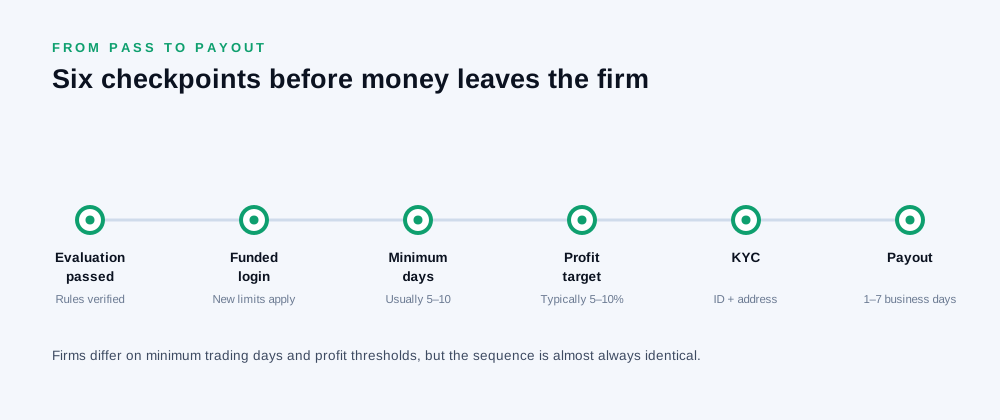
The payout sequence runs minimum trading days, profit threshold, consistency check, verification, transfer. A refusal lands at one of those steps, and the step it landed on is the first thing to identify. Firms rarely name the step explicitly, but the wording gives it away: a ratio is quoted in one case, a document in another, a practice in a third.
Getting the branch wrong is expensive because the remedies are not interchangeable. A trader who answers a consistency refusal with identity documents wastes a week, and a trader who answers an integrity finding with more trading wastes the account. Read the email twice before replying once.
Consistency, and why only this one clears
The consistency refusal quotes a percentage and a threshold, something like "your best trading day represents 63% of your total profit, exceeding the 40% limit". It is a timing refusal rather than an accusation: the account traded within the rules and the profit is real, but the distribution is too concentrated for the firm to pay out on a small sample.
This is the one branch that resolves by continuing to trade. Additional ordinary winning days raise the denominator, the ratio falls, and the next request goes through. The repair is usually one to three weeks at the same or reduced size, and the arithmetic is set out in full in the consistency ratio guide.
Two details decide how long the repair takes. The first is whether the refused profit carries forward as the base for the next request; if it does, a handful of average days is enough, and if the cycle resets, the trader is starting again. The second is whether the firm measures against profit before or after a withdrawal, because requesting a large payout shrinks the denominator and can push the ratio back over the line.
Ask the support team for the exact denominator they will apply before trading the repair. A reply that states the figure converts a guessing game into an arithmetic exercise, and it also creates a written record of the firm's interpretation that is useful if the second request is refused on a different reading.
Prohibited practice found in review
The second branch is a finding that the account was not traded the way the terms require. Copying signals, running the account to a third party, using an EA the terms exclude, holding through a restricted news window, or exploiting a pricing or latency artefact all fall here. The wording usually names the practice and cites the clause, and it often arrives weeks after the activity, because the review is retrospective.
This branch does not clear by trading. The finding is about how the profit was made rather than how much of it there is, and the standard outcomes are a cancelled payout, a closed account, or both. A trader who believes the finding is wrong is arguing about evidence, so the useful response is a factual timeline: what the strategy was, which tools it used, and what the terms permitted at the time.
The most common genuine misunderstanding is the EA boundary. Many firms permit automation that executes the trader's own logic and prohibit automation that reacts to the platform in ways a human could not, or that is shared between accounts. The line is drawn in the terms rather than in the software, so a tool's marketing description is not the test. The EA rules cover where that boundary sits.
A second common finding is account management. Letting another person place trades, even a friend or a mentor, is generally treated as third-party trading regardless of whether money changed hands. The account sharing rules set out the distinction between access, advice and execution.
Identity and payment mismatch
The third branch is administrative and the easiest to prevent. The payout is sent to an account in the trader's verified name, and any mismatch stops the transfer: a married name that differs from the ID, a middle name missing from the bank record, a business account, a payment processor in a different country, or a crypto address that has been used by someone else.
The failure mode is that the transfer is attempted and returned rather than refused outright, which adds a week to the cycle and produces a second, vaguer email. Traders who have changed bank, moved country or use a payment method in a different currency should confirm the details before requesting rather than after.
Documents have their own timing problem. A proof of address older than the firm's window, a bank statement with the address redacted, or a screenshot instead of a PDF will each fail verification, and each failure resets the queue. Submit clean, current documents that match the account name exactly, and keep the same payment method across payouts so the history is consistent.
A breach identified after the fact
The fourth branch is a rule breach that was not flagged in real time. Firms reconcile accounts post hoc: they check maximum contracts used, news windows, weekend holding, and whether the drawdown was ever exceeded at any point in the day rather than only at the close. An account that passed the threshold can still be closed when one of those checks fails.
This branch is the hardest to contest because the firm's record is the platform's record. If the reconciliation shows twenty-one contracts where the plan allowed twenty, the argument is about the plan's terms and not about what happened. The useful prep is to keep a personal log of maximum simultaneous positions and of any trade near a restricted window, so the numbers can be checked against the firm's statement within days rather than weeks.
Drawdown breaches measured intraday are the subtler case. An account that dips below the floor at 10:40 and recovers by 11:00 has breached, because the rule is measured on equity continuously rather than on the closing balance. A trader watching only the end-of-day figure will believe the account is intact and be surprised by a closure at payout. The FTMO rule numbers set out which figures are measured continuously.
Reading the refusal email
The email is usually short and structured in three parts: the decision, the clause, and the account's state. The decision says the payout will not be processed. The clause names the term that was not met. The account state says whether the account remains open, is frozen pending review, or has been closed.
Those three parts decide everything that follows. If the account remains open and the clause is consistency, the path is trading. If the account is frozen, the path is evidence and support. If the account is closed and the clause is a practice or breach, the path is a written appeal with dates and records, and it should be expected to take longer than the reply cycle.
Reply in the same thread and answer the clause directly. A reply that addresses everything except the citation reads as evasive and usually produces a template response. One paragraph per point, with the relevant record attached, moves faster than a long narrative about the trader's history and intent.
The appeal, and the file that supports it
An appeal that works is an evidence file rather than an argument. Four items cover most cases: the platform statement for the period in question, the trade log with timestamps, the terms as they read on the date of the trades, and a one-page timeline of what happened and when.
The terms snapshot matters more than traders expect, because firms revise their rules and the version in force on the trade date is the one that governs. A trader who downloads the current terms during an appeal may be arguing against a stricter document than the one that applied. Save the page at the time of purchase, ideally as a dated PDF.
The timeline should be factual and short. Date, action, reason, outcome. Nine entries beat nine paragraphs, and a reviewer can check nine entries quickly. Attach rather than paste: a statement PDF with the relevant rows highlighted is faster to verify than a table retyped into an email.
If the finding is upheld and the account is closed, the realistic outcome is a new attempt on different terms rather than a reversal. The comparison of refusal policies across firms shows how much they differ, and it is worth reading before choosing where to spend a second attempt.
What is not appealable
Three refusals are effectively final, and treating them as negotiable costs weeks. A confirmed prohibited practice is one. A drawdown breach verified against the platform record is another, because the record is the definition. A payment mismatch that the trader cannot document is the third — the firm cannot send money to a name it cannot verify, and no amount of correspondence changes that.
What is genuinely reviewable is narrower than most refusals suggest: whether the clause cited was in force on the date of the trade, whether the figure quoted was computed correctly, and whether the activity fell inside the permitted side of an ambiguous boundary. Those three are worth an appeal. "I did not know" and "it was only once" are not, and framing a case that way spends the credibility that a genuine review needs.
What to write back
Each branch has a reply that suits it, and using the wrong one wastes the only cheap opportunity in the process. Keep every reply short, factual and in the original thread.
For a consistency refusal: state the ratio you compute, the threshold you are working to, and the additional profit you intend to book before the next request. Ask for confirmation of the denominator the firm will use. Three sentences and one question, with no argument about whether the rule is fair.
For a prohibited-practice finding: list the tools used, the dates, and the clause you relied on at the time, and attach the terms as they read on those dates. Ask which part of the clause the activity is said to breach. That question forces a specific citation, and a specific citation is either answerable or demonstrably wrong.
For a payment mismatch: name the detail that failed, state the correction, and attach the corrected document. No explanation of intent is needed, and adding one makes a two-day fix look like a dispute. For a breach identified in review: ask for the specific figure and timestamp, then compare it against your own log before responding at all.
The common thread is that every useful reply asks for a number, a date or a clause. A reply that asks for reconsideration has nothing for a reviewer to act on, and it usually receives the template response it invited.
Preventing it in the last ten days
The last ten days of a payout cycle are where refusals are made, because that is when the account is closest to the request. Five habits cover almost every preventable case.
Keep size constant so no single session dominates the profit. Check the consistency ratio weekly rather than at the request. Confirm the payment details match the verified identity before submitting. Stay clear of restricted windows for the final two weeks instead of testing the boundary. And keep the maximum simultaneous position under the plan's cap with a margin, because a bracket order can overshoot a count that looked safe.
None of those is a trading insight. They are process hygiene, and the reason they matter is that a refusal at the payout wastes the weeks between the pass and the first transfer — the period when a funded account is most valuable and least defended. The first payout timeline shows where those weeks go, and the withdrawal process covers the mechanics.
Denied against delayed
Most payouts that traders describe as denied were never decided. They are sitting in a queue, waiting on a document, or held while a reconciliation runs, and the difference matters because a delay has no findings attached. A trader who appeals a delay as though it were a finding spends credibility for nothing.
The distinction is visible in the wording and in the account state. A delay says the request is being processed, or that further information is required, and it normally comes with a list of what is missing. A denial says the request will not be processed and cites a clause. If the email does not cite a clause, it is a delay until proven otherwise.
Delays cluster around three causes: a payment detail that failed a check, a verification document that was rejected as unreadable or out of date, and a review that has not completed. Each has a different response — correct the detail, resubmit the document, or wait — and asking support which of the three applies is a single question that saves a week of speculation.
The practical rule is to give a delay its stated window before escalating, and to escalate by adding information rather than by restating the request. A second message that includes the corrected document moves the queue. A second message that asks for an update does not.
The first payout specifically
The first payout carries the heaviest review of any request on the account, because it is the first time the firm has had to verify the profit and the identity together. Later payouts reuse that work and clear faster. Most refusals on a healthy account therefore happen at the first request, and most of those are preventable.
Three checks stack at that point. The consistency ratio is measured for the first time. The identity and payment details are verified for the first time. And the whole trading history is reconciled against the rules for the first time, including contract counts and restricted windows from the evaluation stage. Any one of those can stop the request even when the other two are clean.
The sequencing explains an experience many traders report: an account that passed the evaluation comfortably and traded the funded stage sensibly is refused at the first request for something that happened weeks earlier. The review is not unfair; it is retrospective by design, and the first payout is when the whole history is examined at once.
The response is to treat the first request as an audit rather than a formality. Check the ratio the week before, confirm the payment details early, and keep the trade log current enough that a question about a specific session can be answered from a document rather than from memory. The first payout guide covers the sequencing, and the payout process sets out each check in order.
Records that answer a review
Four documents cover almost every review question, and all four should exist before the request rather than after it. The first is the platform statement for the full period, exported rather than screenshotted. The second is the trade log with entry and exit timestamps, sizes and instrument names.
The third is the terms as they applied on the date of the trades. Firms revise their rulebooks, and a version downloaded during an appeal may be stricter than the one in force when the trades were placed. Saving the page at purchase, dated, is the cheapest insurance in this entire process and almost nobody does it.
The fourth is a one-page summary of the account's maximum simultaneous exposure by day. That single number answers most contract-limit questions and it is not visible on a standard statement, which reports trades rather than the maximum open at any moment. A trader who computes it weekly knows the answer before the firm asks.
Keep the same four documents across attempts and firms. They are portable, they take minutes to produce once the habit exists, and they convert a review from an argument about memory into a comparison of records. The rejection patterns show how often the missing document is the whole dispute.
After a refusal: stay or move
A consistency refusal is a reason to stay, because the account is open, the profit is real and the repair is arithmetic. A prohibited-practice finding is a reason to move, because the account is closed and the firm's reading of the clause will not change on appeal. A payment mismatch is neither: fix the detail and stay.
For a trader deciding whether to spend a second attempt at the same firm, the useful inputs are the clause that was cited, the firm's retry pricing, and whether the finding would follow them to a new account. A disclosure that was missing at the first firm can be made at the second; a practice that is prohibited at one firm is usually prohibited at most of them.
Switching firms has a real cost beyond the fee. New rules, a different platform, a new payout cycle and a new verification all have to be learned, and the first month at a new firm is statistically the worst month for refusals because the trader does not yet know where the line sits. That cost should be set against the value of a clean start.
The comparison of approaches is the place to start when the answer is to change route entirely, and the client results show what a completed path looks like when the sequence is followed in order rather than repaired afterwards.
Common questions
Can a denied FTMO payout be reversed?
Yes for a consistency refusal, which clears as total profit grows. A confirmed prohibited practice or a verified drawdown breach is effectively final, and a payment mismatch is fixed by correcting the details rather than by appealing.
Does a refusal close the account?
Not always. The email states the account's status, and a consistency refusal usually leaves the account open. A closed account is stated explicitly, and it changes the appeal into a written case rather than a trading repair.
Why was my payout refused weeks after the trades?
The review is retrospective and runs at the request rather than in real time. Contract counts, news windows and intraday drawdown are reconciled against the platform record when the payout is submitted.
What if my bank name differs from my ID?
The transfer will fail verification. Update the payment method to an account in the verified name, or supply the document that links the two names, before submitting the request.
Can I appeal with screenshots?
They are accepted as supporting material but rarely as primary evidence. A platform statement PDF and a trade log with timestamps carry more weight than images that cannot be tied to an account record.
Is a refused payout the same as a breach?
No. A consistency refusal is a timing decision made under the payout clause and does not end the account. A breach is a rules finding, and the two are written under different clauses even when the emails look similar.
Does a passing service avoid payout refusals?
No. It delivers a passed evaluation; the funded account's payout conditions still apply from the first day of funding, including consistency and verification.
Get to the payout with the rules already handled
Flat $220, any firm, any account size — paced so the first request is not refused on a ratio.
Related reading
- The payout sequence, step by step
- The consistency ratio, worked
- When a payout is rejected
- FundedNext payout refusals
- Apex payout refusals
- How to withdraw from a funded account
- FTMO's rule numbers
- Account sharing and third-party trading
- Prop firm rules matrix
- Client results
- Passed challenges and certificates
Payout conditions, verification requirements and review practices are set by each firm and change without notice. This page describes the common structure of a refusal and is not a statement of any firm's current policy. ElitePropX is an independent service and is not affiliated with, endorsed by or sponsored by any proprietary trading firm. Trading involves substantial risk of loss; this page is general information, not financial advice.